-

Now available for $24.95 including shipping. -
Now available for $21.00 including postage. Vendors I Like
 Click Here to buy from Cobrahead
The Flower Shows
The old timers say that on Groundhog’s Day you should still have half your woodpile left. I say you should have ordered your seeds and made plans to attend at least one spring flower show. I’m still working on my seed orders, but would like to share the details of the flower shows with you now so you can make plans, too.
The first each year on the list of shows is the New Hampshire Orchid Society show in early February, this year February 8-10. It is just orchids. Orchids of all kinds, and paraphernalia for orchid growers. Adults are $10, seniors $6, and you can get a $2 off coupon on their web site ((www.nhorchids.org)). It’s at the Radisson Hotel in Nashua.
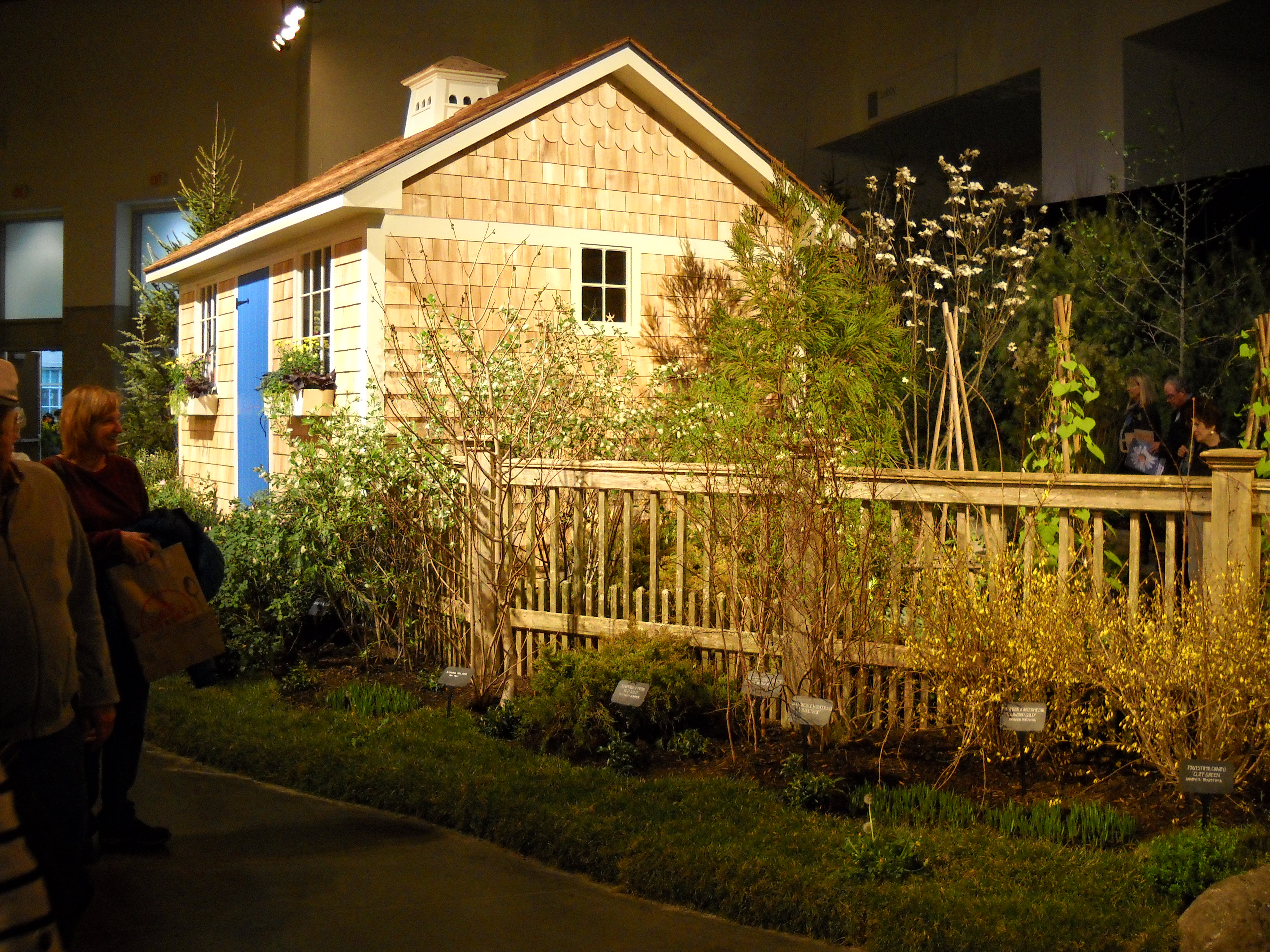
Rhode Island Show 2012
The first big shows are in Providence, RI and Hartford, CT on the weekend of February 21-24. I attended the Rhode Island show these last 2 years, and loved it! It has many of the attractions of the Boston show, but not the crowds and crazy drivers of Boston. It has a good menu of speakers, an excellent variety of vendors and plenty of floral displays. I also love the sand sculptors that create magical sand castles – almost life size.
The Providence show is held in the Rhode Island Convention in downtown Providence. Admission is$19 for adults, but you can save $2 by buying in advance. There is also a food and wine show featuring well-known chefs from 1-5 daily; if you intend to attend that, the price for both is $30. Info: www.flowershow.com.
The Connecticut Flower and Garden Show will be at the Connecticut Convention Center in Hartford, February 21-24. The theme this year is “Love in Bloom” and boasts 300 booths and 80 hours of seminars. I went on a Saturday last year, and it was very busy – almost too busy, for me. But there is a lot to see. Admission is $16 for adults and, please note, they only accept cash for tickets at the door. Info: www.ctflowershow.com.
Rhode Island Snow 2012
One of my favorites is the biennial Vermont Flower Show, held this year on March 1-3 at the Champlain Valley Expo Center in Essex Junction, Vermont. I love that the members of the Vermont Nursery and Landscape Association all work together to create special exhibits – rather than competing against each other. This year’s theme is “The Road Not Taken” after the Frost poem. Parking is free and easy, crowds are reasonable, there is plenty to see, and there will be a nice variety of speakers. I’ll be presenting Friday afternoon and Saturday morning. Admission is $15, only $3 for kids 3-17 and $12 for seniors over 60.
The Vermont Show is a family-friendly show: There is a nice family activity room where they will have performers as well as art supplies and games. The Vermont Federated Garden Clubs Association encourages children to enter a container-grown plant with interesting foliage or flowers. And, for kids of all ages there is a great display of model trains. This is the smallest of the shows, but full of flowers and flowering shrubs. There will be an excellent show of stonework by Dan Snow, a dry stonewall expert. Info: http://greenworksvermont.org/
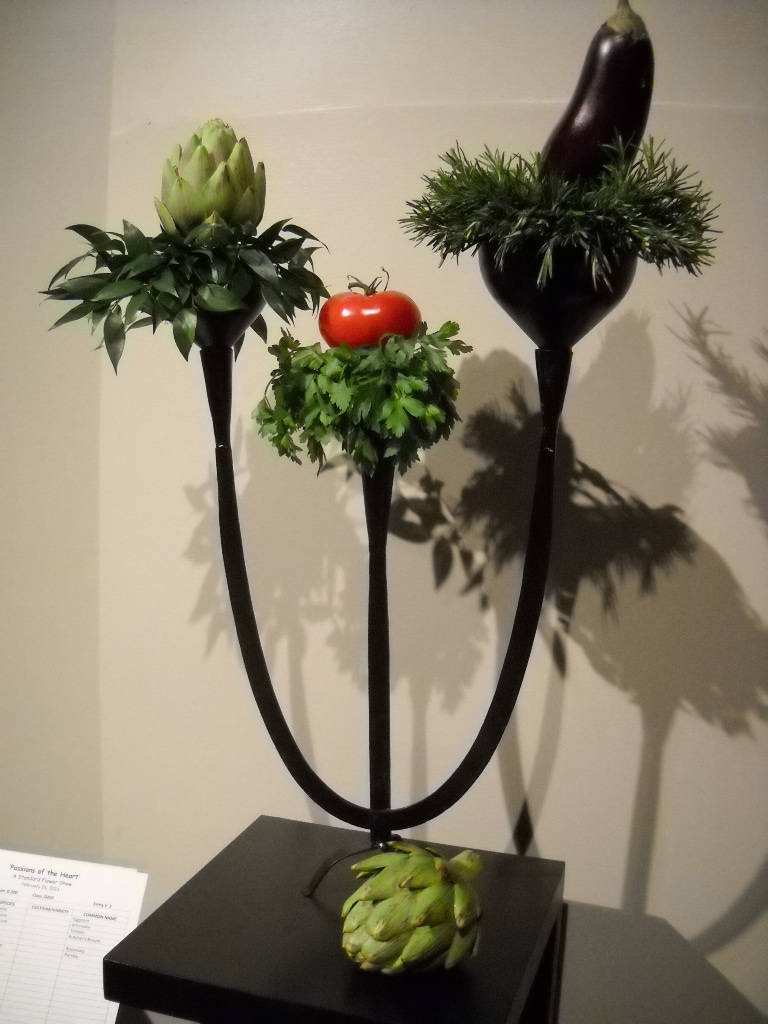
Rhode Island Show 2012
The Philadelphia Show is the opposite of the Vermont Show: big, busy, and brassy. It has been in existence since 1829, and hosts over 250,000 visitors each year. It will be held March 2-10 at the Pennsylvania Convention Center. Tickets are (ouch!) $27 – but worth it. If you’re a serious gardener, you must go at least once in your life! Info, http://theflowershow.com/.
The Portland, Maine Flower Show is March 7 -10 at the Portland Company Complex on Fore St, downtown. Tickets cost $13. Info: http://portlandcompany.com.
Boston is another big show with lots to offer. Held each year at the Seaport World Trade Center, it is March 13-17. Lots of displays, lots of speakers. Reading the list of talks, I loved this one: “Jaw-Dropping, Traffic-Stopping, Get-Your-Neighbors-Talking Container Gardens” by Deborah Trickett. That alone is almost enough to get me there! There are lectures by plenty of well known garden experts to choose from. Tickets are $20. Info: http://www.bostonflowershow.com.
After Boston comes The Seacoast Home and Garden Show in Durham, NH on March 23-24. A nice small show. Tickets are only $8. Info: www.NewEnglandExpos.com.
The last show of the season is Bangor, Maine April 5 to 7 in the Bangor Auditorium. Their website www.bangorgardenshow.com
We can’t change our weather, but we can change our attitudes about winter – by going to the garden shows. I recommend it. Smell the daffodils, go to a lecture, buy something in bloom. You’ll feel better.
You can reach Henry at PO Box 364, Cornish Flat, NH 03746 or henry.homeyer@comcast.net. His websites are www.gardening-guy.com and www.henryhomeyer.com.
Weeds … Alien Invaders or Plants Just Looking for a New Home?
It’s winter, and I have time to get caught up on my reading. When I was in Wales last fall I made a book-lovers pilgrimage to Hay-on-Wye. This is a town of 1,500 to 2,000 souls with at least 28 independent bookstores, mostly stores selling used books. That’s about a bookstore for every 50 people living there! Needless to say, it attracts lots of booklovers, especially in June when it has a book festival.
I spent 2 days poking around bookshops looking for weird and wonderful books and found plenty. Among them was a book on weeds, Weeds: The Story of Outlaw Plants by Richard Mabey (Profile books, 2010).
The author is a British nature writer with an interest in plants, especially weeds. Weeds, he explains, are opportunists. Cities are full of weeds growing in the most unlikely places: between the cracks of the sidewalks or walls, in abandoned lots – and once a weed seed even germinated in someone’s eye! Wherever they find a niche, they grow. Many can produce large numbers of seeds or are able to spread by roots that wander; most have arrived from distant countries.
We gardeners know, as he points out, that weeds move in when we disturb the soil – to plant a tomato or to create a flower garden. But a weed, according to Mabey, is just a plant growing where we want to grow something else, or nothing at all. I liked his quote from Ralph Waldo Emerson that a weed is “a plant whose virtues have not yet been discovered”.
In late fall I got an email from a friend asking me to identify a weed that had been troublesome in his cold frame. “I attach an image, as I do not even know the name of this curse to the garden world, this Medusa which has been defying eradication. Can you put a name to this curse with an idea how to best cope with it?”
I told him that his bane was chickweed (Stellaria media), and that it is edible – some people use it like lettuce or steam it like spinach. Once he knew that, he changed his attitude 180 degrees. Which is lucky, as he did some research and found that chickweed can bloom 5 times per year with each plant producing up to 20,000 seeds that can remain viable in the ground up to 40 years. He emailed that, “I guess I might as well enjoy the fact that it is edible and is most profuse at a time of the year (early December) when there is not much else edible growing vibrantly.”
But back to Richard Mabey’s book on weeds. I learned that Kentucky bluegrass is not originally from Kentucky, but arrived from Europe where it is a not-very-prominent meadow grass. But it found different conditions here in the new world, and thrived.
Speaking of lawns, some gardeners, I think, could enjoy life a lot more if they accepted weeds a little more. I’m pretty lax about weeds in my lawn – I don’t remove them unless, like thistles, they can hurt bare feet. If they’re green and can be mowed, they’re okay by me. I like dandelions, I think they’re cheerful. I don’t understand the desire to poison them or dig them out.
In another bit of trivia, I learned that the common burdock (Arctium lappa) inspired a Swiss inventor, George de Mestral, to create velcro. According to Mabey’s book, Mestral came back from a walk with his dog and studied the burrs attached to its fur – and realized that it could be copied in nylon. He patented Velcro in 1951.
Weeds, Mabey pointed out, are highly adaptable. In a relatively few generations they can modify their color, height, or seed size to fit in with agricultural crops – disguising themselves, as it were, to avoid being eliminated. And some are positively vicious. Field bindweed (Convolvulus arvensis), which resembles morning glories, not only monopolizes soil nutrients, it exudes pheromones that inhibit germination of most grain crops. Quack grass (Agopyron repens) produces a toxin that can poison corn.
But many “weeds” invade our spaces and become a part of our acceptable plant palette. The state flower of Vermont is red clover, which is not a native flower, for example. Mabey is all for giving “naturalized” citizenship to those weeds that can be useful to us, like that chickweed mentioned above. There are just a few that he singles out as truly scary.
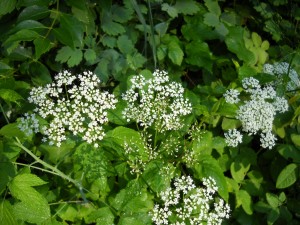
Goutweed
First on the scary list is kudzu, a Japanese vine that has become a real pest down South. Unless/until global warming gets much worse, we don’t have to worry about it here. But we have Japanese knotweed, also known as bamboo. He says an insect predator is being tested in England as a way to control it, but at present there really is no easy way to get rid of it– even for gardeners who are willing to use chemical poisons on it. And he writes about my nemesis, goutweed (Aegopodium podagraria). Ugh! I thought I had beaten it once by digging it all out and replacing 12 inches of soil, but after a few years it came back.
So enjoy your winter, and try not think about the weeds that are just waiting, like us, for spring. Either that, or get your house ready to go on the market if you have goutweed or Japanese knotweed.
Henry Homeyer is the author of a new children’s book, Wobar and the Quest for the Magic Calumet. His web site is www.henryhomeyer.com.
Tulips
Winter is here and our flower gardens are, for the moment, just memories. But potted tulips in reds, purples and yellows are available at florist shops and grocery stores to brighten our spirits and grace our tables. For about $10 you, too, can have a few tulips in a 6-inch pot. If you keep them lightly watered and not too hot, they should last for at least a week.
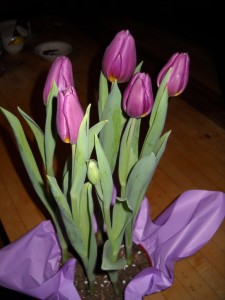
Potted Tulips
On a recent rainy, slushy day I dug out a book on tulips that I’d been given years ago and never read, The Tulip by Anna Pavord. She is an excellent writer, but a bit obsessive when it comes to tulips. She follows the history of tulips in Europe from its origins in Turkey and Iran, describing in detail the kinds of tulips and who grew them. She even mentioned one sultan who had 920 gardeners!
The book continues through the tulip fads of Europe and the well known tulip craze in Holland when certain tulips sold at auction for the equivalent of 10 years income for a tradesman. I love tulips, but I’d certainly never be tempted to bet the ranch on being able to propagate and sell rare tulip bulbs. The Dutch particularly loved striped tulips. The best ones were actually created by a virus that was carried from plant to plant by aphids, causing some (but not all) to mutate.
The book has a nice summary of the kinds of tulips available: there are 15 “divisions” or groups of tulips, including the simple ones akin to the wild varieties originally from Persia or the East. It also has 50 pages of description of the common named varieties. This is truly a book for tulip-obsessive gardeners, and I admit I skipped over long sections of it. At 438 pages it would be a challenge for all but the most avid tulip lover to read in its entirety.
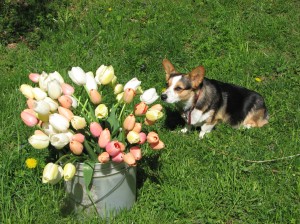
Maureen/Other Tulips & Daphne
As I read through the descriptions of the divisions of tulips, I realized that I have at least tried growing of a few of each kind at some point in the past 30 years. I have settled into growing the tallest, most dramatic ones and treating them as annuals. My favorite is a creamy colored one called ‘Maureen’. I’ve read that it is a tetraploid, meaning that it has been somehow manipulated to have twice the number of genes as normal, so it grows bigger than most– 28 to 32 inches tall. This is not a GMO (genetically modified organism), but a hybrid developed in the 1950’s.
In my experience tulips run down hill with time: if I plant 100 bulbs in a cluster, as I like to, I expect to get 90 or more blossoms, come spring. But the second year I might get just 50, and half that the following year. So I re-plant in the same bed each year, and don’t worry about past year’s bulbs. After bloom season, I grow annual cutting flowers in that same bed, mainly zinnias.
Of the shorter tulips, I’ve found that the division called Kaufmanniana is very pleasing. These are short, stocky red tulips that are much more perennial than the big ones. The division called Greigii is another low, simple group. Those that I grew were yellow with stripes, and lasted several years before they disappeared. Tulip bulbs, as you may know, are attractive and tasty to rodents of all kinds and the stems and flowers have been providing lunch for deer forever.
My gardening grandfather, John Lenat (1885-1968) was a very friendly character, who spoke to everyone he met – in the line at the grocery store, at the bank or walking down the road. Along with a love for flowers and tomatoes, I inherited that – to my advantage. Many years ago I was standing in line at the local food Coop and, as Grampy would have done, I struck up a conversation with a woman who had selected some freshly cut tulips to buy.
That woman in line taught me a great trick. She explained that tulips can be persuaded to stay in bud rather than opening up (and soon dropping their petals) by dropping 3 pennies in the vase of water. Actually, this woman was someone who remembered WW II when, in 1943, pennies were made of steel and clad with zinc. So she said, “Drop three copper pennies in the vase.” Since I collected pennies as a boy, I knew about the zinc penny. But anyhow, I tried it, and it works! I don’t know what the copper does, but I’ve had tulips stay in bud for a week or more in the vase until they finally dropped their petals all at once.
Whether you are enjoying cut tulips or live tulips growing in a pot, keeping them cool always prolongs their bloom time. If you keep your house at 70 degrees, try to find a cooler location for them. Or put them in the fridge or in an unheated entryway at night.
Each fall I plant tulips in containers and store them in a cool dark place. Around the first of March I bring the tulips up to the warmth of the house and they soon blossom – long before my outdoor tulips.
So go buy some tulips. They’ll help you through the gloomy days of winter.
Henry Homeyer can be reached at PO Box 364, Cornish Flat, NH 03746 or on-line at henry.homeyer@comcast .net. His website is www.henryhomeyer.com.
Small Seed Companies
Although seed catalogs started arriving in my post office box even before the holidays, now is the time when I expect a deluge of colorful catalogs promising me hundreds of kinds of seeds for new/old/flavorful/special plants. I enjoy growing vegetables and flowers from seeds, so I am the kind of sucker those companies love. It’s too early to plant things, but now is the time to drool over those catalogs and order some seeds.
Most big seed companies do not grow their own seeds on a farm in their home state. They contract with farmers in places that excel at growing a particular crop – beans, for example, or carrots. They provide seeds, the farmer grows them, and then the farmer sells the product to the company.
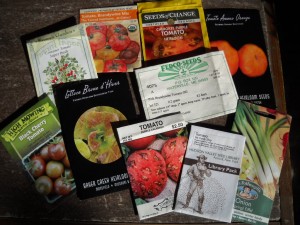
Seed Packages
I like small seed companies, particularly those that specialize in heirloom, open-pollinated plants. Open pollinated plants are those that breed true, year after year – if you follow some basic rules about planting distances and saving seeds. I bought seeds from Hudson Valley Seed Library in New York State last year (www.seedlibrary.org) and was pleased with the performance of their seeds, and with the fact that they encourage you to save seeds – and even to buy seeds you grew for a credit.
I like seed cooperatives that are not out to make their stockholders a lot of money. Fedco Seeds in Maine is one of those, and I have been buying their seeds for decades (www.fedcoseeds.com). I like that they sell seeds in small quantities. Most of us don’t need 100 tomato seeds of any one variety.
Seed companies that grow their seeds in New England are the ideal, but few exist. High Mowing Seeds (www.highmowingseeds.com) is a wonderful Vermont company, but Vermont weather is “iffy” for a seed grower. So they grow some seeds in Vermont, but also contract farmers to grow their seeds in places like Idaho which have more reliable growing conditions.
One of the problems we have here in New England, many years, is our short growing season and cool weather. So I recently did a little research on-line to look for Canadian seed producers. Many are not willing to ship to the US because of the paperwork, but some are. I recently talked to Greta Kryger at Greta’s Organic Gardens (www.seeds-organic.com or 613-521-8648) in Gloucester, Ontario. She is a small producer with a flair for the unusual. Thumbing through her on-line catalog I ran across several things I have never grown before – or even heard of.
I shall try the “lichti tomato” from Greta. According to the web site, “They’re about the size of a cherry, and taste like a cherry crossed with a tomato. A very pretty and attractive plant that originated in South America, but has been naturalized in many countries. Start plants like you would a tomato.” She told me on the phone that the plants have thorns and are quite prickly. On that same page she lists Jaltomato, Greenberry and Miltomato Vallista – all either in the same genus as tomatoes, or closely related to them. All are small fruits, but offer some unusual flavors.
Vesey’s Seeds (www.veseys.com), located on Prince Edward Island has been in business since 1939 and they say their varieties are good for short, cool summer seasons. They are not focused on heirloom or organic seeds, though they sell some of each.
Some gardeners get intimidated by catalogs with hundreds of choices, so Vesey has made some nice collections of seeds to help you out. Among these are a “Vegetables for Beginners” collection, which includes things like ‘Merlin’ beets that require no thinning and ‘Sugar Sprint’ peas that do not require a trellis. They also have a children’s collection with things like ‘Purple Dragon,’ a purple-skinned carrot that my grandkids love. You can save money by buying their collections – their beet collection, for example contains 3 packages of beets for just $6.20. And so forth.
Vesey’s website also has a page with a single top pick for each kind of vegetable. I’ve grown many of them, and think their choices sound good. You can get your order priced in US dollars, which is handy, even though the American and Canadian dollars area nearly equal.
Starting plants from seed is not for everyone. But you can save money and try things that are not available from garden centers if you do. And if you teach your children to start carrots by seed outdoors, they will love to eat raw carrots and grow up to be gardeners. What could be better?
Henry Homeyer has a new book for kids, a fantasy-adventure chapter book about a boy and a cougar: Wobar and the Quest for the Magic Calumet. Go to www.henryhomeyer.com for details.