-

Now available for $24.95 including shipping. -
Now available for $21.00 including postage. Vendors I Like
 Click Here to buy from Cobrahead
Forcing Bulbs for Spring
Winters can be hard on many gardeners: short dark days, icy roads and little to do in the garden. Yes, I like to snow shoe and cross country ski, but it doesn’t replace gardening. I water my houseplants (and occasionally talk to them), but they are weak substitutes for the real thing. By the time mud season comes in March, I want blooming flowers to brighten my life.
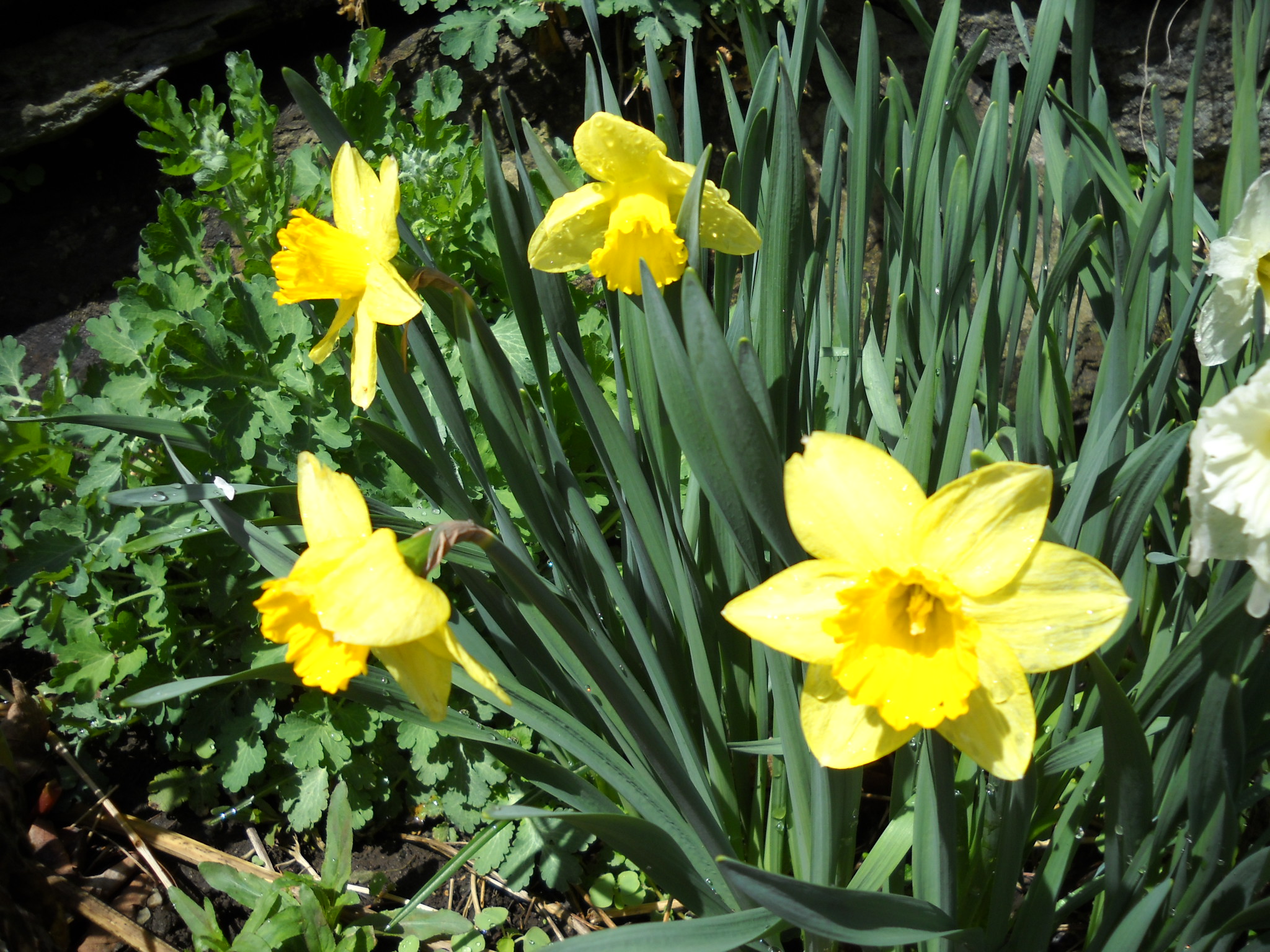
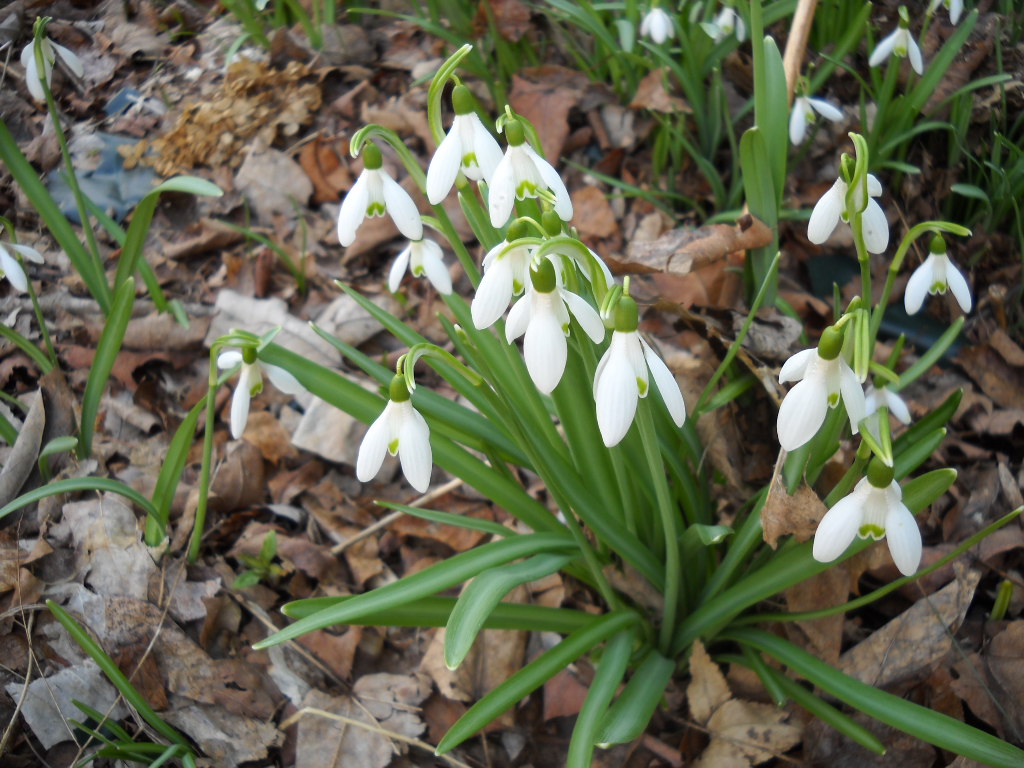
I get early blossoms in two ways: First, I have early bulb plants outdoors, including hundreds of snowdrops that bloom in March. And second, I force bulbs to bloom early indoors. Now is the time to plant bulbs so that they will bloom when we need them the most – a month or two before they bloom outdoors.
In order to prepare bulbs for early blooming indoors, you will need a place to store them that is cold, but not as cold as the outdoors. Despite global warming, I still see minus 20 every winter, even if for only a few days. Bulbs planted in the ground have some protection against the cold, but if you were to plant bulbs in pots and leave them outside, the extreme temperatures would kill most. Bulbs left in a cool basement or garage will do just fine.
Ideally temperatures for bulbs used for forcing will be between 33 and 50, though a few days of below freezing temperatures is not be a problem (my basement often goes a below freezing). Left in a warm location, the bulbs will grow green tops – but not blossoms.
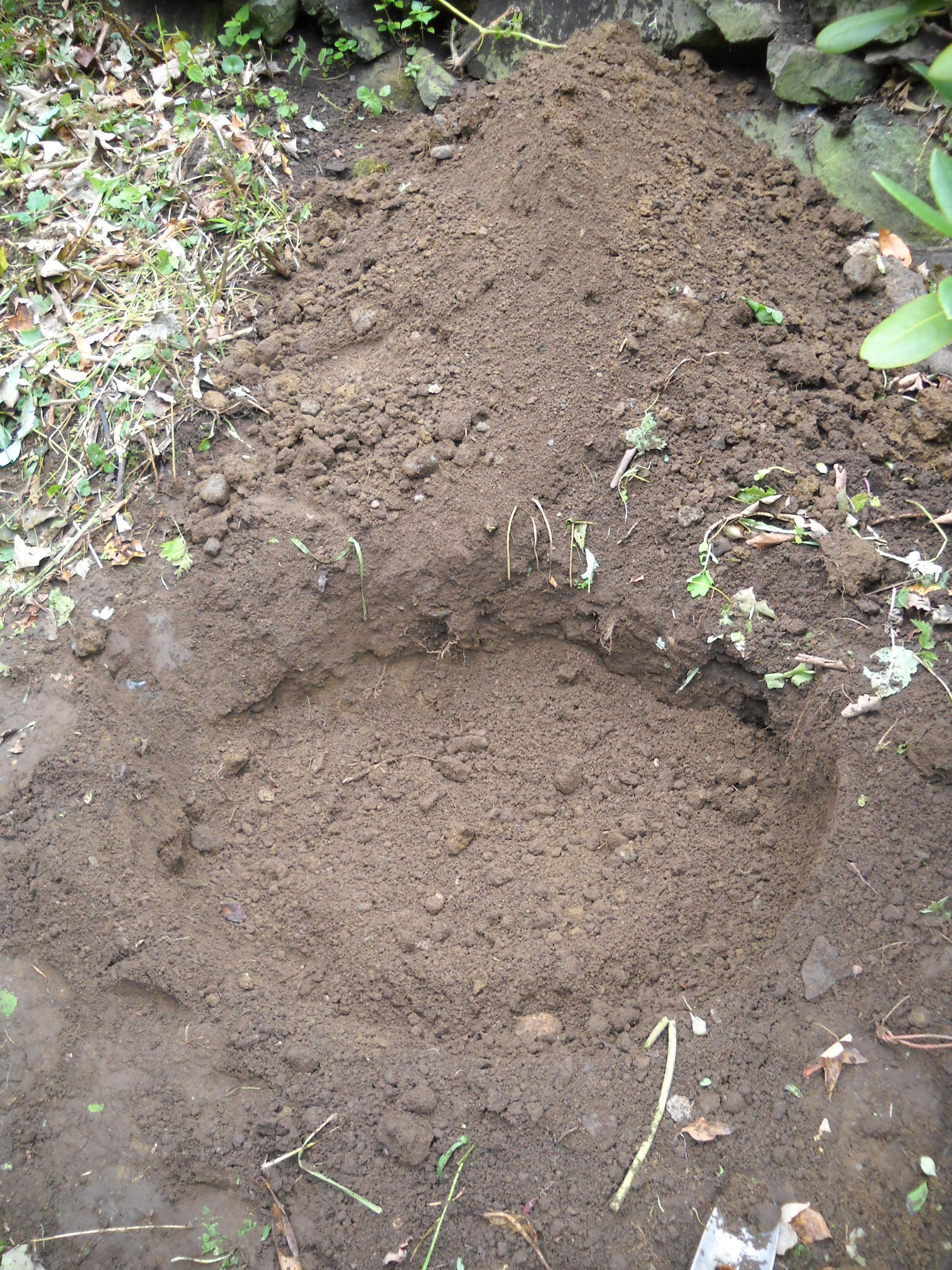
Bulbs can be planted for forcing in pots or window boxes. Good drainage is important to avoid rotting the bulbs, so don’t plant them in ordinary garden soil. I think an ideal mix is one that has half compost and half potting mix. I want the mix to be lightly moist at planting time, but not soggy. Once a month I check the pots to make sure the soil is not bone dry; if it is, I water lightly.
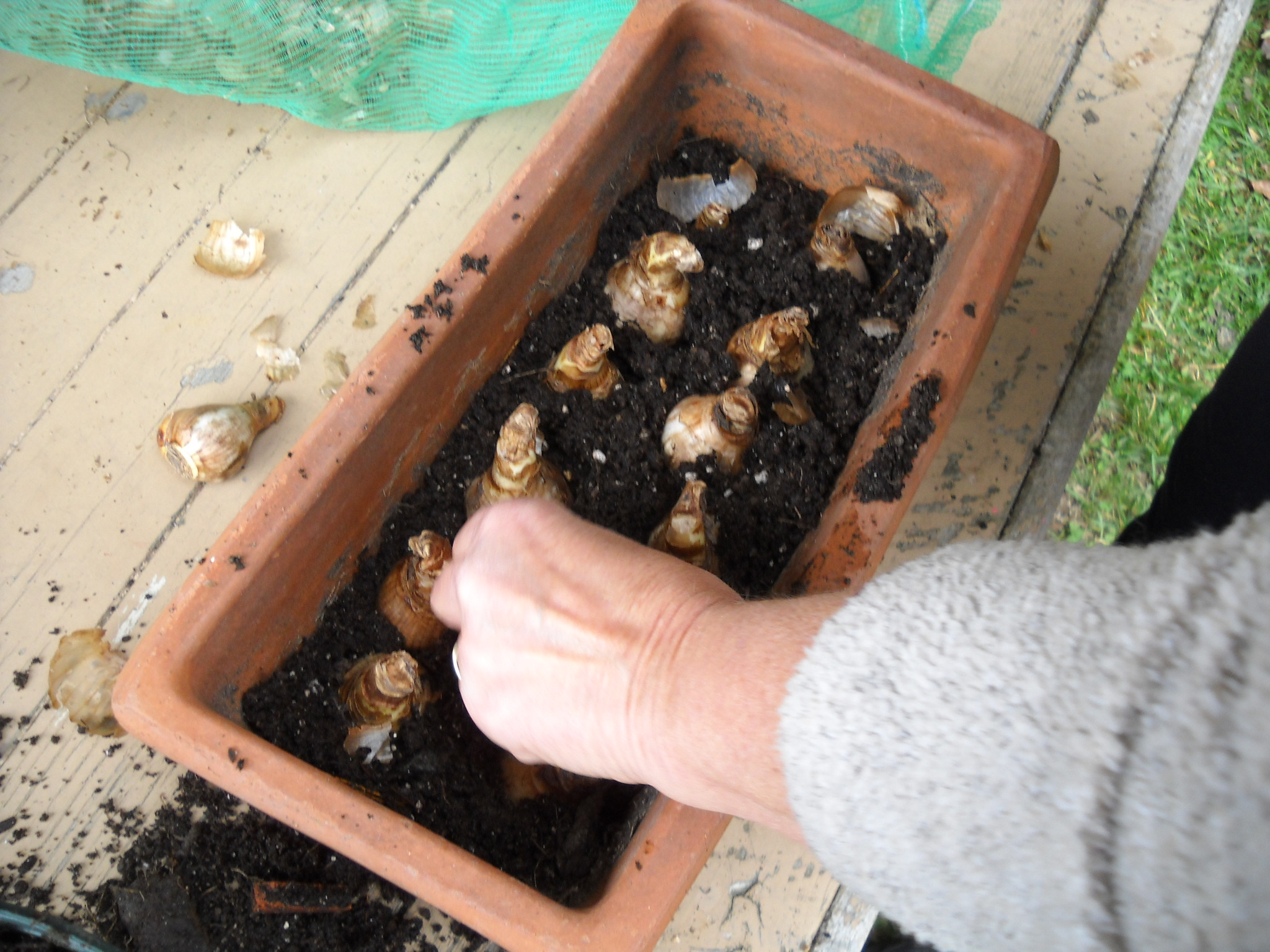
Forcing Bulbs
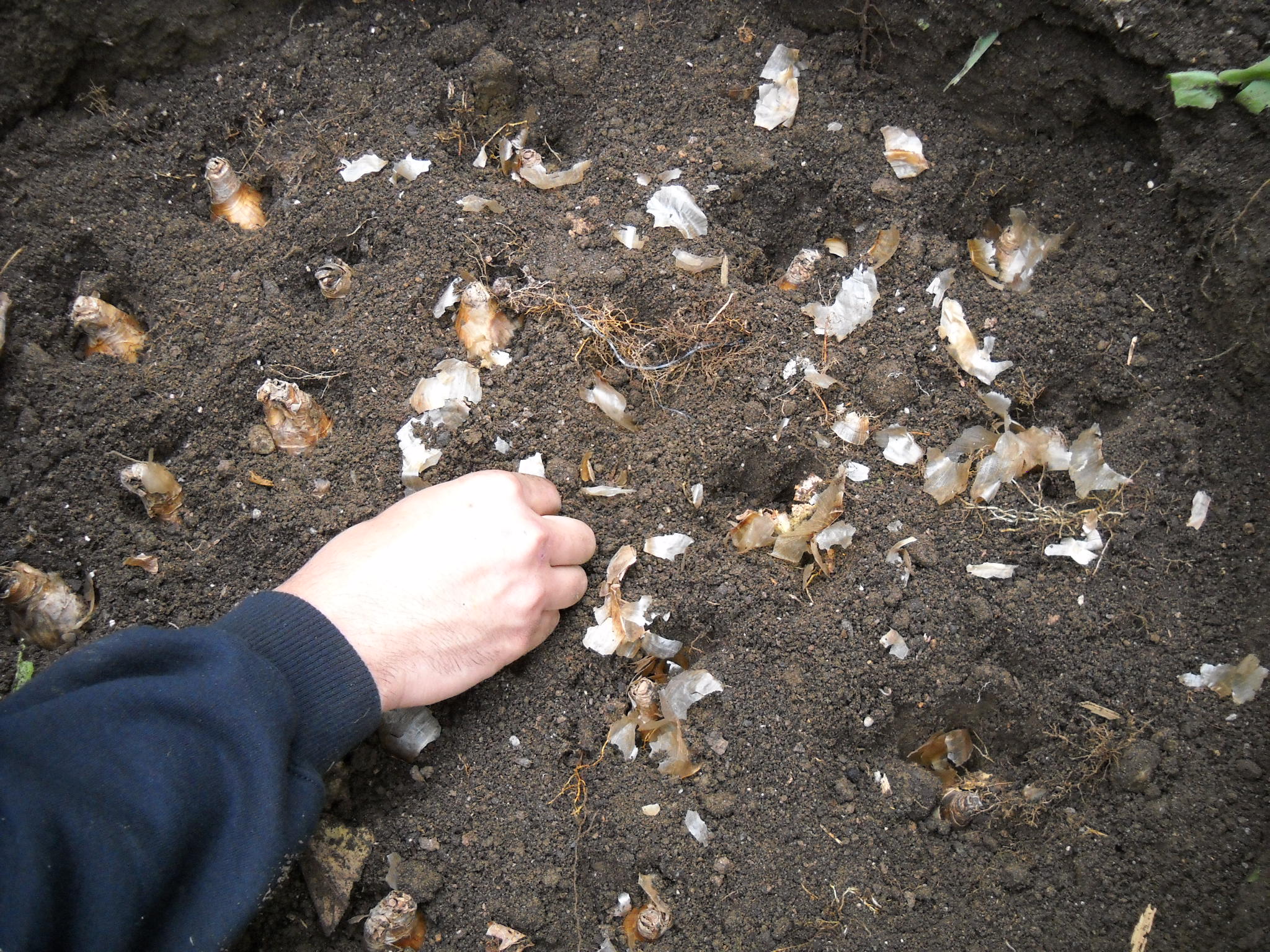
When planting daffodils or tulips outdoors, I plant them 6-8 inches deep but that is not necessary when planting bulbs in pots. Depending on the type of container I use, the pointy tips of my bulbs may be just an inch or two below the soil surface. And I plant them shoulder-to-shoulder, crowding in as many bulbs as possible in the container. After they finish blooming in the spring I will plant the bulbs outside, but for now they have everything they need to bloom inside the house.
Timing is key to success with forced bulbs. Little bulbs like crocus need just 8-10 weeks of dormancy, but daffodils need 12 weeks, and tulips do better with more, up to 16 weeks. Choose bulbs that are marked “Good for Forcing” or that are listed as “early” rather than mid-season or late. If you are selecting bulbs now, make sure that they are still firm, not papery and dried out. And if you see them with long green sprouts, pass them by.
Beware of mice. If you have mice, they will eat your tulips unless you exclude them somehow – with wire mesh screening, for example. Daffodils are lightly poisonous, so mice don’t eat them.
You can maximize blooming by planting two layers of bulbs. I often use those 8-inch pots that perennials come in for forcing. They are not elegant, but can be dressed up with wrapping paper or baskets when displayed on the table. I put in an inch of gravel, an inch or two of soil mix, then daffodils or tulips. I cover them with soil, and then add a second layer of bulbs. The small bulbs like crocus work well for a second layer. Leave a little space at the top of the pot for watering.
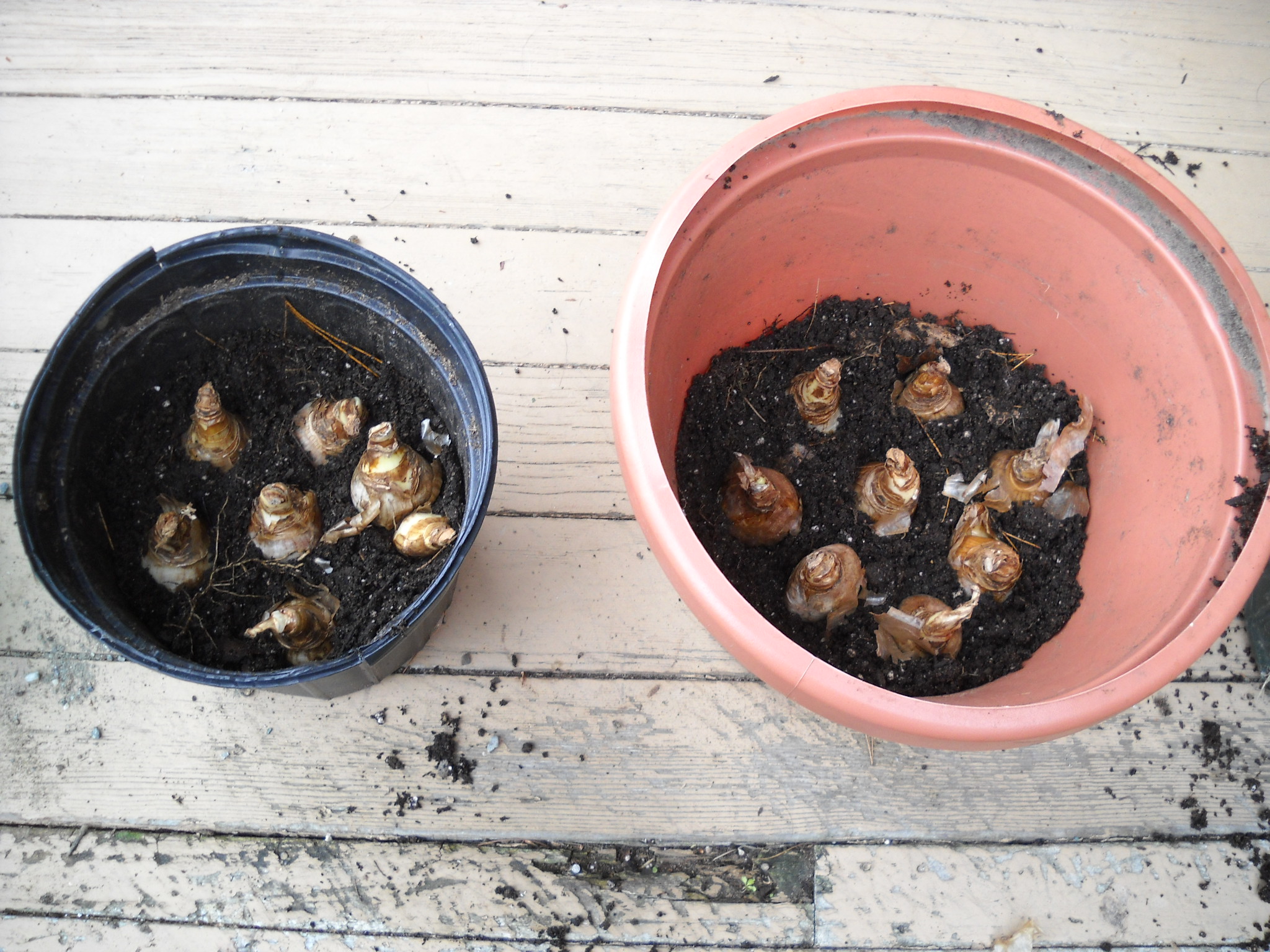
Forcing Bulbs
When planting two layers of bulbs I used to worry about the big bulbs coming up and pushing the little ones aside like playground bullies. So I carefully placed the little ones above the spaces between daffodils. I even used broom straws to show me where to plant. But one year I just put them in without worrying about crowding and every bulb did fine. Plants know more than we give them credit for, I think.
When you take your plants out of their cold resting spot, most will begin to grow almost immediately. I generally start mine off in a cool location in the house, and once they have fully woken up I put them on a sunny, warm windowsill. A trick for prolonging their blooms (which also works with cut flowers from the florist) is to move the flowers into a cold mudroom or entryway at night. Cool temperatures prolong the life of your flowers.
So go to your local feed-and-grain store, garden center or food coop; get some bulbs and prepare them for forcing. Come March you’ll be ready for spring, and will have some flowers ready to perform their annual dance before their cousins outside do.
Henry Homeyer has a new children’s chapter book that just came out: Wobar and the Quest for the Magic Calumet. Read about it at www.henryhomeyer.com.
Labyrinths
Despite my jokes to the contrary, I know that you gardeners won’t really turn to a life of crime now that gardening is over for the summer. But you might go into a decline, wasting time watching afternoon television or reading trashy novels. Don’t. Please don’t. There are always possibilities for projects outside, even after flowers and vegetables are through for the season. One such project to consider is building a labyrinth.
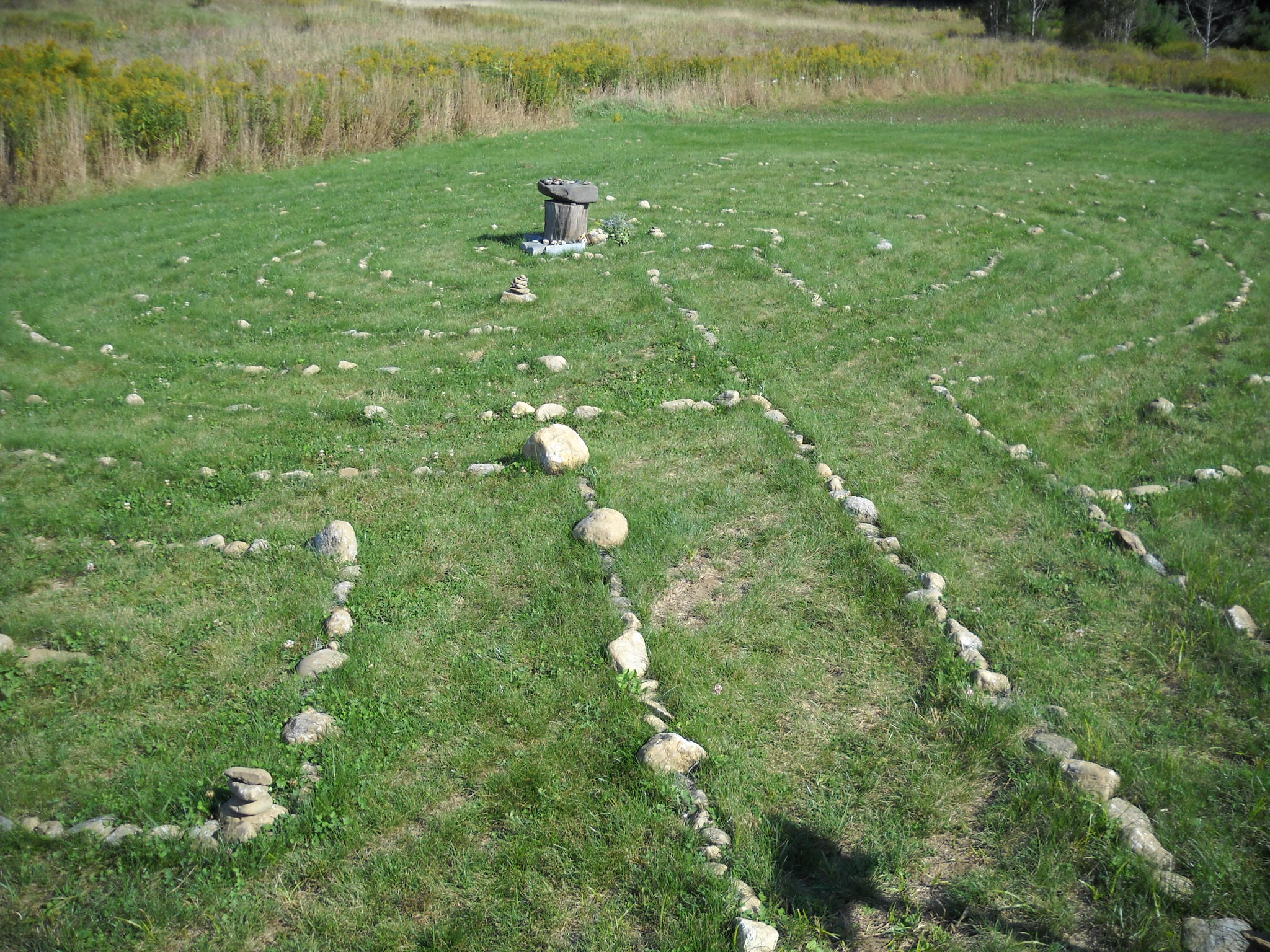
Harmony Farm Labyrinth
I recently visited a labyrinth at Harmony Farm, a non-profit nature-based education center, open to the public at 28 Bowers Rd, Hartland, VT. (www.harmonyfarmvt.com). They have built a 55- foot diameter labyrinth in memory of Derek Cooper, a young worker at the farm who is now deceased. It is a simple, though time-consuming project that, once completed can be very spiritual in nature.
Labyrinths are sometimes confused with mazes. Both involve walking a path in an area usually defined by a circle. But a maze is a puzzle with many choices about which way to go. A labyrinth has no choices. The pathway winds around, turns corners, and seems to go to the center of the labyrinth – only to turn and lead back to the outside. Eventually you reach the center after walking every step of 7 or more concentric circles.

Labyrinth
History is unclear about the origin of labyrinths. Labyrinths appeared in Crete and Egypt over 2,000 years ago. They were introduced inside Catholic cathedrals in Italy in the 12th century and in France in the 13th. Worshippers walked them as a way of calming the mind and becoming at one with God. Some crawled on their knees while praying. Some walked labyrinths instead of going on a pilgrimage. Famous labyrinths are at the Cathedrals in Chartres, Reims and Amiens in northern France, but now they can be seen outdoors all over the world.
Knox Johnson, one of a family of farmers and gardeners living and working at Harmony Farm, introduced me to their labyrinth and explained how it was created. The first step in creating a labyrinth was to find a relatively open, flat space for it. Barbara Johnson recommends getting someone to dowse the site to find just the right spot, using either crystal dowsing, or rods.
Once the spot was identified, Knox tilled the soil late in the summer of 2011. He allowed the weeds and wild grasses to come back for a few weeks and then tilled it again, getting rid of most of them. He added lime to improve the soil pH. He raked the area, smoothing out the surface and finally seeded it with a seed mix called “Eco Blend with Clover” from North Country Organics (www.norganics.com).
Clover is good in a seed mix because clover plants fix nitrogen from the air, turning it into useful nitrogen and enriching the soil. Unfortunately, many seed companies no longer include clover seed in their mixes because “weed-n-feed” treatments have herbicides that kill clover. So clover has been declared a weed.
This summer the real work began. Once the grass was well established, Knox and a friend laid out the pattern. He used a device that holds a can of spray paint to mark out the lines. He used a long light-weight cable to define the circles. The spray paint in its holder was attached to one end of the cable, while the other end was looped over a stake in the center of the labyrinth.
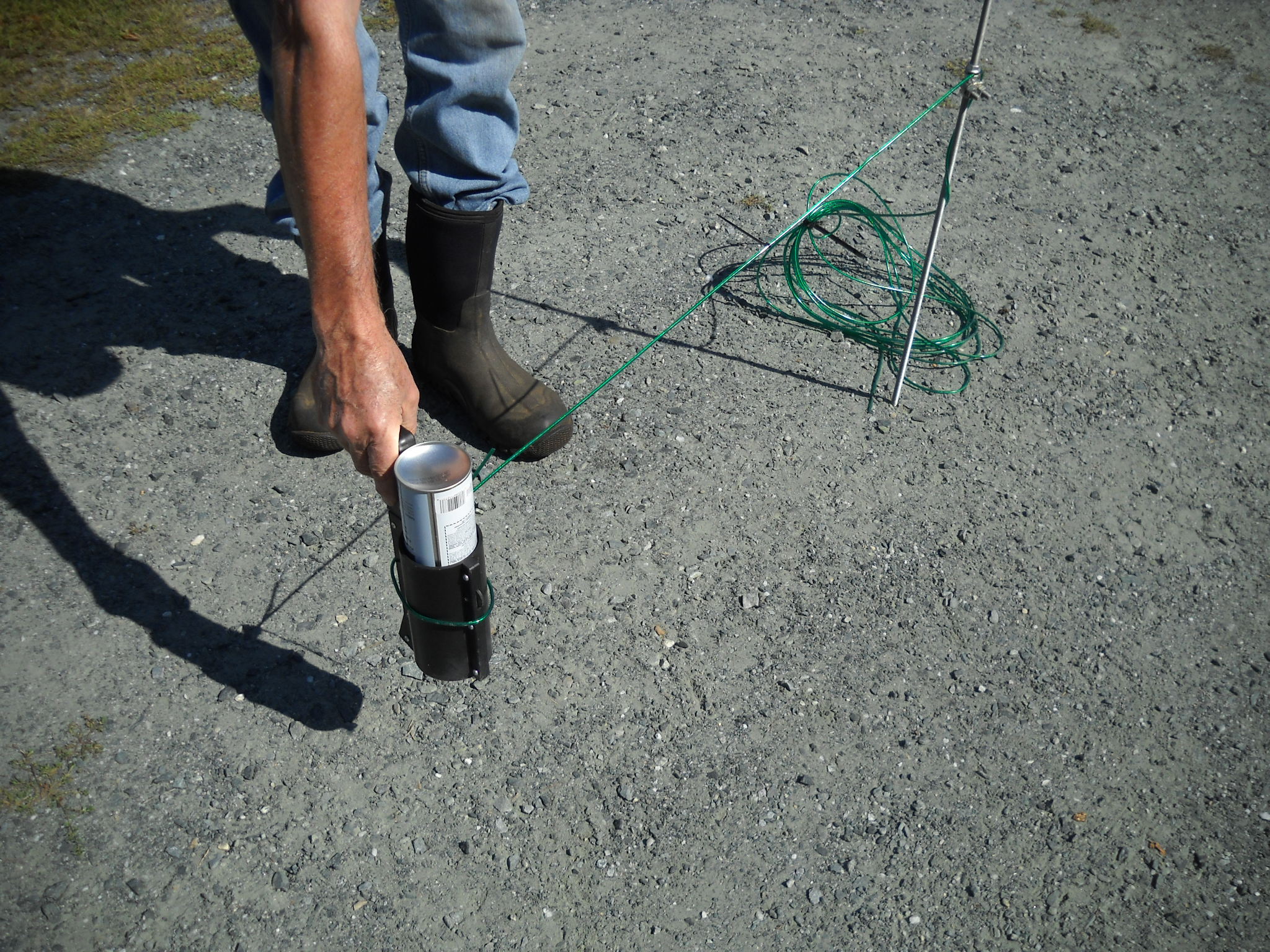
Paint for Labyrinth
Knox sprayed white paint while keeping the cable taut. The center of the labyrinth is a 4-foot space which eventually was surrounded by seven concentric circles, each 31 inches apart from the next. He had a design copied from the cathedral in Bayeux, France, and used stakes to mark turns in the walkway. He told me it really on took an hour or two to mark the lines.
Because of all twists and turns, that path to the center of the labyrinth is about 1,000 feet from the entrance. That amounts to a lot of stones needed to line the path. They used smallish stones, so 4 or 5 were used in every foot. But if you create your labyrinth you can use whatever size you want.
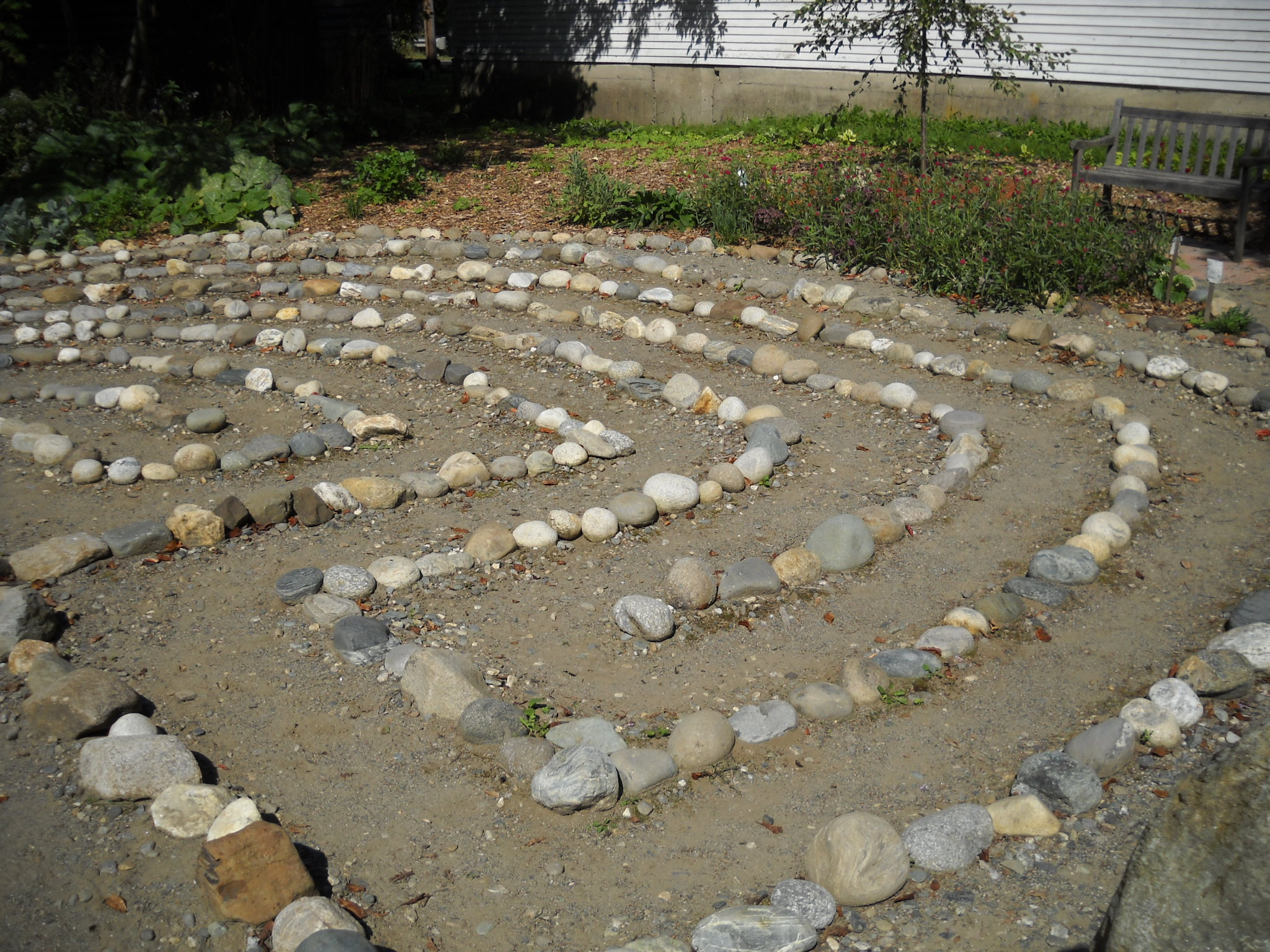
Universalist Church Labyrinth
Knox directed me to the Universalist Church in Hartland, VT, just half a mile from the labyrinth at harmony farm. Bryce Lloyd, a Boy Scout, built a lovely labyrinth near the church as his Eagle Scout project. Bryce used larger stones, and installed gravel instead of allowing grass to grow. I assume that landscape fabric was put down beneath the gravel to keep weeds out – though some weeds will persist no matter what, I fear.
Walking a full-sized labyrinth like the one at Harmony Farm takes 5 minutes or so. I find that walking one is an easy way to clear the mind and to forget for a few minutes the deadlines and worries of life. One moves forward, one turns back, one concentrates on the journey. I find walking a labyrinth very relaxing. I don’t think I will build one myself, but they are nice to visit and are more common than you might think.
Henry’s new book is out: Wobar and the Quest for the Magic Calumet from Bunker Hill Publishing. It is a chapter book for kids, a fantasy-adventure about a boy born with a mustache and a magical ability to speak to animals and understand them. Learn more at www.Gardening-Guy.com.
My Vegetable Garden Report
Remember when we had to write reports about our summer vacations for school? Well, this is my report on my summer in the vegetable garden: what worked, what didn’t.
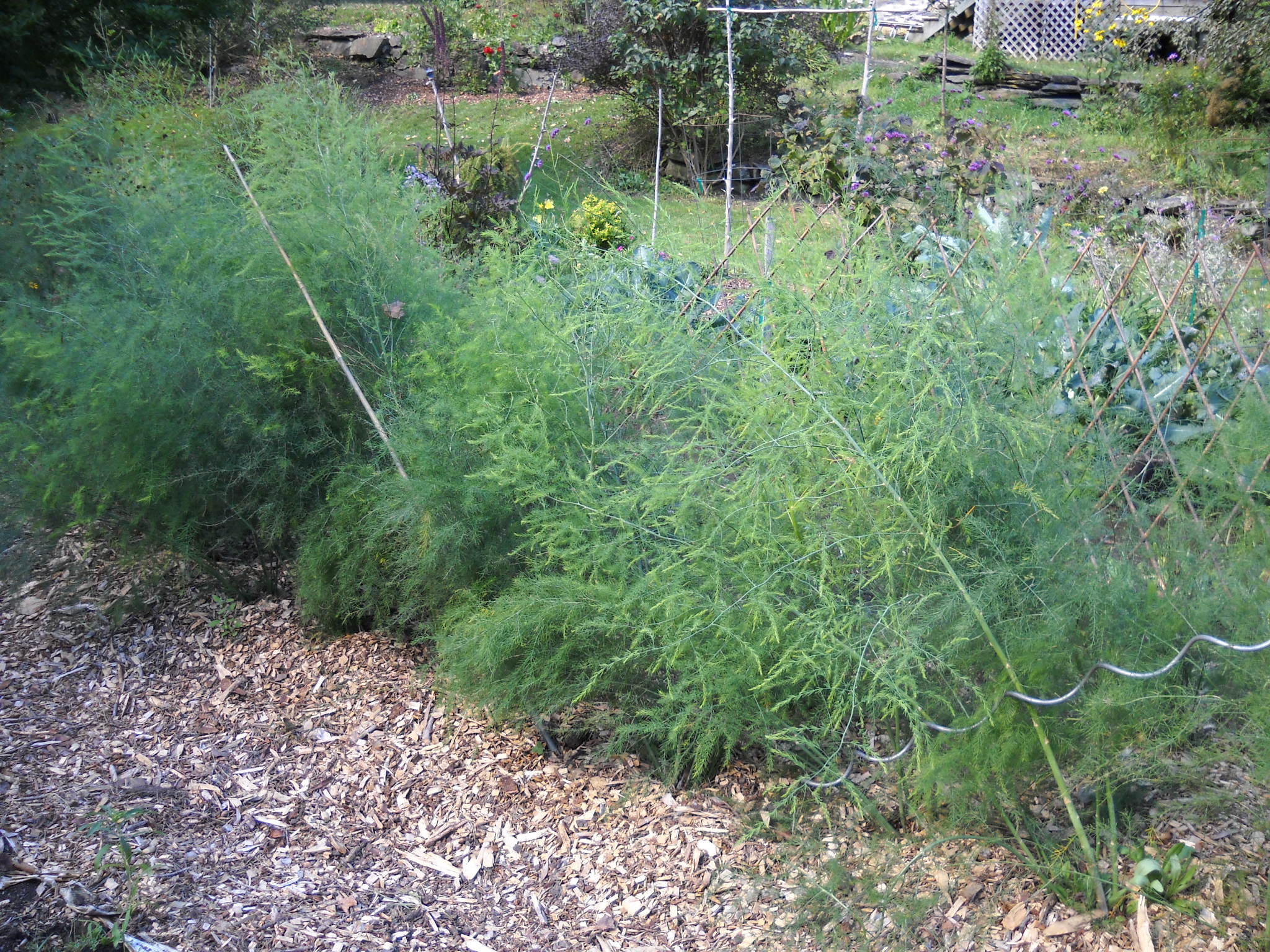
Asparagus Patch
Overall, it was a great growing season. We had lots of sunshine and my garden got about an inch of rain a week, just what most plants need. My tomatoes suffered a bit from a variety of early blights – the leaves browned and dried up, starting at the bottom. This has been increasingly the case in recent years, and next year I intend to try a bio-fungicide called Serenade, which contains live bacteria that destroy fungi. Still, I put up lots of tomatoes and ate them 2 or 3 times a day from early August until the end of September.
Of the new varieties of tomatoes I tried this year I liked best a small red one called Mountain Magic, a full sized yellow called Valencia and an oversized plum tomato called Linguisa. The first two are from Johnny’s Seeds, the last from Hudson Valley Seed Library. All 3 were quite disease resistant.
At the end of September I saw what appeared to be the dreaded late blight so I sent a sample to the UNH plant pathology lab, and it was diagnosed as late blight. Fortunately, late blight does not survive our winters except, occasionally, in potato tubers.
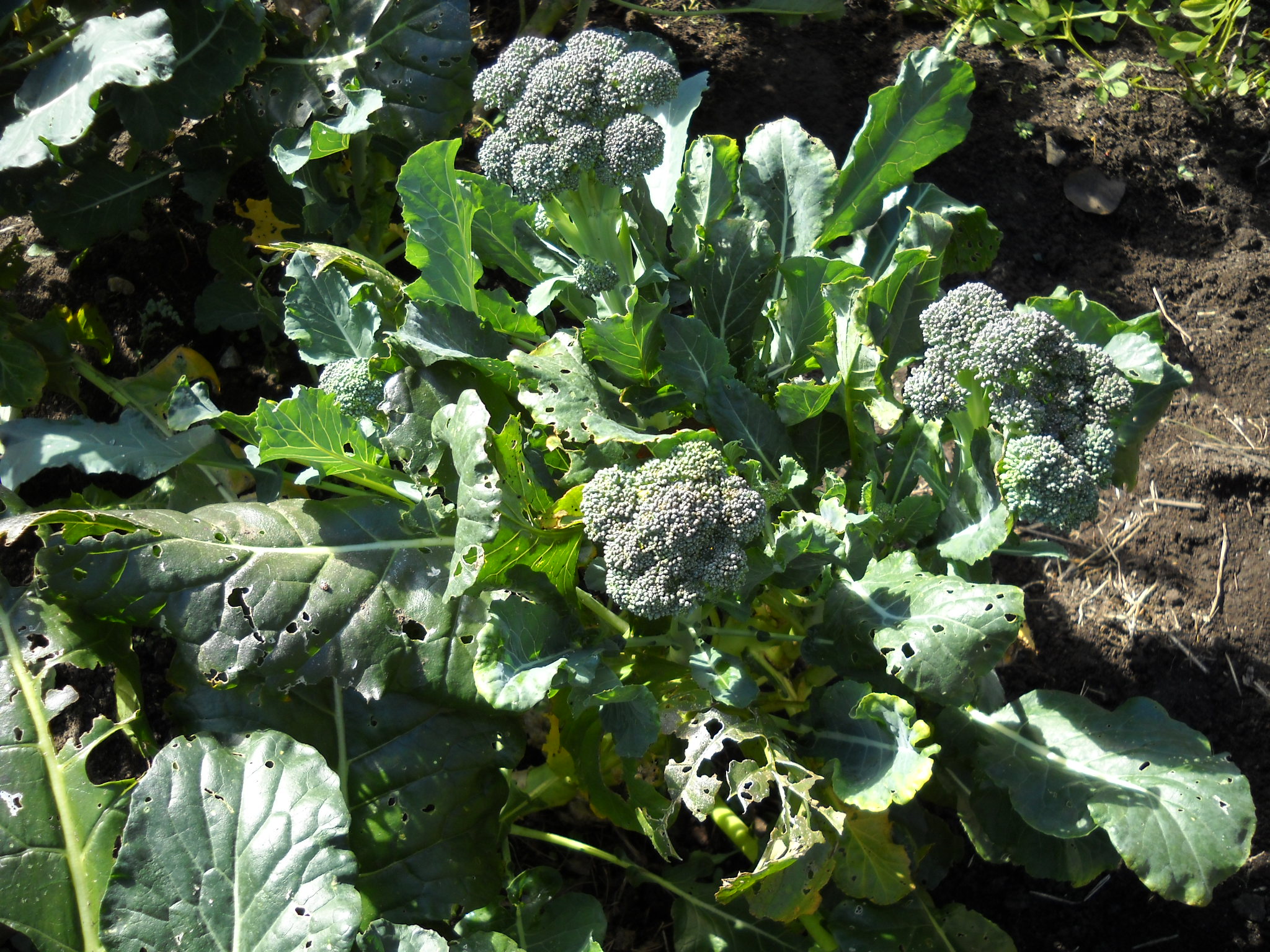
Broccoli Side Shoots
What did well for me? It was a great year for onions, beets, carrots, broccoli and leaf crops from lettuce to kale. My most surprising success was my new asparagus patch. I planted roots in June, and each plant is now 6-12 bushy stems. Many of the plants sent up stems thicker than a pencil, but I restrained myself and did not eat any. I used a “Jersey” cultivar of asparagus which produces all-male plants and no seeds, which is good. Seeds yield too many little plants and these compete for water and nutrients. If you have older plants with seeds, cut them down now.
I always try a few new things in the garden if I can, and this year I got some peanuts for planting from Burpee Seeds. I planted some in cell-packs indoors since peanuts are a southern crop, and I wanted to give them an early start. I also tried direct planting once the soil was fully warmed in early July. Direct seeding didn’t work, and the transplants only produced a few peanuts each. Peanuts bloom down low, and then a “peg” develops
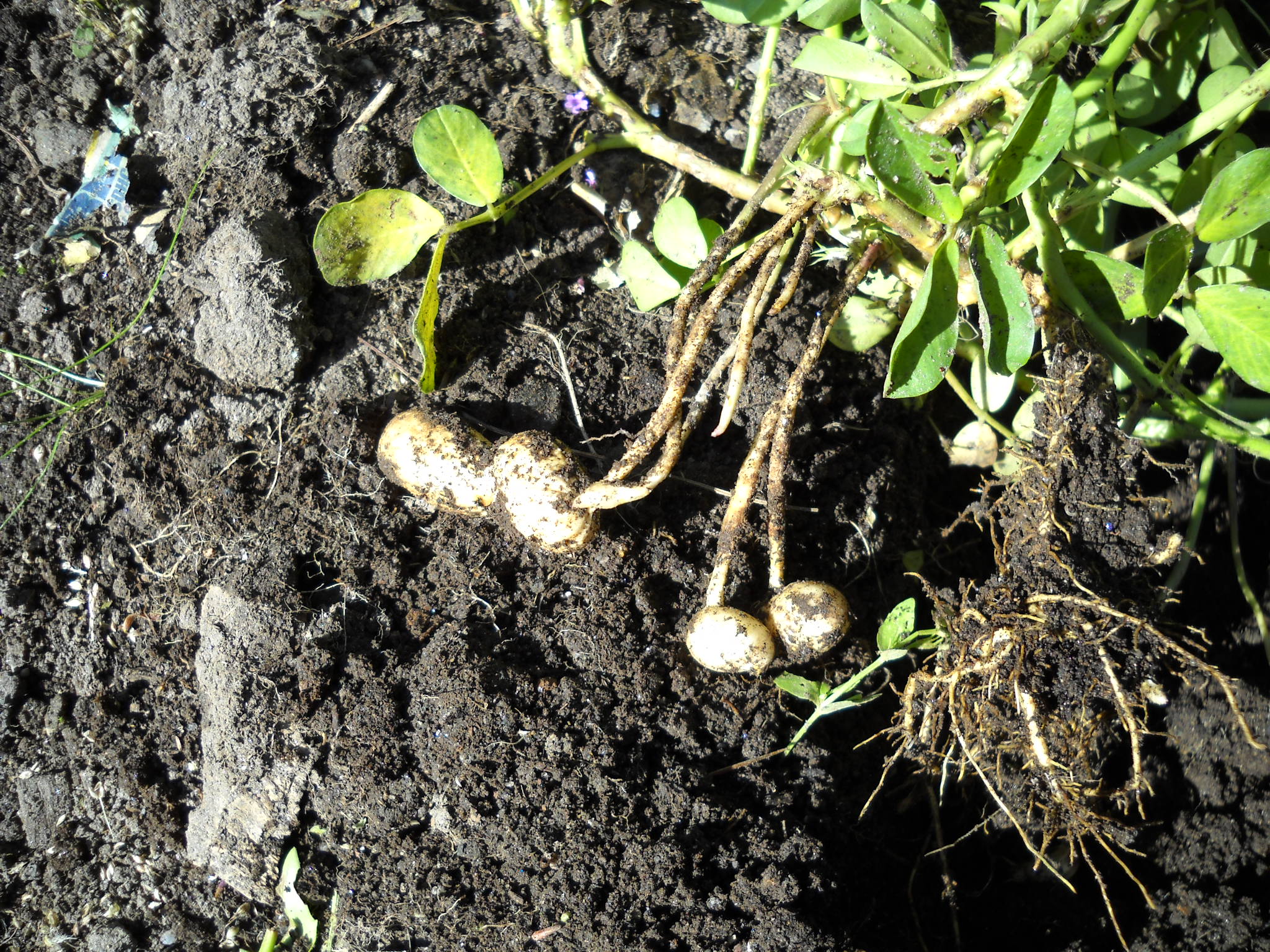
Peanuts
which contains the flower stem and peanut embryo. The peg grows into the soil, and produces a peanut. I only got 3 or 4 pegs per plant, so they are not worth the bother, I think.
I also tried scorzonera, a European root crop also called black oyster plant, serpent root, viper’s herb, viper’s grass and black salsify. I harvested one recently – but with some difficulty. I tried to pull it like a carrot, only to have the top break off. I used a trowel to loosen what I thought was pretty loose soil in my wood-sided raised bed. I got my hand down around the root some 6 inches below the surface and tugged. Slowly I lifted it out. Much to my surprise, the root was 12 inches long, black, and nearly perfectly cylindrical, though only ¾ of an inch across!
I also planted salsify, a similar root crop, though white. It is a slow-growing root crop. If you do try it, be advised that the young plants look like grass, so don’t weed them out. I enjoyed the flavor of both salsify and scorzonera, though I liked the latter better – it has a somewhat nutty flavor when sautéed in olive oil.
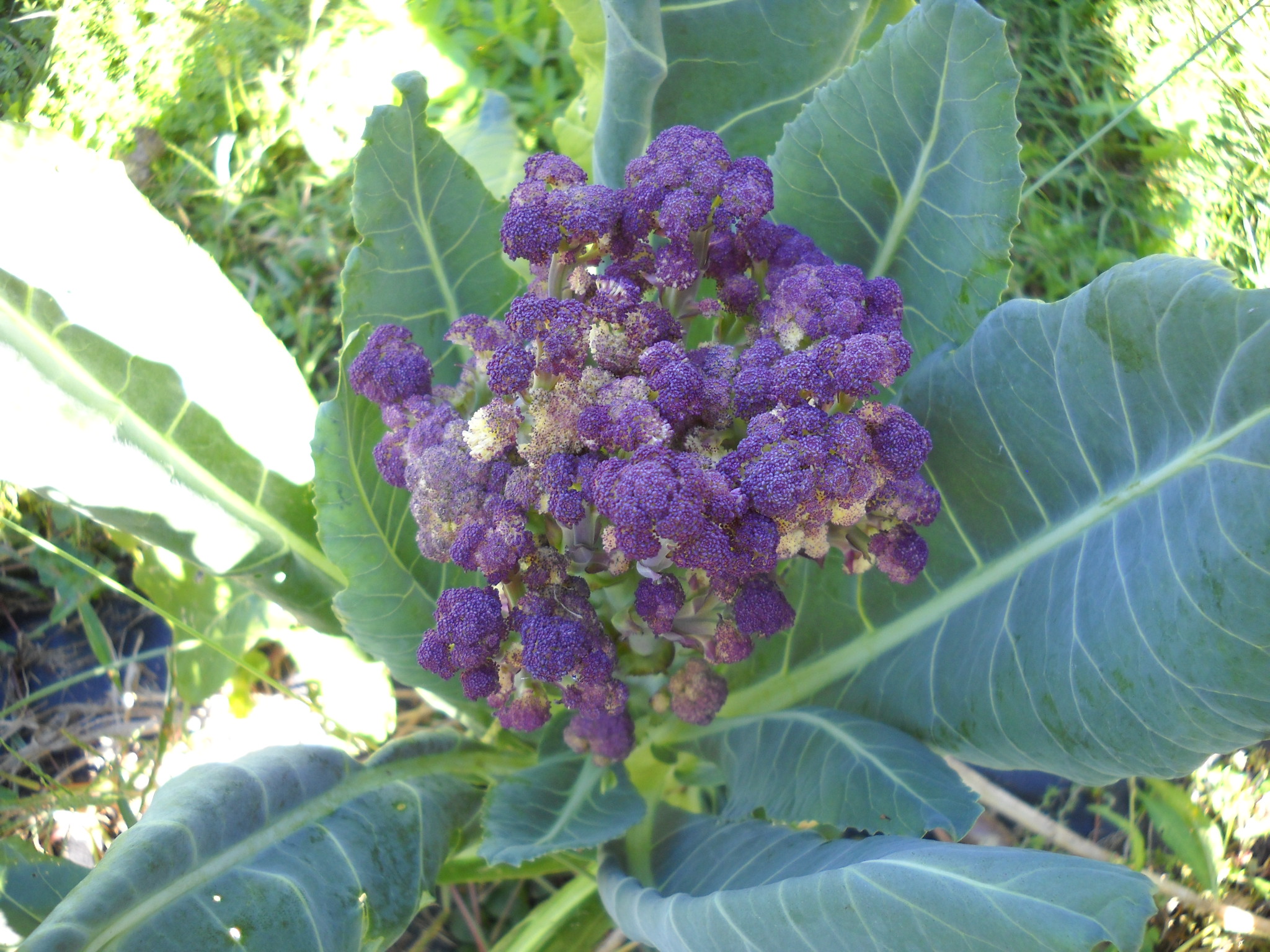
Purple Cauliflower
I planted purple cauliflower this summer, and it was very tasty. The variety I tried, from Franchi Sementi seeds promised that it would develop side shoots like broccoli, and I have seen a few little ones starting in October. The primary heads took until mid- to late-September to develop fully. Broccoli has been fabulous this year, producing side shoots into October. The variety that did best this year is ‘Arcadia’, and I will do it again next year. Very productive.
Usually I have no deer problems, but one rogue 4-point buck came around often. He ate my pole beans late in the season and several summer and winter squashes. Dang! I hope he doesn’t start a family here! My dogs aren’t keeping him away – I may have to reduce their dog biscuits quota to keep them on their toes.
Another new effort was growing ground cherries. These resemble tomatillos with paper skins, but with a sweet fruit inside. Very tasty, but they didn’t ripen until late September- if then. I learned they are called ground cherries because they fall on the ground when ripe.
Gardening is always somewhat a mystery. Sometimes one vegetable does well, other times it can be a complete bust. But I keep on experimenting with new things – that’s part of the fun of it.
Henry’s new book is out: Wobar and the Quest for the Magic Calumet from Bunker Hill Publishing. It is a chapter book for kids, a fantasy-adventure about a boy born with a mustache and a magical ability to speak to animals and understand them. Learn more at www.Gardening-Guy.com.
Garlic
If you’ve harvested everything but the kale and Brussels sprouts in the garden, pulled the weeds and shaped your raised beds in anticipation of spring, you may think that you’re all done. But unless you‘ve planted at least a little garlic, you are not. If you love Italian or French food as I do, you simply must plant some garlic. It’s the simplest, easiest crop I grow.
First, unless you have saved garlic from your harvest in July, you need to buy garlic. Do not just buy garlic at the grocery store. Much garlic sold is “soft neck” garlic grown either in California or (shudder) China. It is not as hardy as the “hard neck” garlic we grow here in New England. I’ve read that garlic at the supermarket has been chemically treated to prevent sprouting, too. I, personally, will not eat anything imported from China as their regulations about the use of chemicals are much less stringent than ours.
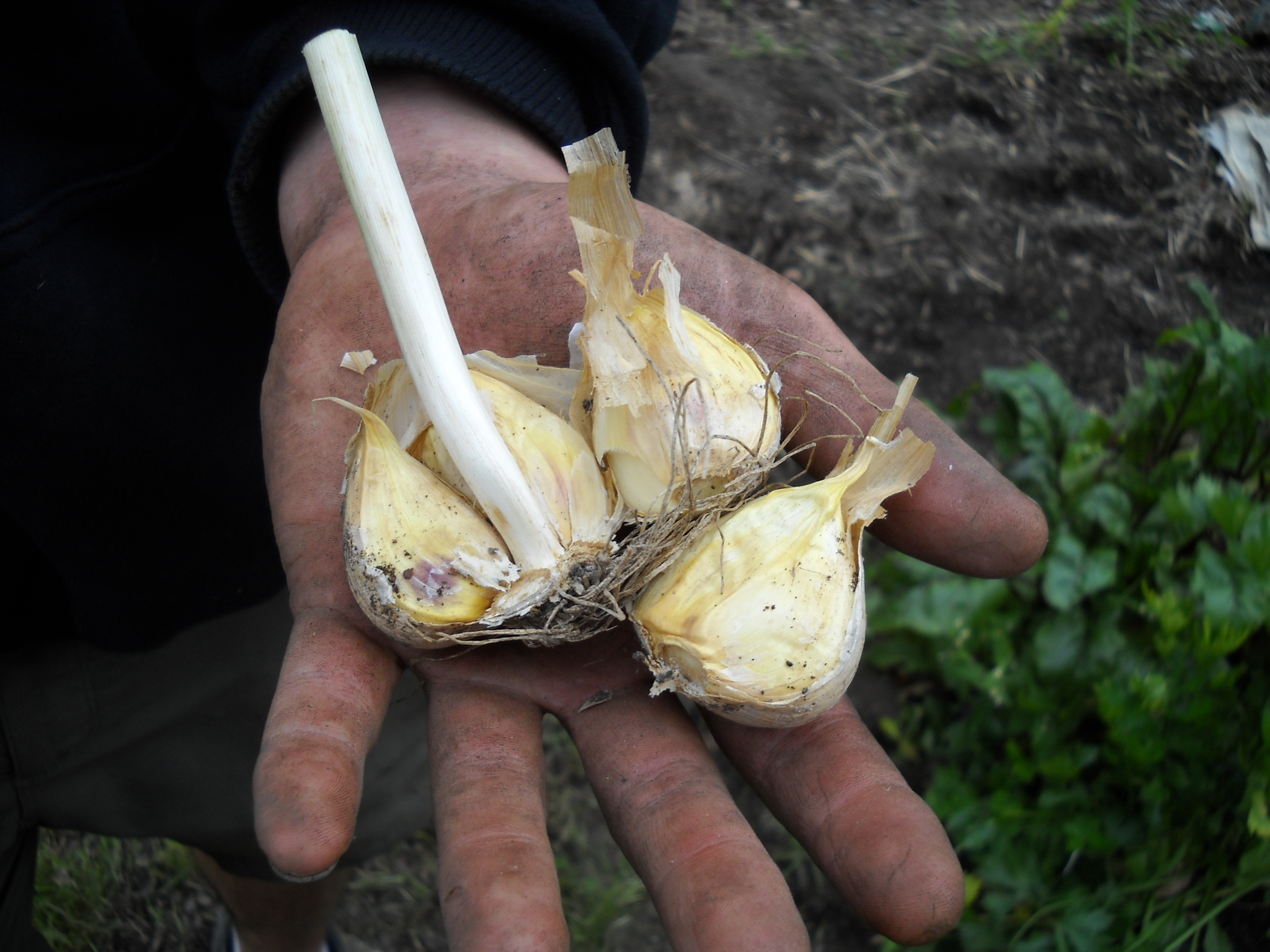
Hardneck Garlic
There are two basic types of garlic. The hard neck garlic I grow has a stiff stem in the middle, around which the cloves of garlic grow. It is plenty hardy in our climate, going through the winter unscathed. Soft neck is the type that is braided and hung in restaurants and kitchens. It last longer, but is not as hardy in the winter, and is less pungent than hard neck. I think hard neck garlic tastes better.
Go to your local farm stand to buy locally grown garlic, preferably organic garlic. Tell them that you are buying it to plant, and ask if they have more than one variety. Try 2 or 3 varieties, and label the garlic as you plant it. Each bulb has from 4-8 cloves, so buy enough to meet your needs in the kitchen – if stored properly it should last all year. One clove a day does not seem like much – but it would be 50 bulbs or more, depending on the number of cloves per bulb. I plant a hundred or more each year, as I also save garlic for planting the following year.
If you can’t get garlic at the farm stand, try your garden center. As a last resort, go to a seed company or search on-line. I like to buy locally, not only to support our farmers, but also because the garlic is best adapted to our local climate.
Mid October is the proper time for planting. It will grow roots and get established before the ground freezes. Some years it will also send up green shoots that will die back when winter comes, but that’s not a problem.
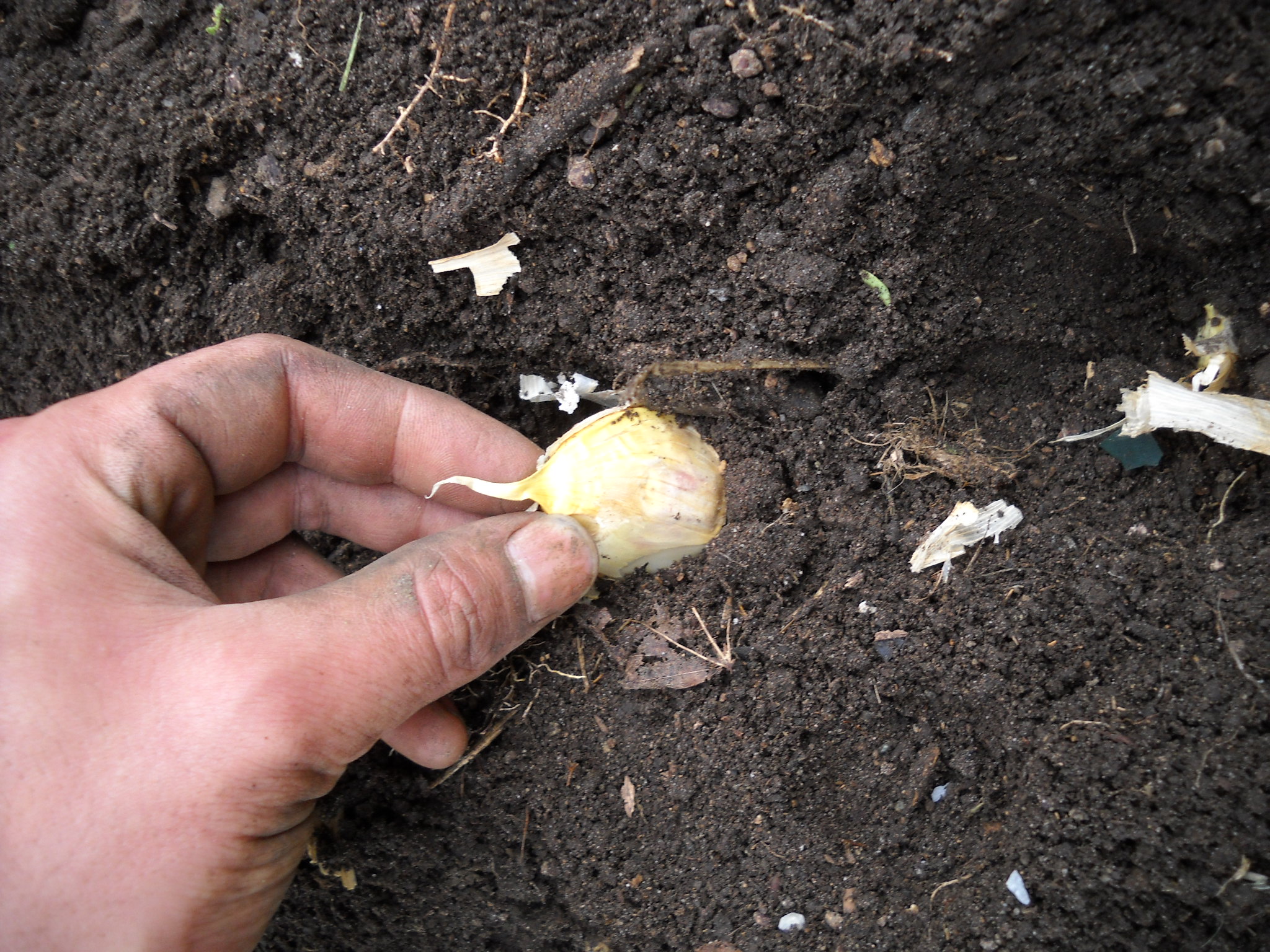
Planting Garlic
Here is what to do. First, inspect your garlic and reject any damaged or discolored cloves. Crack open a bulb and pay attention to the shape of the cloves. The rooting end is flatter, the growing tip is more pointy. You should plant the pointy end up, though planting it upside down wouldn’t kill it – just wastes energy.
Prepare the bed by working in 4 inches or more of compost if you have it. Garlic grows best in rich, dark, well-drained soil that also holds moisture. If you have sandy soil it will dry quickly in summer, so adding compost or chopped leaves will help to hold moisture. Garlic should not be grown in soggy, wet soil either. Clay soils hold water; if you have clay, amend it with compost and shape up the soil into raised beds for better drainage.
Next I take my favorite hand tool, the CobraHead weeder, and mark straight lines in the soil with its single finger-like steel tip, creating furrows. I sprinkle some Pro-Gro organic fertilizer into the furrows, and then run the CobraHead through it again, loosening soil to a depth of 4 to 6 inches and mixing in the fertilizer. In general, I plant 3 rows down a raised bed that is 30 inches wide.
Then the fun part: planting. Just push the cloves of garlic into the soft soil. The pointy tip should be a couple of inches deep. I plant cloves about a hands-width (5 inches) apart. I don’t cover the cloves until I have finished a row, so I can see my spacing as I go along. Then I gently cover the row and firm the soil in place by patting it gently.
The last part of the planting is to cover the soil with a thick layer of straw or mulch hay. I put on 6 inches or more, and the winter snows pack it down so that it becomes a 2-3 inch layer. Garlic sprouts will push right through the hay in spring, but most weeds will not germinate and compete. Garlic, like most plants, does best without weeds.
So that’s all you have to do. In June the garlic scapes, or flower stems, will be tall and curly. Great for use in stir fries. I also use them in flower arrangements as they are very interesting to look at, swooping around in curves and loops. Then in late July or early August I harvest the garlic. Store it in a cool dry place. I just wish growing tomatoes was as easy as growing garlic. Sigh. But that would be too easy!
Henry’s new book is in bookstores! Wobar and the Quest for the Magic Calumet is a fantasy-adventure for children 8-12 about a boy and a cougar. For more, go to www.Gardening-Guy.com.