-

Now available for $24.95 including shipping. -
Now available for $21.00 including postage. Vendors I Like
 Click Here to buy from Cobrahead
Tomato Hornworms and Other Late Summer Pests
Sometimes it’s easy to get discouraged about the garden: Early in the spring there are seeds that don’t germinate well in cold, wet soil. Then the weeds germinate too well and try to take over the garden when things warm up. Next Colorado potato beetles attack the potatoes. By mid-summer early blight and other diseases start killing leaves and slowing growth on tomatoes, and now the tomato hornworms come along to browse the tomatoes and their vines. Gee whiz, is there no mercy for gardeners? I thought gardening was supposed to be easy!
But there is some good news. Mother Nature is doing her best to control some pests, tomato hornworms among them. Tomato hornworms are green larvae that get huge (up to 3-5 inches long), and have voracious appetites. Bad infestations can defoliate tomato plants in just a day or two. Because of their green color and markings, they are often very hard to notice, too. This year they seem worse than normal, according to some of my readers – though not in my garden. This is the season when they are most prevalent.
If you seen a tomato hornworm with little white attachments something like small grains of uncooked rice, do not kill the hornworm as it is being attacked by the larvae of a parasitic wasp. These white projections are cocoons containing the pupae of a braconid wasp. They indicate that the good bugs have found the bad bugs, and will destroy them.
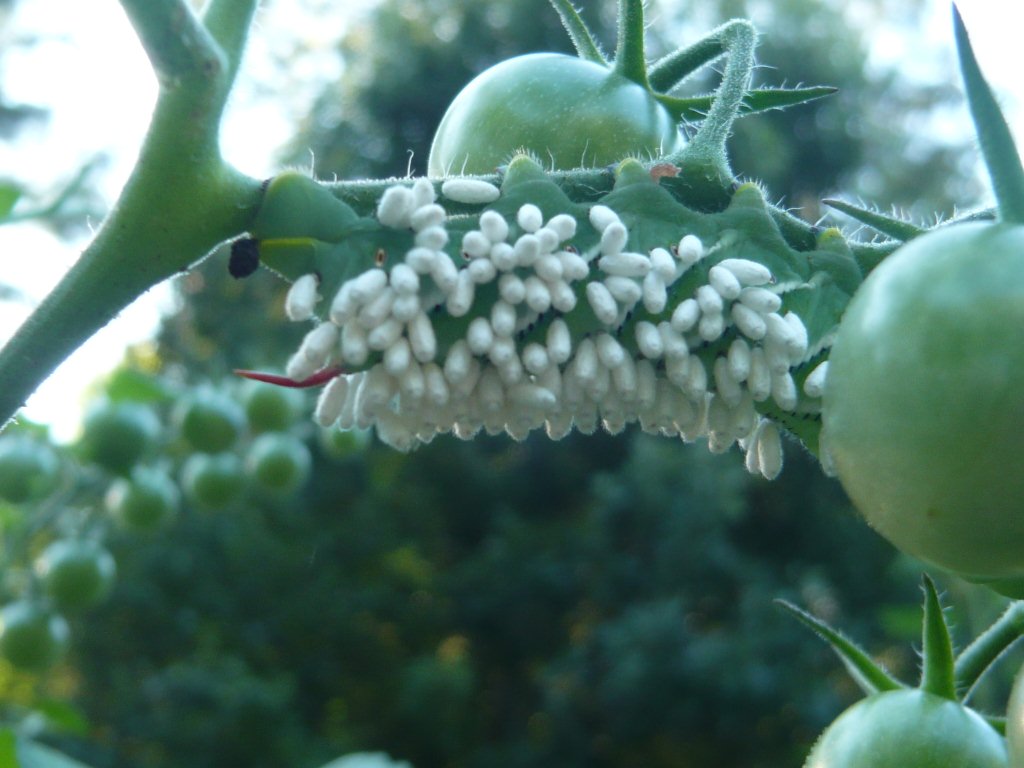
Hornworm with cocoons attached
I watched a hornworm that was covered with these tiny white cocoons, and over a 24 hour period it ate nothing. It was slowly dying, and appeared to have no appetite. I called Dr. Alan Eaton, NH State Entomologist, who told me that the wasps kill their prey slowly, allowing the larvae to feed long enough to develop. At a certain point, he said, the hornworms stop feeding. When he encounters a hornworm with parasitic wasp cocoons, he takes no chances – he moves it to another location away from his tomatoes where the braconid wasps can develop.
If you’ve seen a moth that resembles a hummingbird, that is the adult form of the tomato hornworm. According to Dr. Eaton, an adult moth of the tomato hornworm is about the same size as a ruby throated hummingbird. They are very strong fliers, and actually overwinter in the places where they can survive without freezing. Then they fly north in the spring, finding new feeding and mating territories.
One last hornworm tidbit: according to Dr. Eaton, there are 2 species, the tomato hornworm and the tobacco hornworm, and the tobacco hornworm is much more prevalent. So if you have been cussing out those nasty tomato hornworms, maybe they’re laughing and saying, “We’re actually tobacco hornworms!”
According to Dr. Eaton – and several readers who have sent me questions – this is a bad year for green stinkbugs. These triangular-shaped green bugs are feeding on everything from grasses and veggies to peaches and apples. Perhaps the mild winter resulted in higher numbers of them. They stink if crushed, so Dr. Eaton recommends picking them and dropping them into soapy water. The brown marmorated stinkbug is often a pest, but the green one is not usually as prevalent as it is this year.
This is also the season that fall webworms appear. You may call them tent caterpillars, but they are of a different species of pest. The tent caterpillars form webs, or tents in crotches of trees early in the summer, but the webworms create their nests near the tips of branches now, and into the fall. With time, the nests get bigger, enclosing more and more leaves as they grow. If the tent is down low you can physically remove the teeming mass of caterpillars by clipping off the branch and dropping it into a bucket of soapy water.
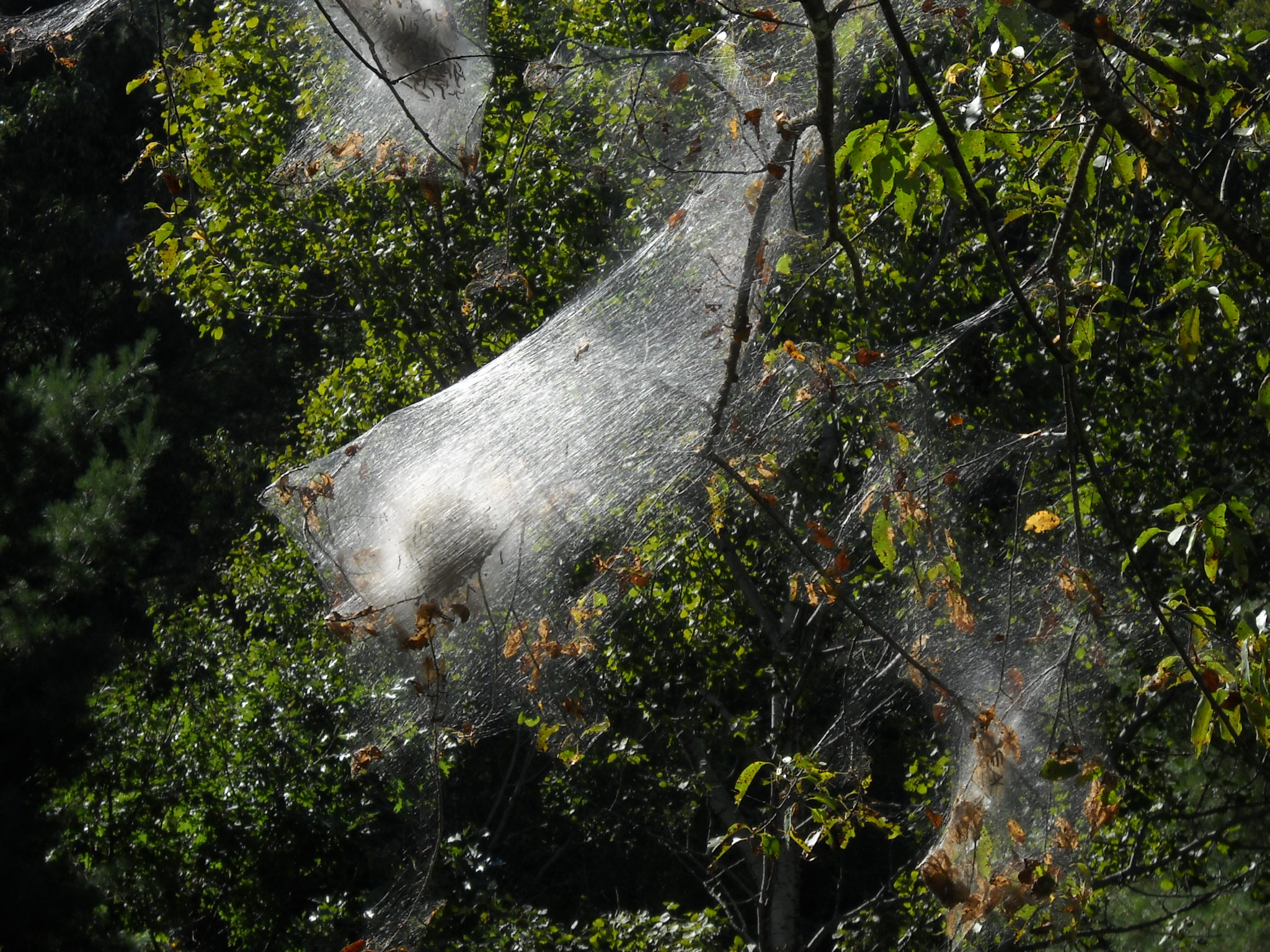
Fall Webworm
If the fall webworms are close enough to the ground that you can spray the leaves near them, you can apply a biological control. There is a product called Dipel, which contains a bacterium (Bt kurstaki) that will kill the worms if they eat leaves sprayed with it. This bacterium will not hurt us, our pets, fish or birds. It is specific to caterpillars. And Dipel lasts for years in the container, so you can invest in a package of it and know that it will be good in the future.
I understand the urge to “nuke” the bad bugs. Hornworms eating my tomatoes? Nuke ‘em. But I don’t. And since I let the braconid wasps feed on the hornworms years ago, I rarely see one of those bad boys. Chemical pesticides change the garden environment. It may please you in the short run, but in the long run, let Mother Nature – and your fingers – take control. Pick’em, don’t nuke ‘em.
Henry Homeyer’s new children’s book, a fantasy-adventure for 8-12 year-olds called Wobar and the Quest for the Magic Calumet, is coming out in October. His Web site is www.Gardening-Guy.com; his e-mail is henry.homeyer@comcast.net.
Uninvited Visitors: the Good, The Bad, and the Ugly
Years ago my sister had a friend in New York who would arrive at my house once or twice a year, unannounced – and always at dinner time. He always stayed until we invited him for dinner but never brought anything to contribute. He had good stories to tell of his times in Africa, so we fed him and excused his unannounced arrivals and large appetite. I‘ve had other visitors who also arrived without an invitation, some of whom wanted to stay for days and who left wet towels on the bathroom floor. There are similarities in the plant world, too: some plants arrive unannounced and shouldn’t be allowed to stay, while others welcomed.
Decades ago a handsome flower arrived in my garden on its own. It was a bellflower, one called, in scientific parlance, Campanula glomerata. This is a nice cut flower with a bright bluish-purple blossom. Never having seen one, I thought I had discovered a new plant, or perhaps a fabulous wildflower had arrived in my garden. I soon learned its name, and that it spread by root, but flopped over, and was, though nice, not as nice as I had first thought. Where did it come from? Who knows? Seeds, I suppose, perhaps in a pot containing other flowers, or carried by a bird.
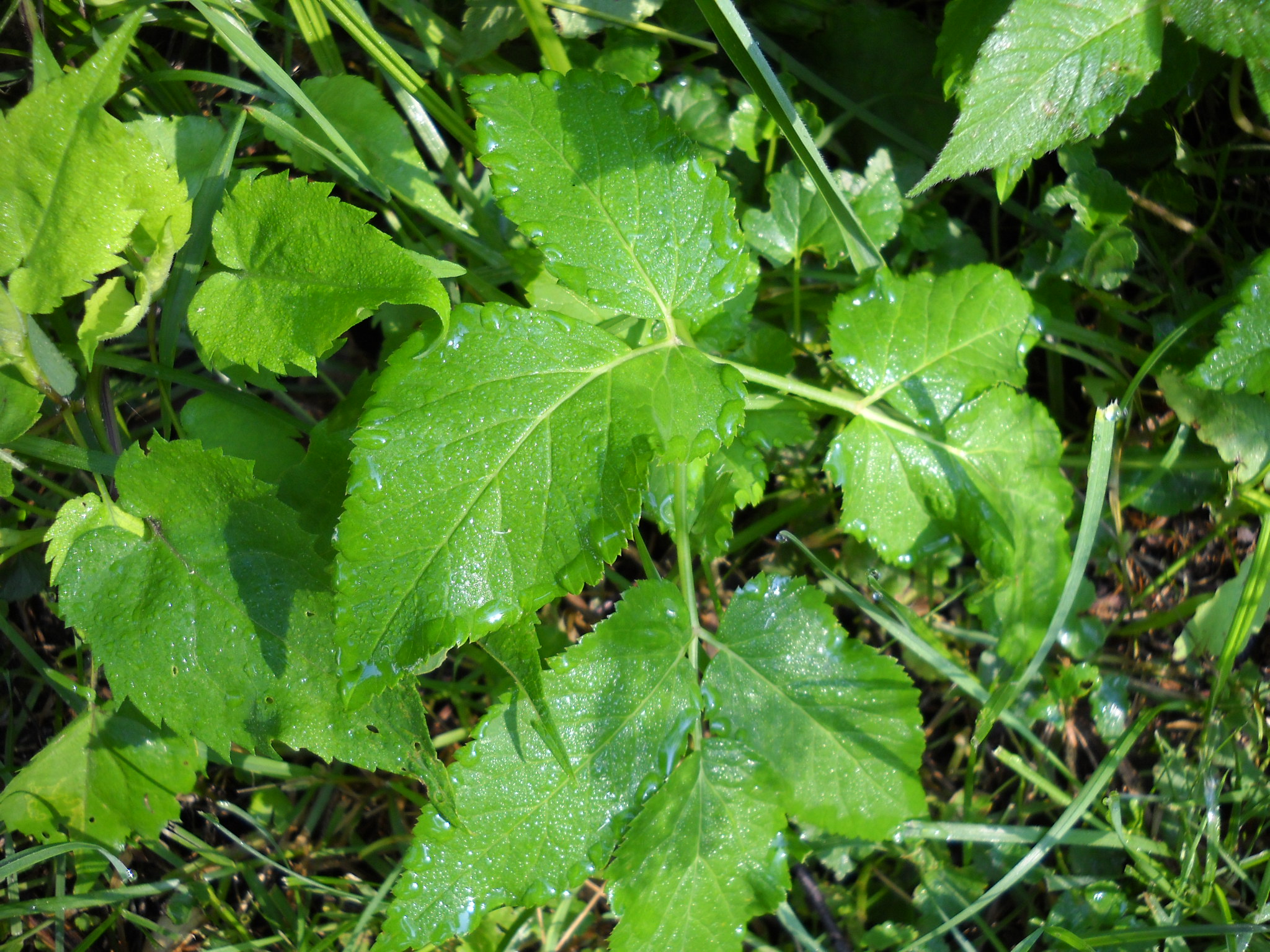
Goutweed
Not all uninvited visitors are nice. Goutweed (Aegopodium podagraria) and bishop’s weed (the variegated form of goutweed), is the bane of many a gardener’s existence. This invasive was introduced from Japan as a groundcover that could grow in sun or shade, wet or dry. The all-green form, goutweed, will take over a flowerbed in no time, smothering less persistent plants. It is nearly impossible to weed out, as even a small section of root will produce a plant – and more roots. For the organic gardener, the only way to control it is to smother it with plastic and a thick layer of bark mulch. I got some many years ago with a gift of iris – their roots were intertwined. Bishops weed, with its green and white leaves, is less invasive, but sometimes it reverts to the all green form and takes over. So beware!
Great blue lobelia (Lobelia siphilitica) is a fine, upstanding blue-flowered plant that comes and goes in my garden as it pleases. I let it pick its own location, seldom weeding it out, as I know it will never be a problem. It forms small clumps of a dozen plants or less, each spike standing 18-24 inches tall. I’ve known it to travel over 100 yards from one year to the next, and I don’t recall that I ever purchased a plant.
Last winter was virtually snowless, so roots of plants got colder than normal (snow is an excellent insulator). I lost most of my hollyhocks, but I assume that seeds are in the ground and that they will return. Many books list hollyhocks as biennials, but I have had some plants that persisted, growing from the same roots for several years – especially if I cut down the stems right after flowering. Hollyhocks have moved around my gardens at will, seeds traveling downhill on rainy days, as near as I could tell. I had to transplant some as they became very well established in my vegetable garden.
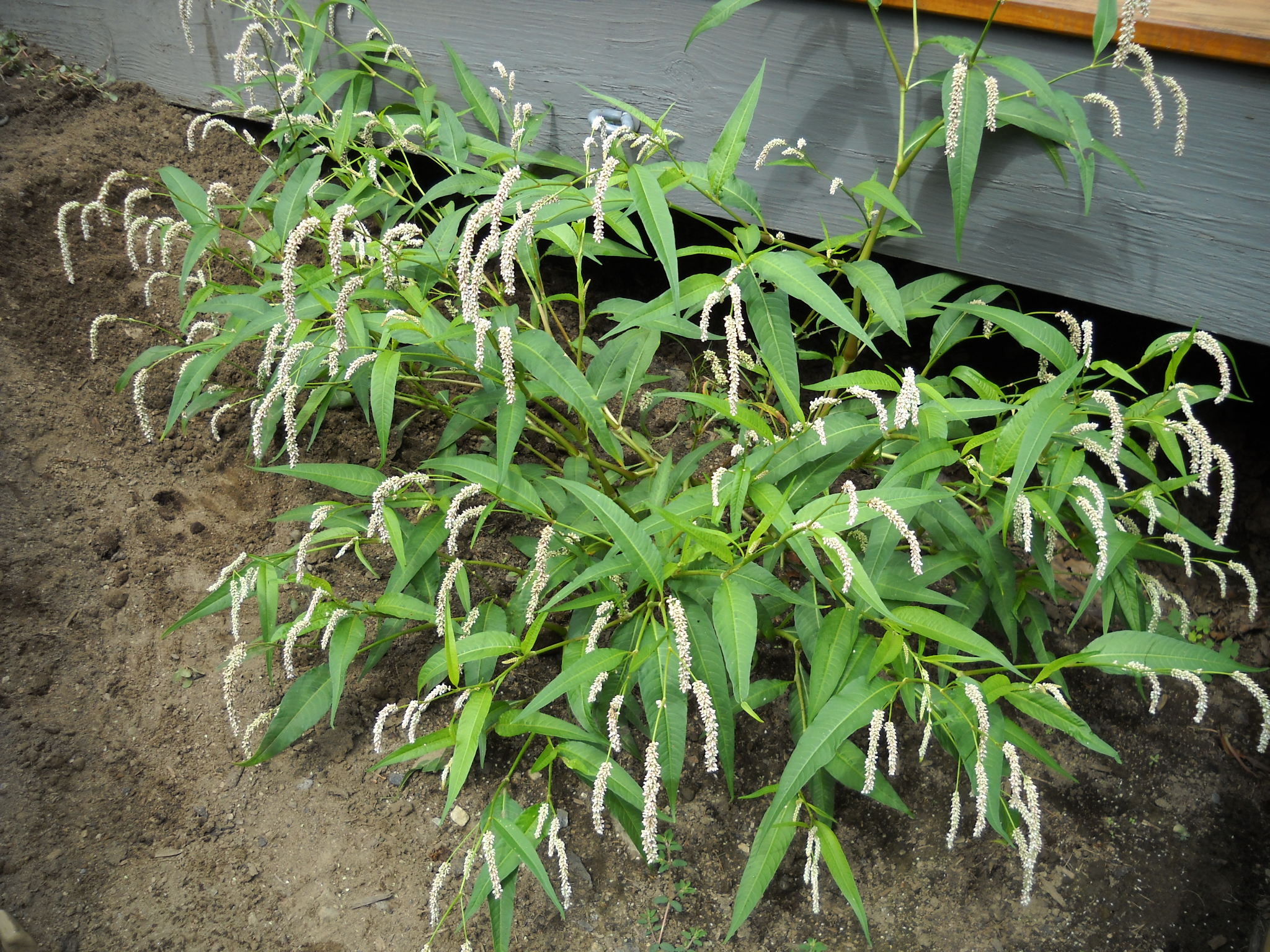
Lady’s Thumb
I recently installed a small garden for a client in Wilder, Vermont, who would not let me remove some of her weeds! She had one that stood nearly 3 feet tall and was covered with small white flowers. It looked to be related to flowers in the genus Persicaria. The weed, deemed a wildflower, is on a Brandeis University web site, http://www.bio.brandeis.edu/fieldbio/leeci_unet/. It’s called lady’s thumb, with the scientific name Polygonum persicaria. That name indicates that the plant looks like a Persicaria, but is in the buckwheat family. So it continues to thrive in her garden – as a wildflower. And now that I know it is a wildflower, not a weed, I like it better. Isn’t that silly? I guess I fear that weeds will take over a space, but know that most wildflowers will not.
That same client also requested that I leave a creeping weed called purslane (Portulaca oleracea). It has glossy, fat leaves and can lay flat against the soil, or stand up as tall as 6 inches. Hers was a low-growing type, and makes a good groundcover – and a nice meal. Yes, I’ve eaten it by sautéing it in olive oil with a little garlic. If you wish to try some, please be sure to get positive identification of it from a knowledgeable person. Most plants are not poisonous, but I’d hate for you to get sick from trying something you should not eat.
Another client told me that she weeded out rose campion (Lychnis coronaria or Silene coronaria) because it jumped up all over the garden. I love it, and let it choose to grow wherever it chooses. It is a biennial with slightly fuzzy gray leaves that has a 4-petaled magenta flower in its second year. But if you want your garden to be ordered and organized in a specific way, perhaps it is not for you.
We all have different tolerances for uninvited visitors, both flowers and people. I think the important thing for me is to know that, if I choose, I can get rid of them without too much trouble.
Henry’s new children’s book, a fantasy-adventure about a boy and a cougar, will be out soon: Wobar and the Quest for the Magic Calumet from Bunker Hill Publishing. His Web site is www.Gardening-Guy.com.
Garlic
Everything has its season; for me, this is garlic season. In early to mid-August each year I harvest 60-100 garlic plants, each bulb or head with 6 to 8 cloves. I tie them in bundles of 10 and hang them in a cool dry location, whole plants including the tops. A month later I trim off the tops, but I’ve been told that curing them with their tops on allows certain nutrients to flow back into the cloves from the foliage. If you haven’t picked your garlic, you should. If you wait too late the outer skin of the garlic will break down and the garlic will not store as well.
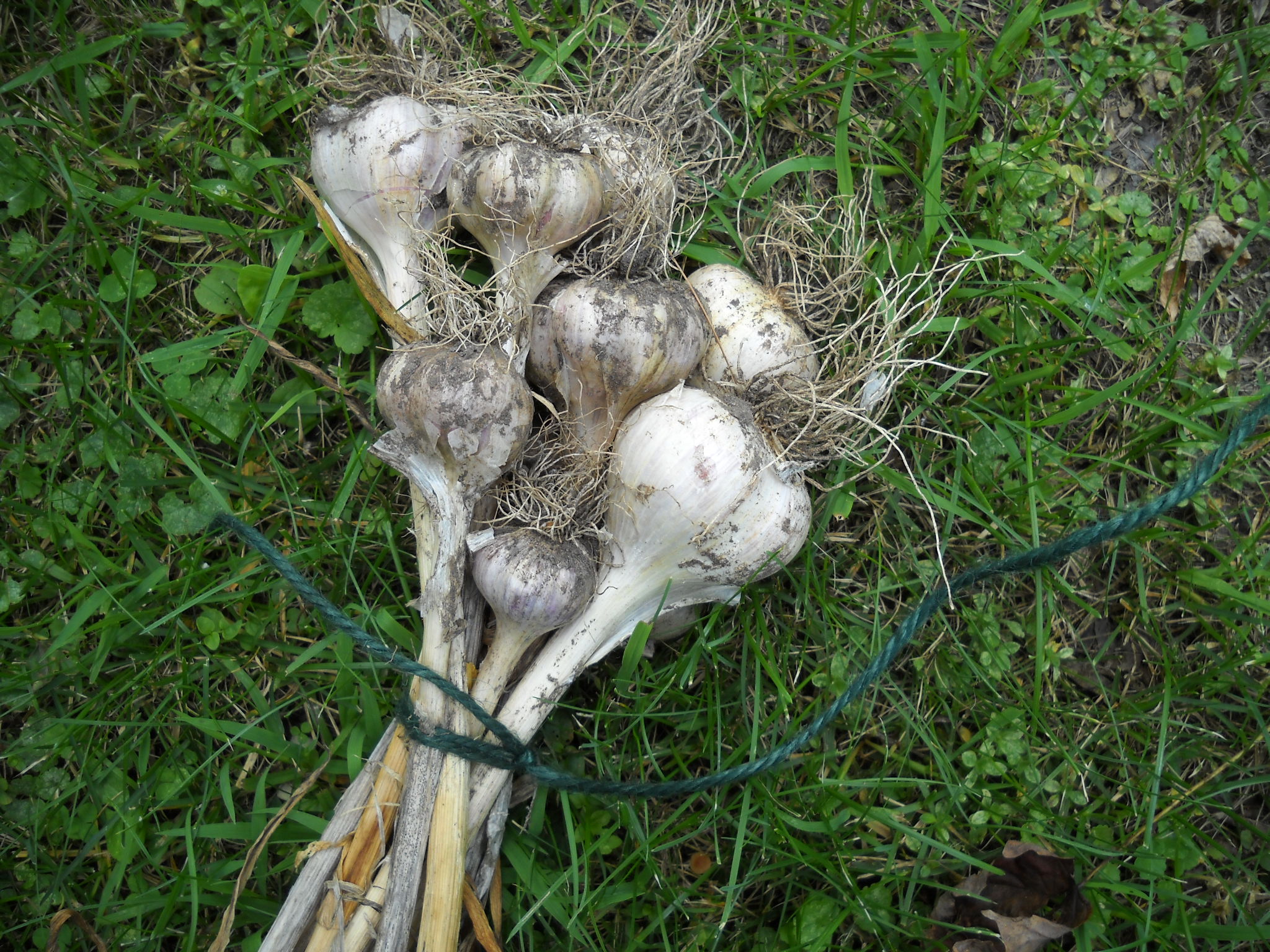
Garlic ready to cure
And what, you might fairly ask, does one do with 100 heads of garlic? For starters, I will save the best 15 heads or more for re-planting. I don’t buy seed garlic, I use my own, year after year. Planting time is not until October, but I select the best garlic and set it aside for planting. That means, over time, that I am developing strains that are best for my soil and climate. Now, after 25 generations of doing so, I grow garlic that is well adapted to my specific conditions.
Then there is pesto. I planted a bed of basil about 4 feet square this spring from plants I started indoors. Recently I cut most of that basil about 8 inches from the soil line and processed it all at once for pesto – the plants will grow new leaves for other uses later. I’ve tried a lot of recipes, and have decided this one, below, is the best. I used pine nuts for it, instead of walnuts or almonds, even though those nuts cost me $22/pound. But 6 batches of pesto only used 3 cups of pine nuts, which translates to about $8 for the nuts. This is a treat, and will last for months if spaced out between meals and not consumed on toast with tomatoes for breakfast, which is what I did the day after making pesto.
Henry’s Pesto Supremo
2 cups basil, well packed down in the measuring cup
1/3 cup pine nuts, roasted
3-6 large cloves of garlic according to your taste
1/3 to ½ cup olive oil
½ cup grated Romano cheese (or Parmesan if you prefer)
salt and pepper to taste
I began by browning the raw pine nuts in a cast iron fry pan at medium heat. The pan had been oiled and then wiped with a paper towel to remove the excess. I find roasting improves the flavor considerably.
Remove basil from stems, wash, spin dry and then pat the leaves dry with a cloth towel. You need enough basil to fill a 2 cup measuring cup with leaves packed down firmly, which is a lot of leaves.
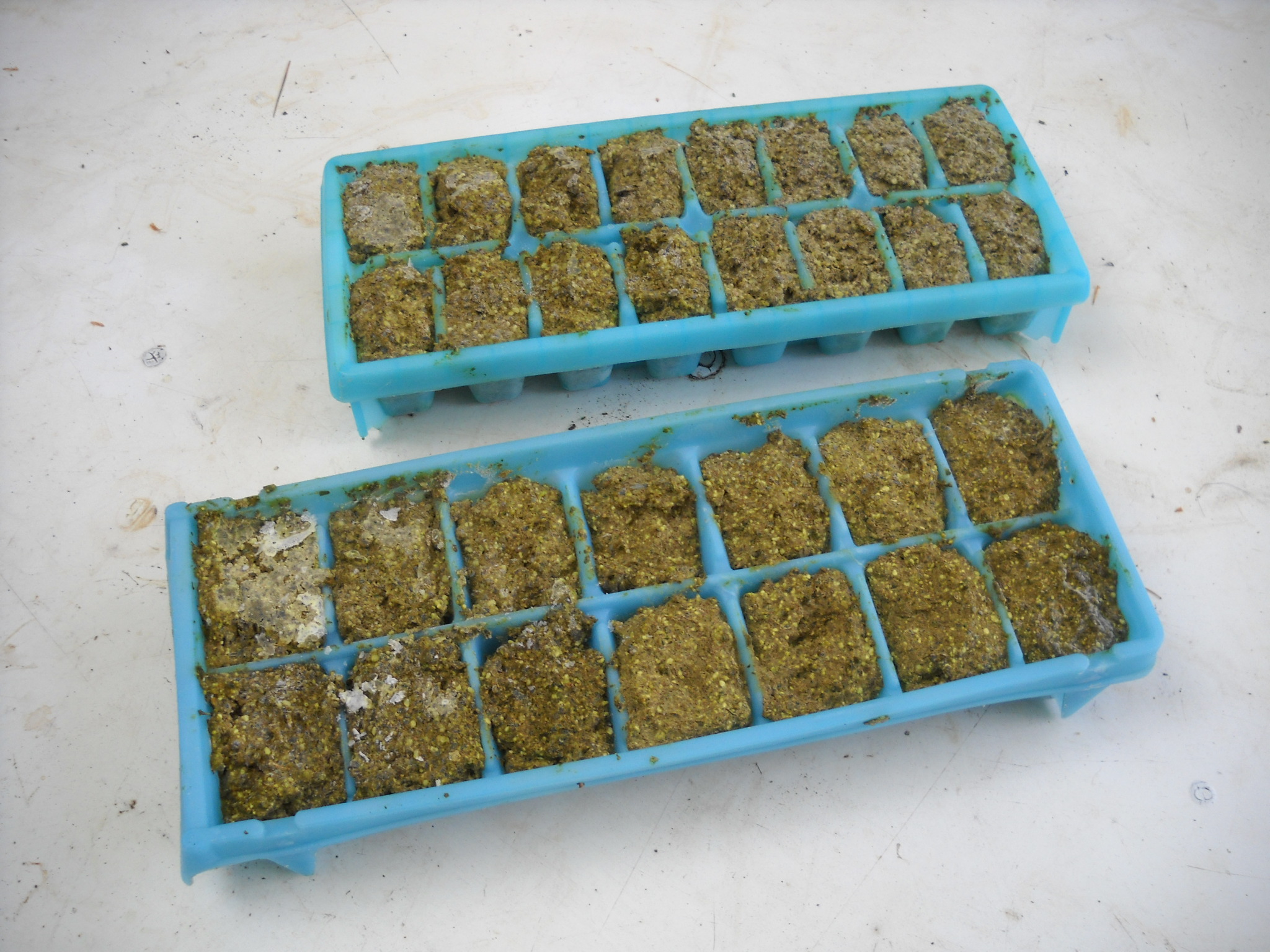
Pesto Frozen in Ice Cube Trays
Place leaves in a food processor and add 1/3 cup of pine nuts and pulse a few times. Mince the garlic in a garlic press, add to blender and then pulse. Add oil slowly with the processor running. Finally add the cheese and pulse a few times. Taste immediately on toast!
Looking for other ideas I called Bill Howard, Executive chef at Three Tomatoes Trattoria (my favorite Italian restaurant) which is located in downtown Lebanon. He started by reminding me that different strains of garlic have different flavors, some with lots of “bite”, others quite mild.
Bill likes a mild strain called “Music.” He roasts it in a 350 degree oven for an hour or so, caramelizing the sugars in it and making it suitable for spreading on toast. I’ve done this in the past by putting whole heads of garlic (skins on) in a small, oven-safe baking dish with a little olive oil. When the garlic is roasted I let it cool, take scissors to snip off the tops, and then squeeze out the soft inner mush onto toasted bread. Sometimes I first lather the toast with a soft goat cheese and then spread the roasted garlic and top with a slice of fresh tomato. Oh boy!
Bill Howard also told me that sometimes when using garlic that has a lot of bite he slices it, and then poaches it in milk, which mellows it out. That seems truly bizarre to me, but I’ve never eaten one of his dishes I didn’t like. Not only does he use the garlic, he makes a garlic-infused béchamel (white sauce) sauce using the milk, butter and flour.
Garlic keeps best in a cool location with low humidity. I keep garlic on an “orchard rack” in the mudroom, a place that stays cool. I got the rack a few years ago from Gardeners Supply (www.gardeners.com) and use it for winter squash and onions, too. It is made from hardwood slats, so there is good air circulation. If you just have a few heads of garlic I suppose you could keep it in a basket in the kitchen, or perhaps in the fridge.
Garlic is believed to cure or prevent all manner of ailments. I learned from herbalist Nancy Phillips (author of The Village Herbalist) that one should mince or chop garlic and then let it sit for 10 minutes before cooking with it. She says this allows certain anti-cancer compounds to develop full potency before use. I have been doing it for years – it can’t hurt.
I do know that garlic adds great flavor to almost any dish. And who knows, I might poach some in milk and use the milk on my cereal. That would be an interesting way to start the day!
Henry Homeyer’s new children’s book will be available in September. Look for Wobar and the Quest for the Magic Calumet from Bunker Hill Publishing.
Keeping Hedges Looking Good
If you haven’t gotten your hedge clippers out yet this season, it’s not too late to do some work on hedges. And even if you have done some trimming, this is a good time for a tune-up. You can keep hedges to a constant size, but it requires some work once or twice a year – every year.
I recently worked on a barberry hedge that had been given a buzz cut with electric clippers last summer, and again this spring. The job last summer was to bring down the height of the hedge by a foot or more, which meant that most foliage was cut off. It looked pretty gawky, like a teenage boy in shorts, all leg. But I knew that would not seriously harm a barberry. Barberries are tough as nails, almost impossible to kill. They are also on the invasive species list in most states.
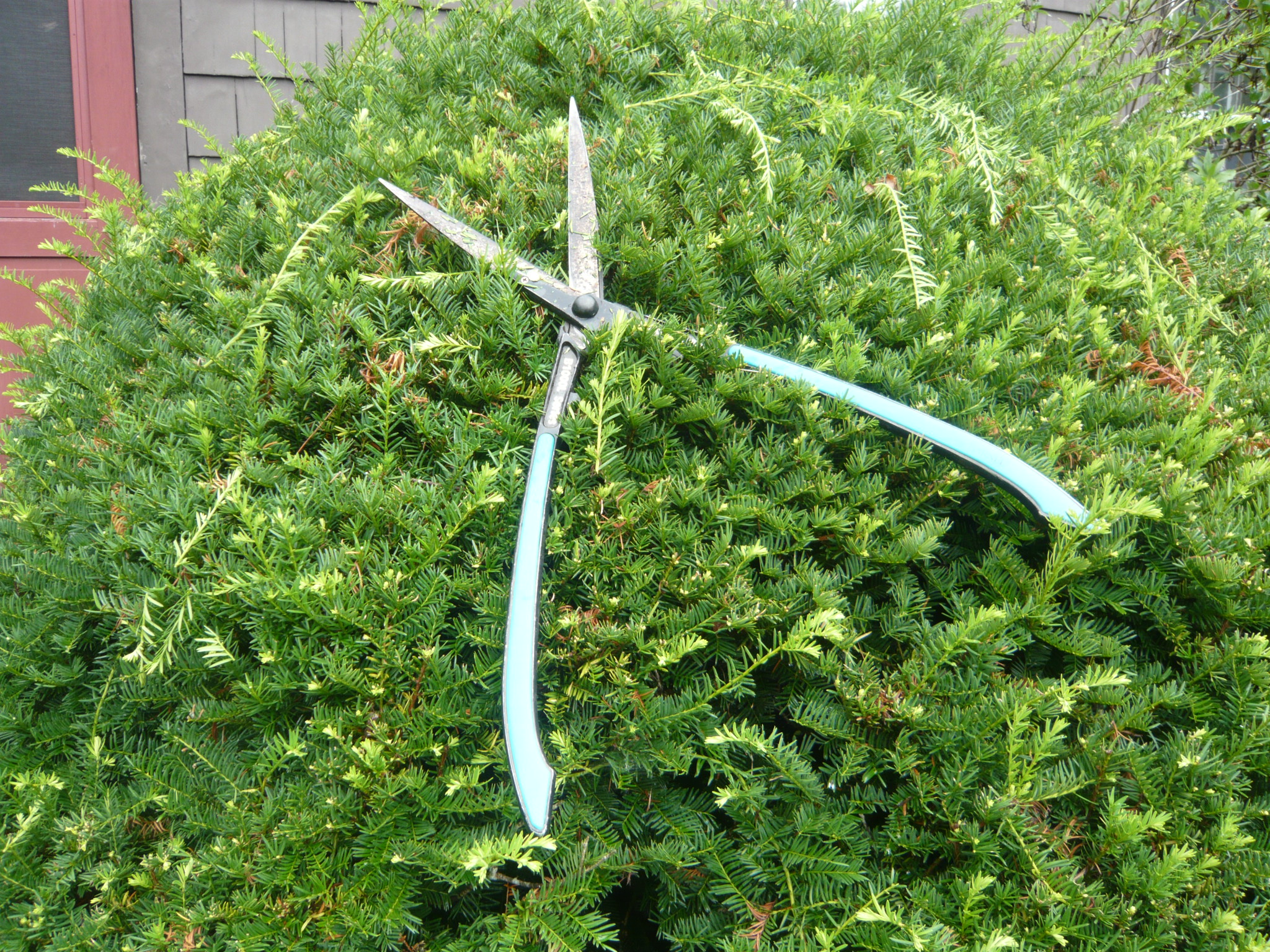
Old Fashioned Hedge Clippers
I decided to use old fashioned hedge clippers, the manual kind, to work on this hedge. I like them because, unlike the powered ones, you can’t do much damage, or at least not quickly. These look like big scissors with 14-inch blades. My goal was to snip off the 6 to 8-inch new shoots that had popped up erratically since its last pruning in May or early June. I wanted to contain the hedge, not change its basic size or shape.
One of the first things I did was to cut out dead branches. These were most prevalent down low, branches that had been shaded out. Then I looked it over to see what kinds of other things had invaded the hedge since its planting. Hedges are great places for birds to rest and nest, away from hungry cats and foxes. That means that birds also drop seeds near hedges, seeds that go through their digestive systems unharmed – and start new plants.
There is an invasive introduced rose called the multiflora rose. These were introduced by highway departments back in the 1950’s, before people understood their potential to take over the understory. Sure enough, there was a multiflora rose that had grown 3 feet above the top of the hedge – in just a couple of months! I crawled into the hedge and cut it off at the base. If I’d been more courageous I would have dug the roots out, too, but that barberry is a pretty prickly customer.
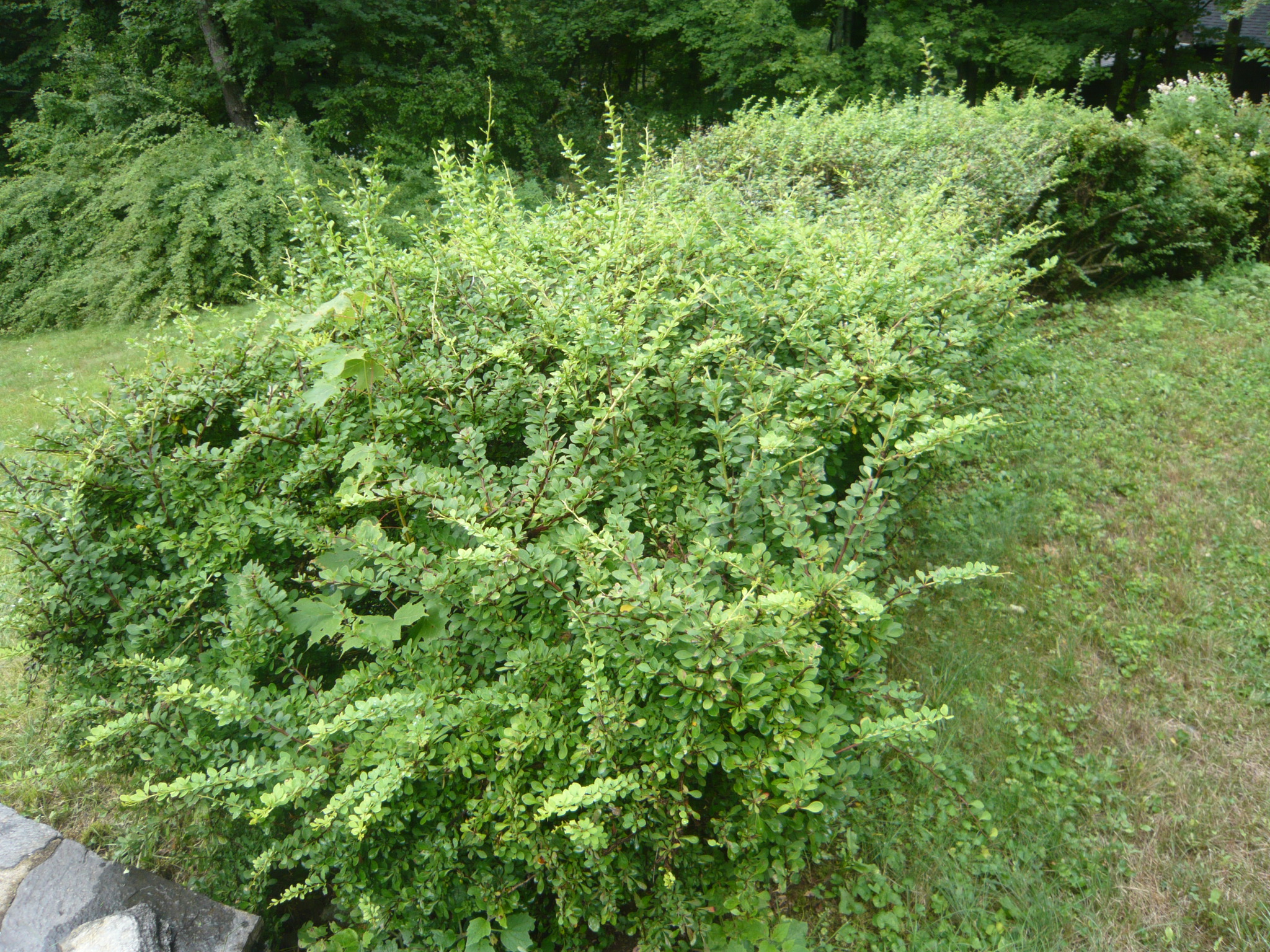
Barberry Hedge in Need of Tune Up
Then I snipped off all new growth that had grown up since its last haircut. I like a hedge that is quite even, so in low spots along the top or holes along the sides I let new growth remain, or trimmed it lightly to encourage it to branch out.
Experts tell us that a hedge is healthiest if it is tapered: it should be narrowest at the top and spread wider as it gets to the ground. That way all the branches get sunshine, even the lowest ones. But most people don’t trim their hedges that shape, so the lower branches die out from lack of sunshine. Hedges spread out at the top, so that before long they are shaped like a “V” – unless you really work at preventing that.
I called Cal Felicetti, a consulting arborist who works for Chippers, Inc in Lebanon, NH and asked him how much a hedge needs to taper. He said an 8-foot tall hemlock hedge should be about a foot wider at the bottom than it is at the top. That way, not only do all branches get sunshine, the hedge sheds snow better – particularly if the top of the hedge is gently rounded. Stand at the end and look down the hedge, he said. The taper should be obvious, and the lines straight.
Cal also said that if you have a tall hedge, consider investing in a good orchard ladder. These ladders have a hinged leg that you can plunk right into the hedge, allowing you to get to the top of the hedge and do a good job of shearing it. A standard step ladder puts you far away from the top of the hedge, encouraging you to take risks leaning over to reach it – or to just give up.
Cal’s last bit of advice was to buy good tools and keep them sharp. I agree. If you buy good tools they’ll last a life time, and longer. Pruning tools need regular sharpening, but once you learn how to do it, it’s easy.
If you like a formal looking hedge, prune now or even later. Hedges are pretty much done growing until next spring, so they’ll stay smooth and even. If you like a more informal look, prune earlier next year and allow your hedges to get fuzzy all over. The main thing is consistency- you can’t afford to skip a year or two, and hope to catch up later. And remember to taper those hedges, they need to be widest at the base.
Henry Homeyer is the author of 4 gardening books. His Web site is www.Gardening-guy.com.