-

Now available for $24.95 including shipping. -
Now available for $21.00 including postage. Vendors I Like
 Click Here to buy from Cobrahead
What to do in Hot, Dry Weather
We New Englanders are pretty lucky. Much of the country is saddled with a hot dry spell reminiscent of the dust bowl era of the 1930’s. I’ve seen pictures in the paper of wizened corn and unhappy farmers scratching their heads and looking up at a cloudless, unforgiving sky. We’ve had more than our fair share of hot days – in the high nineties, even – but so far I’ve had at least a thunderstorm once a week. Each week vegetables (and many flowers) need one inch of water –either from the sky, or from your watering can – but we don’t always get that.
Recently I went to water the garden of a friend who was away for a week. The soil was as dry as powder. She had planted pole beans before she left, and they should have sprouted, but had not. I watered the bean plot, but water from the hose wouldn’t penetrate the soil. It just ran off. So I scratched the surface to loosen up the crust on top, and re-watered a few times using a watering can, giving it a slow sprinkle. Finally it worked: when I poked a finger into the soil it was dark and moist for at least 2 inches. Then I spread a light layer of straw over the soil to shade it.
Imagine yourself marooned on a desert island. No shade? You bake. Add a palm tree or two, and you survive nicely. Same for your lettuce and tomatoes. The plants love the sun, but their roots need some shade in hot, dry times.
In the vegetable garden I favor a layer of newspapers – 4 to 6 sheets thick – covered with straw, hay or leaves. I keep the newspapers away a little from the stem of each plant, as I want moisture from light rains to reach the soil. Straw comes from grain crops that have been threshed, so it is not supposed to have seeds (though it always has a few). Mulch hay always has seeds; it is grass grown for fodder for cows and sometimes it gets spoiled as feed (by rain) and sold cheaply to gardeners. The price difference is considerable – $3 for hay versus $10 or more for straw, so I generally use hay. The newspapers help to keep seeds out of the soil.
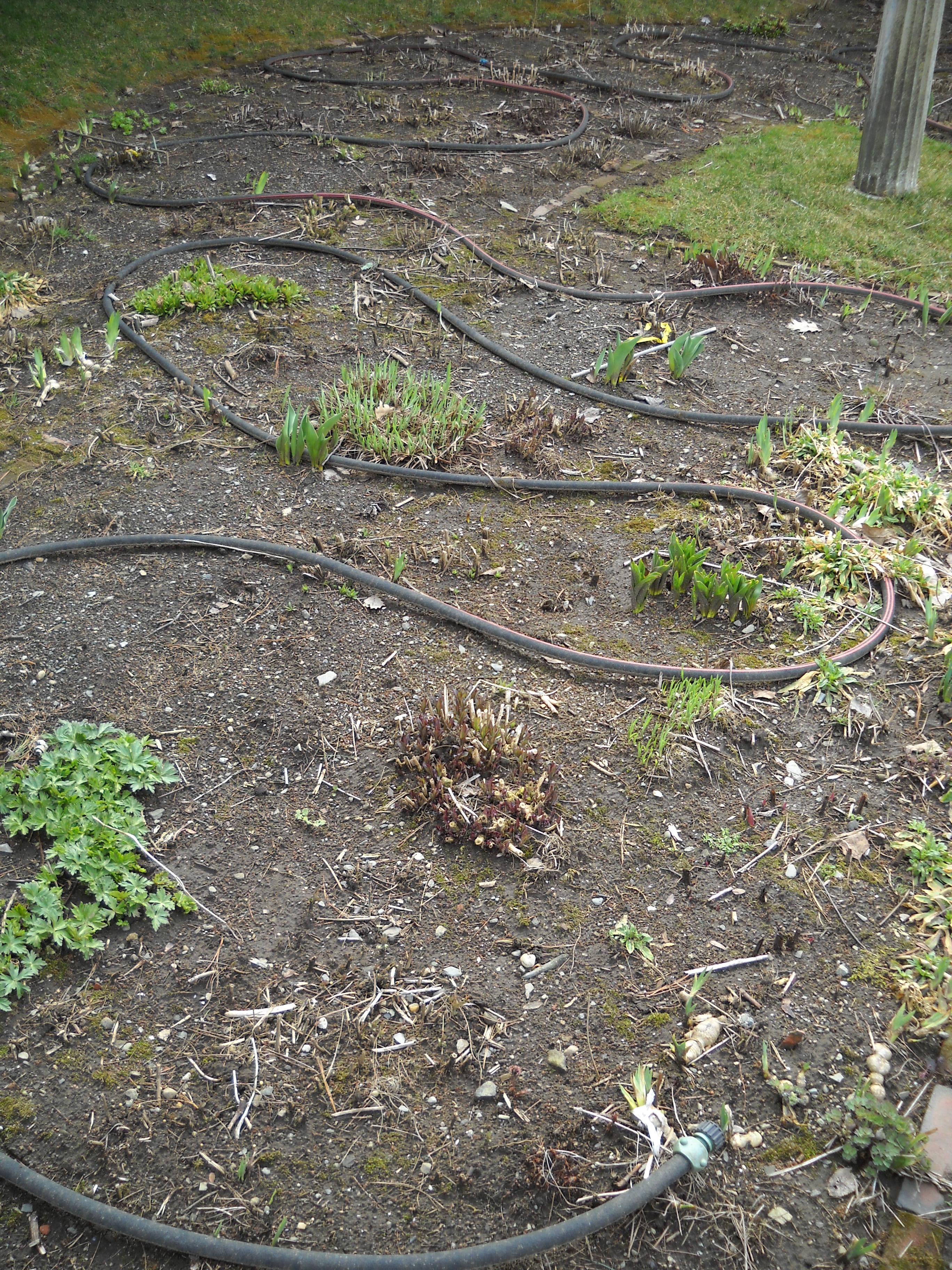
Soaker hose in flower garden in fall after clean up
What kind of watering device is best? I’ve tried plenty of them, most recently soaker hoses. Soaker hoses are designed to leak. They are a rubber-like substance that is somewhat porous. They ooze water their entire length, and that water spreads out for about 6 inches around each hose. I installed a pressure regulator and a filter to keep particles from the water source (a pond) from clogging the pores of the soaker hose. Still, some rows – or sections of a row- got more water than others – and not in a predictable way. So some plants got little or no water, some got too much; a few rows had perfectly even distribution.
I also installed a timer, which allowed my client to go away and know her beets or tomatoes were being watered in her absence. Timers work, but get the simplest kind possible. I have installed some that you have to program, and find those can be aggravating. I like a simple one that comes on every day at the same time, but allows you to set how long the hose will run. Test it well – before you go on vacation.
While working as a WWOOFer on a willow farm in France a few years ago I set up an emitter watering system; it worked a lot better than the soaker hoses. (WWOOF stands for Willing Workers on Organic Farms; see www.WWOOF.org for details). The system ran three quarter-inch plastic feeder lines down the rows of plants. I used a special tool to punch holes in the feeder line and inserted barbed connectors that attached to quarter-inch lines. Each small line went to an emitter that delivered a measured amount of water per hour, depending on plant needs. Some emitters just oozed water, other types sent out a spray to cover 2 square feet or so.
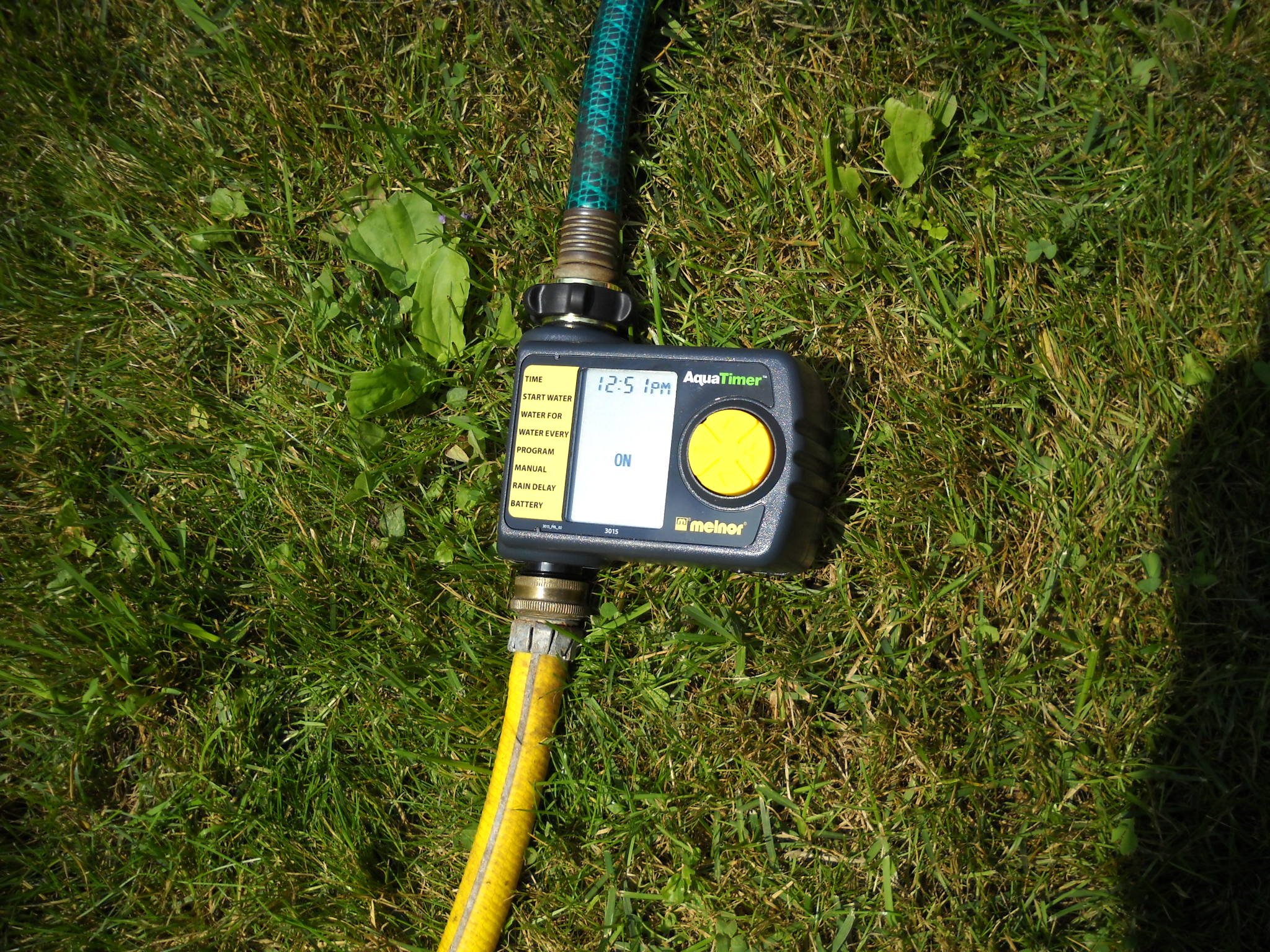 One nice thing about an emitter system is that you don’t end up watering the weeds: if you put an emitter at each tomato plant, for example, the space between plants is not watered the way it is with a soaker hose. And you can see (and replace) an emitter that gets clogged and does not deliver water. I can’t figure out why most garden centers on the East coast don’t sell these systems –every hardware store in California does.
Lawns in August can look pretty brown if a watering ban is put in place – especially if you only use chemicals on your lawn. Lawns that are given compost every year and have biologically active soil seem to do much better at staying green in dry times. It also helps to keep the grass longer in August – taller grass helps to shade the soil, like those palm trees mentioned above.
We’re all largely dependent on the heavens to provide our lawns and gardens with rain. But if we treat our soil well and provide plenty of organic matter, everything does better in times of stress – including the gardener.
Henry Homeyer is a garden designer and the author of 4 gardening books. His Web site is www.Gardening-guy.com.
Mid-Summer in the Vegetable Garden
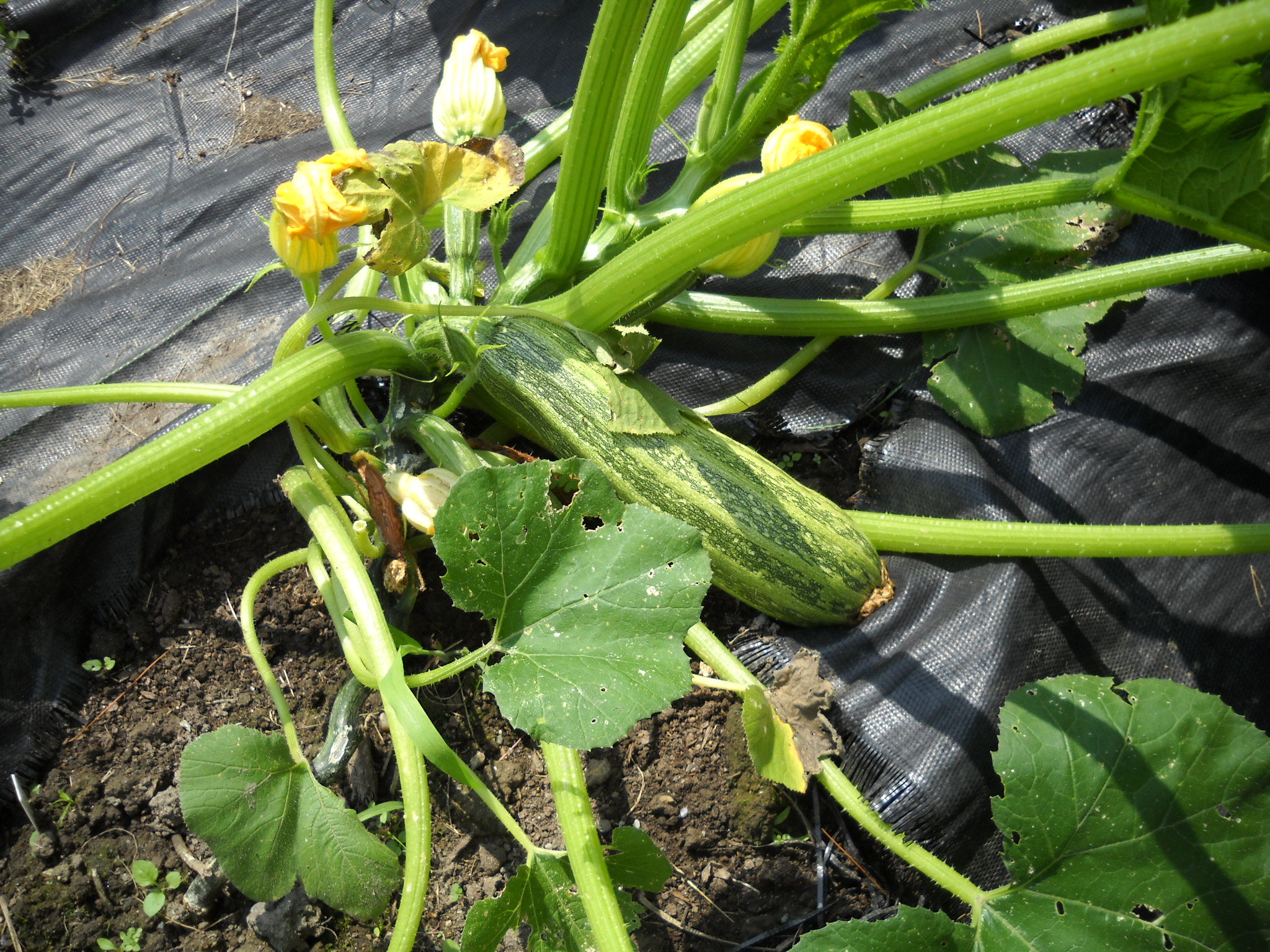
Romanesco Zucchini
Summer squash of all sorts are ripening up nicely, so I know it’s mid-summer in the vegetable garden. Soon gardeners will be dropping off bags of squash in unlocked cars, on porches, and, occasionally, on seats of buses and in public libraries. When you’re not distributing the booty in creative ways, here are some suggestions for tasks in your vegetable garden now.
If you see lower leaves of tomato plants browning up, snip them off with a sharp pair of scissors and dispose of them in your trash, not the compost. It’s a good year for tomatoes, so far. No late blight, not much early blight for most of us. On a recent tour of my 32 tomato plants, I only found a few that had any discolored leaves at all. This may be due to the fact that when I installed tomato cages in June, I cut off lower leaves that might touch the ground. Most leaf diseases are soil-borne and spread by splash-up. So removing lower leaves, even now, is a good practice. Mulching with leaves, straw, hay, pine needles or grass clippings helps prevent disease, too.
I’m eating edible-pod peas and freezing some for the winter. I blanch them briefly – about 60 seconds- and drop them into cold water before patting them dry on cotton towels, and then freezing them in zipper bags. Once the crop is finished I’ll have a nice 10-foot section of wide raised garden bed for planting late season veggies. Here are some possibilities of ways to use that bed:
1. Fall radishes. I buy seeds for one called ‘Red Meat’ in the Johnny’s Seeds catalog that I love. It only works if you plant it in mid-to late-summer. It is very mild, and pretty on a plate. Pink centers are surrounded with a band of white, then green – just like a watermelon. It is tasty even if grown 3 to 4 inches in diameter. I serve it with a vinaigrette sauce. At the Cornish General Store I found seeds by Agway for a fall radish called Chinese White Winter; the packet says to plant after August 15. It grows to 5 inches long or more, stores well, and is mild. I shall try it.
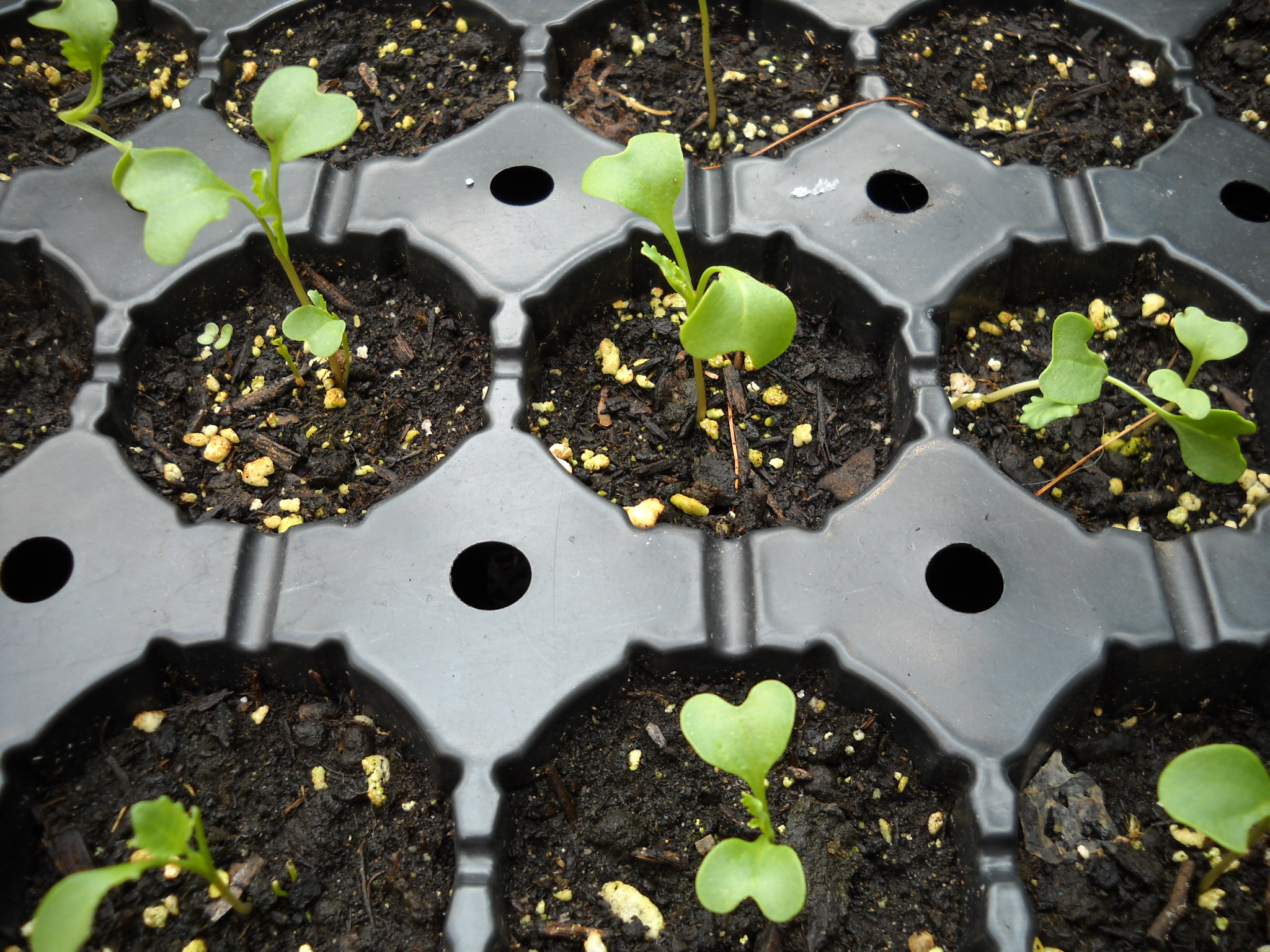
Broccoli Starts
2. Late season broccoli. Start some by seed now in cell packs, transplant into the garden when they are 2-3 inches tall. You’ll have full sized heads in 55-65 days. Or buy seedlings now if you can find them. Broccoli produces well into the fall as it is very frost hardy.
3. Bush Beans. I have 2 plantings already, but I could do a third planting for the freezer. ‘Provider’, a reliable variety, takes just 50 days from planting to harvest, and will produce for 3 weeks or more. If you plant today, you should be able to harvest plenty before frost.
4. Lettuce. Fall lettuce is crisp and tasty. Plant directly in the soil, or if you have no space now, plant in cell-packs, and plant when you have space.
Other tasks now? Scratch in a little rock powder or wood ashes around pepper plants. Peppers produce late in the summer, and can be stimulated to be more fruitful, sooner, with a dose of rock powder now – a quarter cup per plant. For more information on rock powders, see my latest book (Organic Gardening (not just) in the Northeast: A Hands-On, Month-by-Month Guide), which should be available at your local library or bookstore. Azomite is the name of one commercially available rock powder.
Your asparagus patch should not be ignored, just because the season is over. Make sure grasses and weeds don’t take over the bed, and water weekly in dry times. I mulched mine with ground branches I got from a local arborist. The chips keep down weeds and hold in moisture.
Make pesto. Basil is more productive if you keep picking leaves or even cutting off the top third of the plant. There is only so much basil you can put in a salad or on a sandwich, so make some pesto and freeze it for the winter when we all crave green things from the garden. The basic recipe contains basil, garlic (lots), parmesan cheese, olive oil and pine nuts. In recent years, pine nut prices have peaked over $20/pound, so I have been using walnuts or hazel nuts, both of which taste just fine.
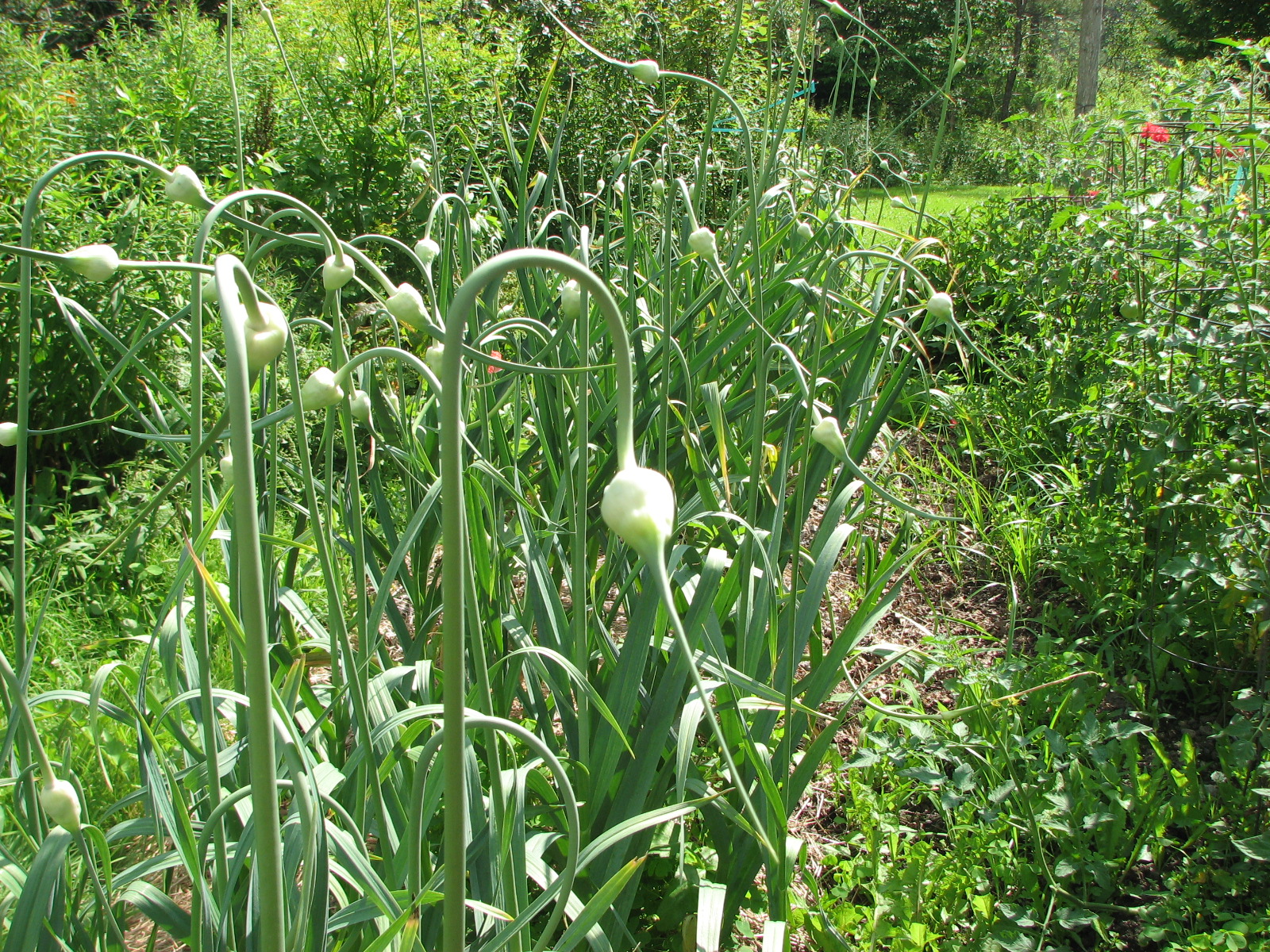
Garlic Scapes
My garlic is getting mature earlier than usual this year. When the tops, called scapes, curl around in loops it is time to harvest those scapes and use in stir fries. Chop and sauté in olive oil to add to other vegetable dishes. The heads, or bulbs, will continue getting bigger for a few more weeks- but I have already nabbed a couple to use now. When you do harvest your garlic, it is best to let it cure for a couple of weeks in a shady, breezy location before you cut off the tops.
It’s easy to get lackadaisical in the heat of the summer, but weeding is still important if you want your best production. It is also important to keep weed seeds out of the soil to minimize your work next year. So keep weeding, but at the end of the day settle into an Adirondack chair near the garden and admire your handiwork as the sun goes down.
Henry Homeyer is a garden consultant, teacher, coach and the author of 4 gardening books. His web site is www.Gardening-Guy.com.
Mid-summer in the Flower Garden
I love George Gershwin’s Porgy and Bess, particularly that song about summertime, when the living is allegedly easy. Fish are jumpin’ and the cotton is high, and all that. Well, it’s mid-summer and the gardening is just as busy as ever, the weeds are high and who has time for fishing? But I’m not complaining. I love the garden and the weeds give me an excuse to avoid cleaning the basement. Here are some of the mid-summer tasks I’ve been working on.
Watering: Pots and planters need daily attention. I poke a finger in pots to verify that the soil mix is still lightly moist. I bought a hanging basket full of supertunias at a fundraiser, and it needs watering every day. The basket is filled with a peat-based potting mix, which loses moisture fast. So the leaves shrivel and it looks awful by the end of the day unless I water daily. I give it some liquid fish fertilizer a couple of times a week, as the potting mix is devoid of much in the way of minerals.
New plantings in the ground that are still establishing themselves also need water every day or two, depending on the weather. But mature flowers rarely need watering if they are planted in the right place. I only water if they go limp.
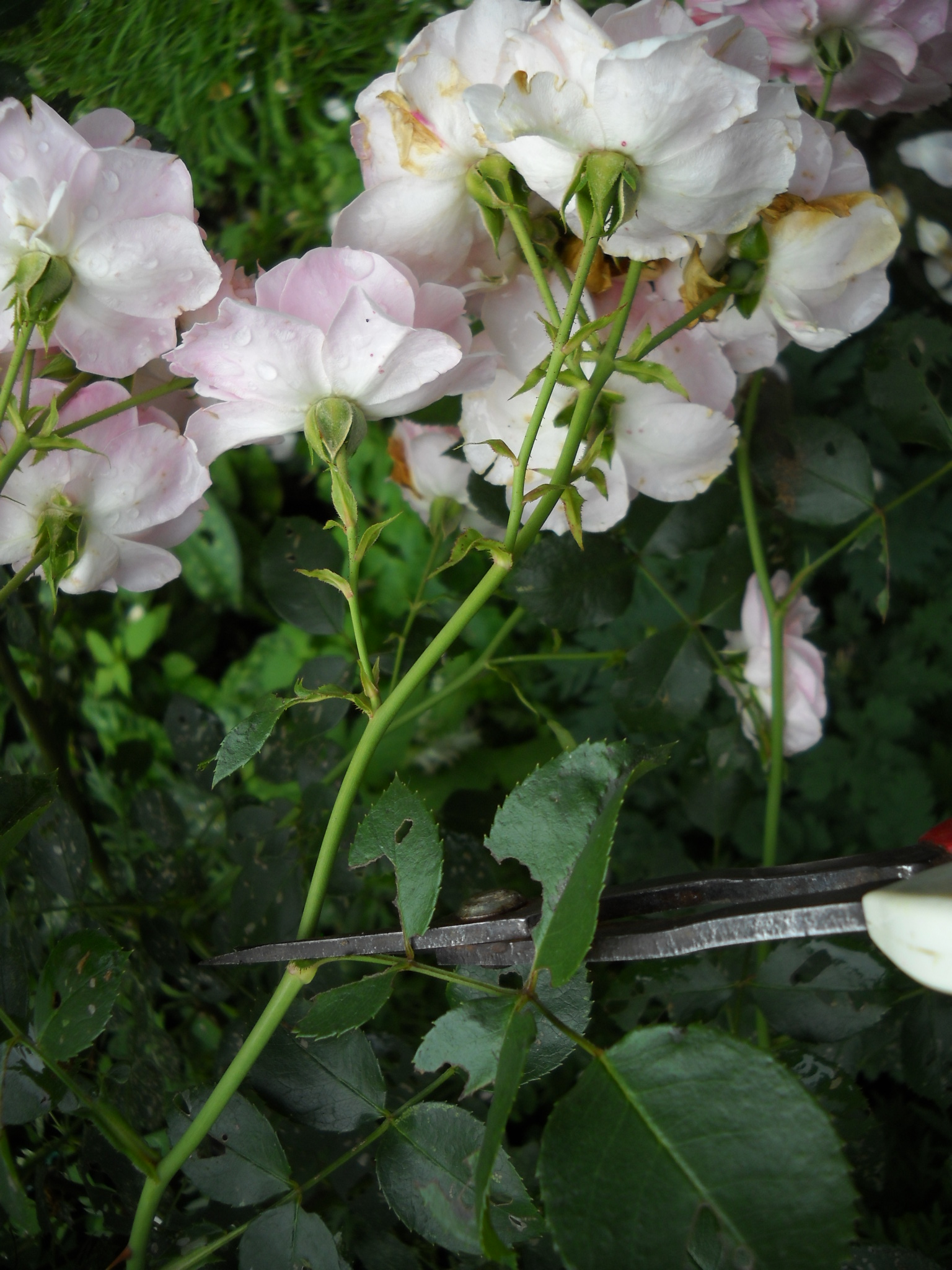
Deadheading roses
Cutting back, pruning. Now is the time to cut off spent flowers. This has been a splendid year for roses, perhaps to compensate for the poor lilac show. Some roses re-bloom, some do not, but cleaning off the dead flowers will improve the looks of the plant. Cut back not just the dead blossom, but all the way back to the next stem that has 5 leaves.
Other plants such as peonies will look better if you cut off the spent flowers, and some (such as and perennial bachelor buttons) will re-bloom. Cut off the flowers and stems of delphinium right to the ground after blooming is done, scratch in some fertilizer, and you should get another stem with blossoms in the fall.
Spring and early-summer blooming shrubs need to have their blossoms cut off now. I recently have worked on forsythia, common ninebark, lilac and spirea. If you cut these back in the fall, you will lose blossoms. Forsythia and ninebark can really grow fast, up to 3 to 4 feet in a season if you let them go at their natural pace, so cut them back before they are totally unmanageable.
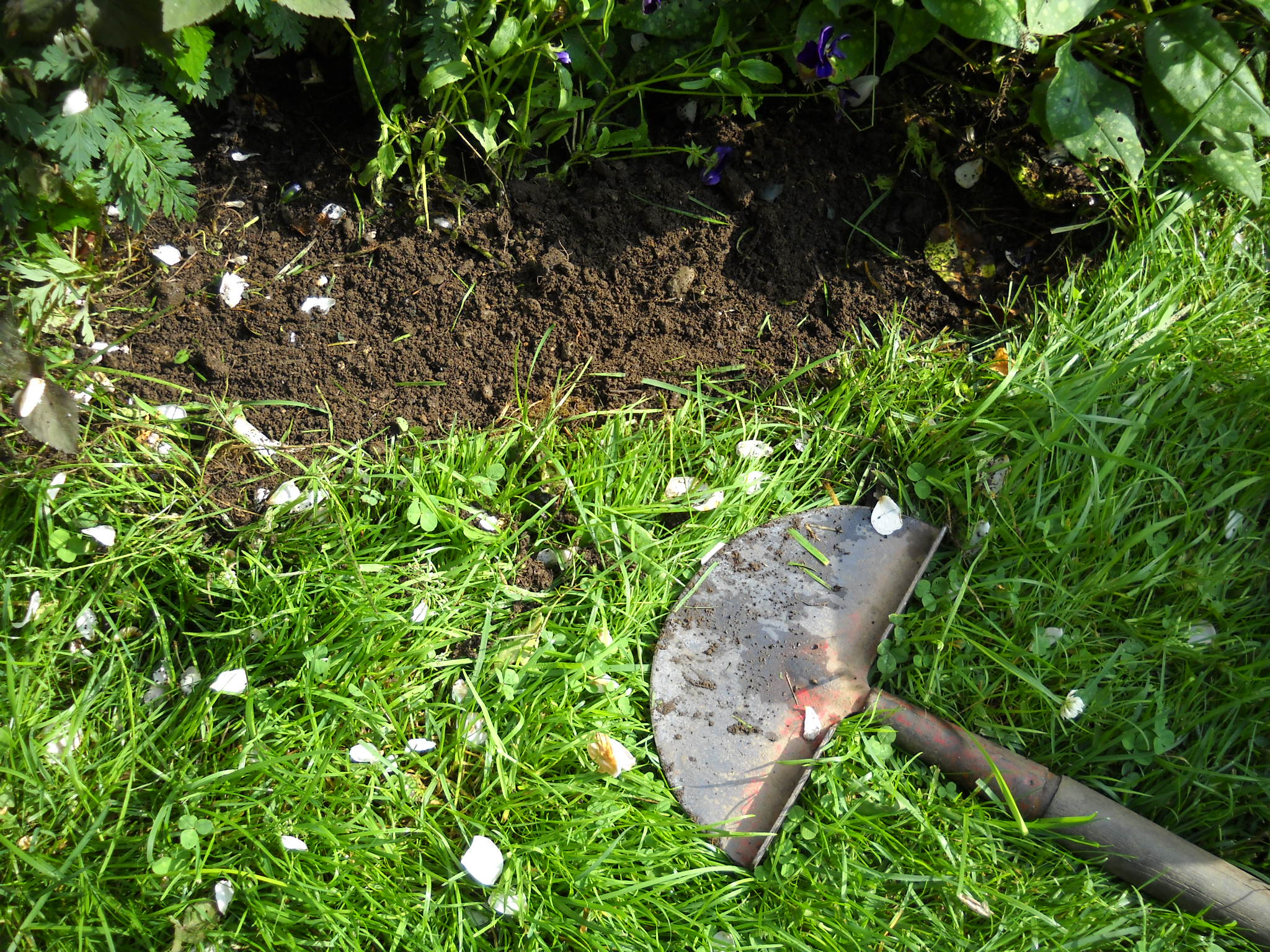
After edging
Weeding. Weeds, those sneaky rascals, get discouraged if you keep pulling them out. But left alone now, midsummer? They grow like crazy. Grasses are trying to sneak in to the garden, too. Keep the grasses at bay by digging a trench at the edge of the lawn. Use a shovel or an edging tool to dig a 4-inch deep, V-shaped trench between the lawn and garden beds. Grasses grow to the edge of the trench and don’t know if it is the Grand Canyon or something smaller, so they stay back.
If you see weeds blooming, stop whatever you are doing and pull the weeds. Or, as the Red Queen would say, “Off with their heads!’Snip off the weed flowers before they can set seeds and sprinkle them into your soil. Then deal with the weed when you have time. Don’t throw weeds with flowers into the compost. Some (most?) can morph from flower to seed even after being pulled, and those weed seeds in the compost can come back to trouble you later.
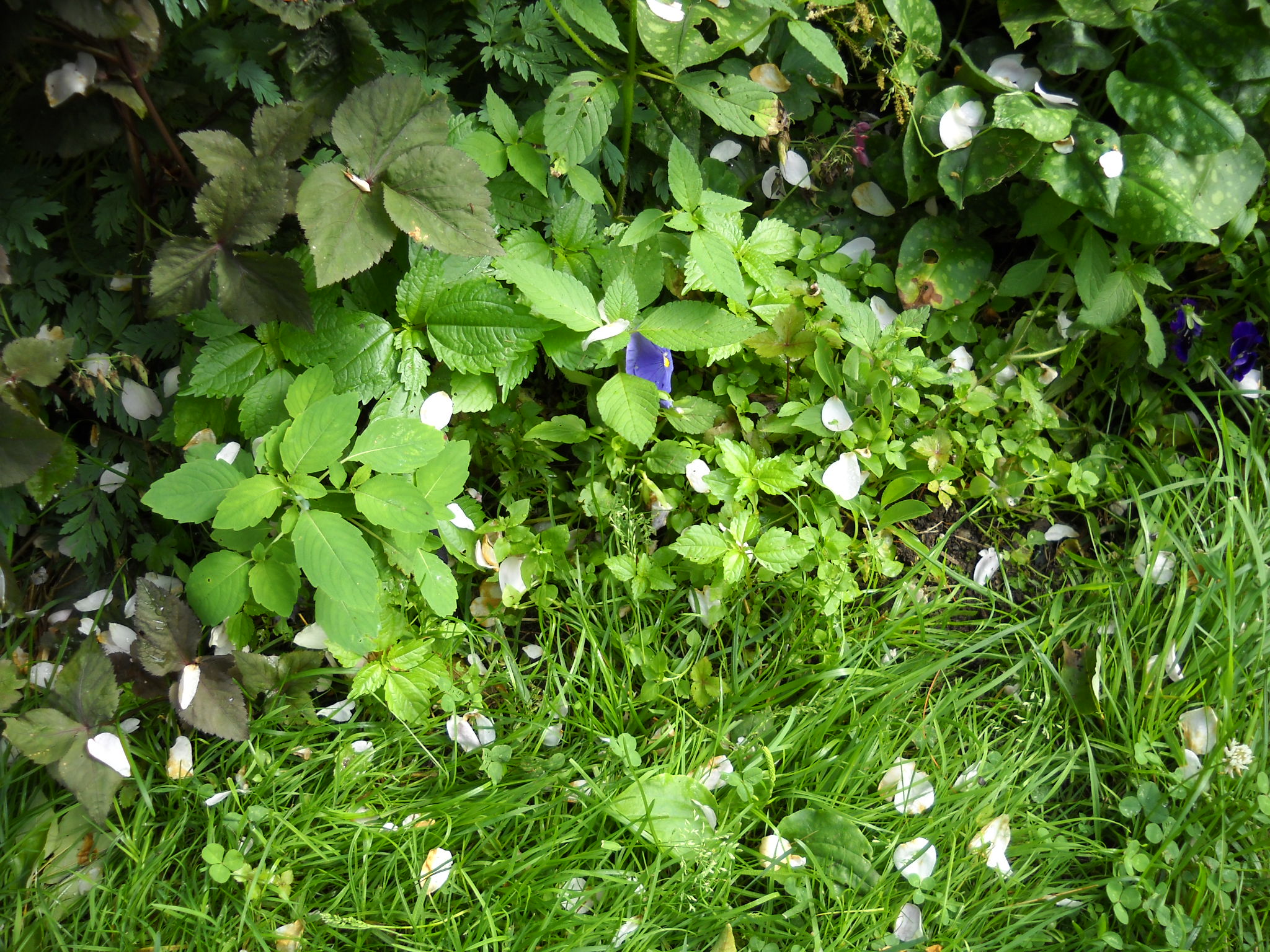
Weeding before edging
Use a good weeding tool when you weed, so that you can get all (or most of) the roots of weeds and grasses. You probably know that my favorite is the CobraHead weeder (www.CobraHead.com). I like the fact that it is so easy to get its single tine under a weed, loosening the soil so that when I tug the weed, it comes out, roots and all.
Mulching. Mulching really reduces weed problems if you weed carefully, and then apply mulch. What to use for mulch? That depends on your budget and your aesthetic sense. Most gardeners use bark mulch of some sort, though many use “color enhanced” wood-based mulch. Not me. I am skeptical of what companies use to enhance the color of their mulch, so I only buy natural, organic mulch.
I also like to use chopped leaves as mulch. Leaves are fantastic sources of organic matter and nutrients that microorganisms can break down and share with our plants. Pine needles, too, are excellent mulch. I know that many gardeners think that pine needles are too acidic to use, but I have never had a problem with them.
Last but not least, this is the time to plant some new daylilies. These are workhorses in the garden. Bugs don’t eat them and they don’t get mildew or blight. They come in different colors, blossom shape, and bloom time. Go to a family-owned garden center or nursery to see what’s in bloom. You just might be amazed.
Henry Homeyer can be reached at P. O. Box 364, Cornish Flat, NH 037476 or by e-mail him at henry.homeyer@comcast.net. His Web site is www.Gardening-Guy.com; you can find his past articles there (including the one you missed because someone wrapped up the fish remains in it).
Saving Money in the Flower Garden
My house sits on a couple of acres, most of which is growing something. There is a big vegetable garden, some trees, berry bushes and decorative shrubs, a little lawn and lots of flowers. I could spend a fortune, I suppose, if I bought flowers for every square foot of flowerbed that I have. Over the years, however, I have learned how to transplant small plants that started on their own from seed – “volunteers” – and how to divide existing perennials.
Let’s start with the volunteer plants. The first thing one must do is learn to recognize the young seedlings – and not pull them as weeds. I do this mainly by the color and texture of the leaves, but shape is important, too. And of course, you can’t use bark mulch in the flower beds if you want volunteers. I grow perennials close together so that they shade out weeds, and try to pull any weeds that do grow before the go to seed.
Twenty years ago a neighbor pulled up in front of my house and handed me a cardboard box with 8 candelabra primroses (Primula japonica). I accepted them with pleasure, and went directly to a good reference book to find out what they needed: rich soil, light shade, consistent moisture. I had those conditions under a small grove of wild apple trees, and planted them there.
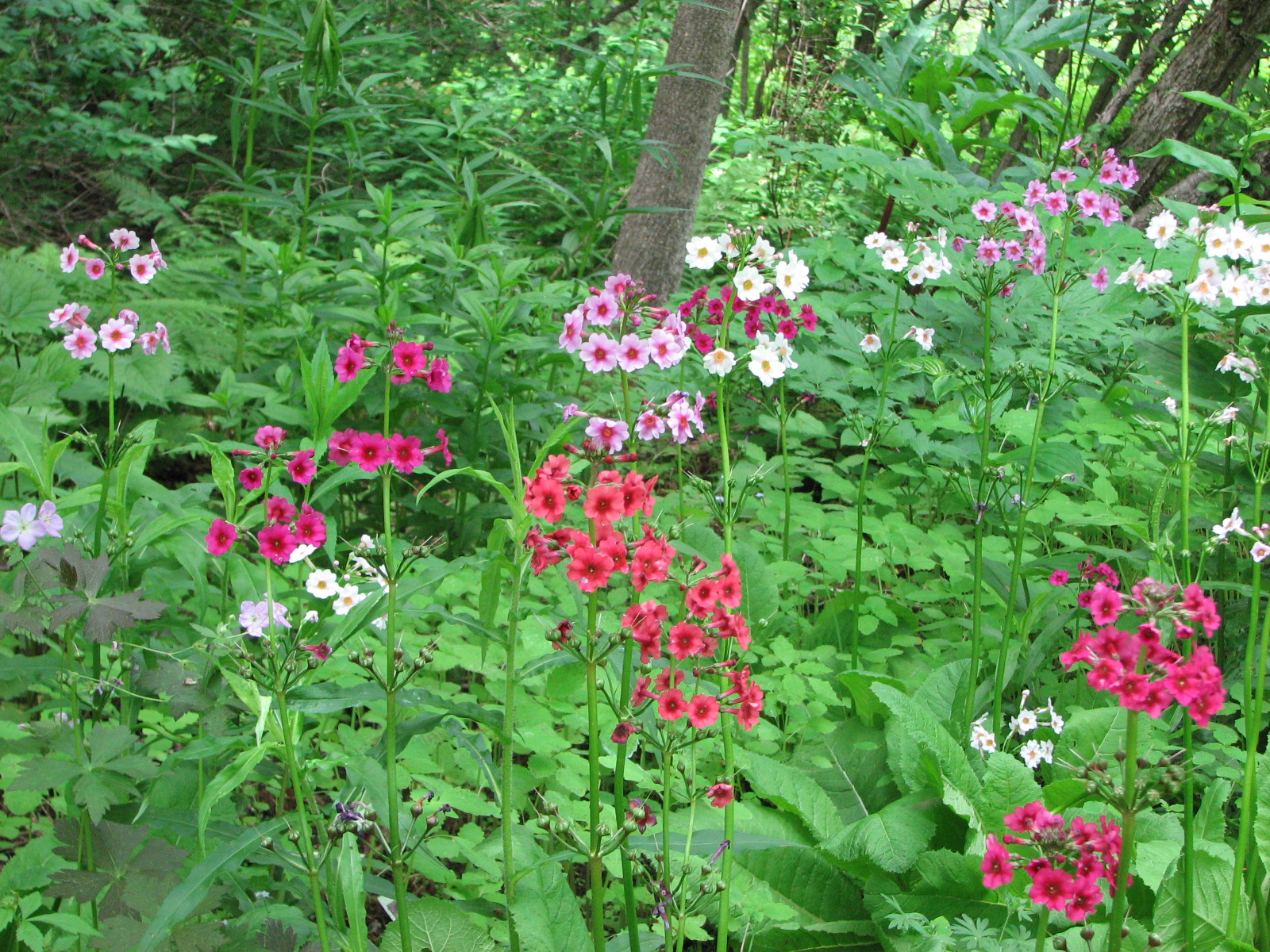
Primula japonica
Now I have hundreds of candelabra primroses and many other kinds. Once I realized that one primrose would grow there, I tried other species, and all but one (P. vialii) have done well there – and spread. Most spread by seed, and one (P. kisona) by root, like a groundcover. I regularly dig primroses and move them or give them to friends.
Giving excess plants to friends, especially lesser known varieties, is a great way to save money. I find that if you give a person a nice clump of flowers, you are most certainly going to go home with 2 or 3 new plants for your own garden.
Dividing plants is easy, once you get the hang of it. But you have to know what kind of root each perennial has, and that generally means some experimentation. The only book I have found that describes dividing for most common perennials is The Well-Tended Perennial Garden: Planting & Pruning Techniques by Tracy DiSabato-Aust. That’s a book that should be in every gardener’s library because it tells you how to prune, deadhead, get to re-bloom, divide and more. It’s in hardback at $34.95 (Timber Press, 2006) and worth every penny.
It is best to divide most perennials in the spring when the foliage is just 3-6 inches tall. Tough characters like hostas and daylilies can be done anytime, though preferably on a cool cloudy day if doing so now. I recently divided a few hostas and took off a section from a large bugbane or snakeroot (Cimicifuga ramosa), and none showed signs of stress.
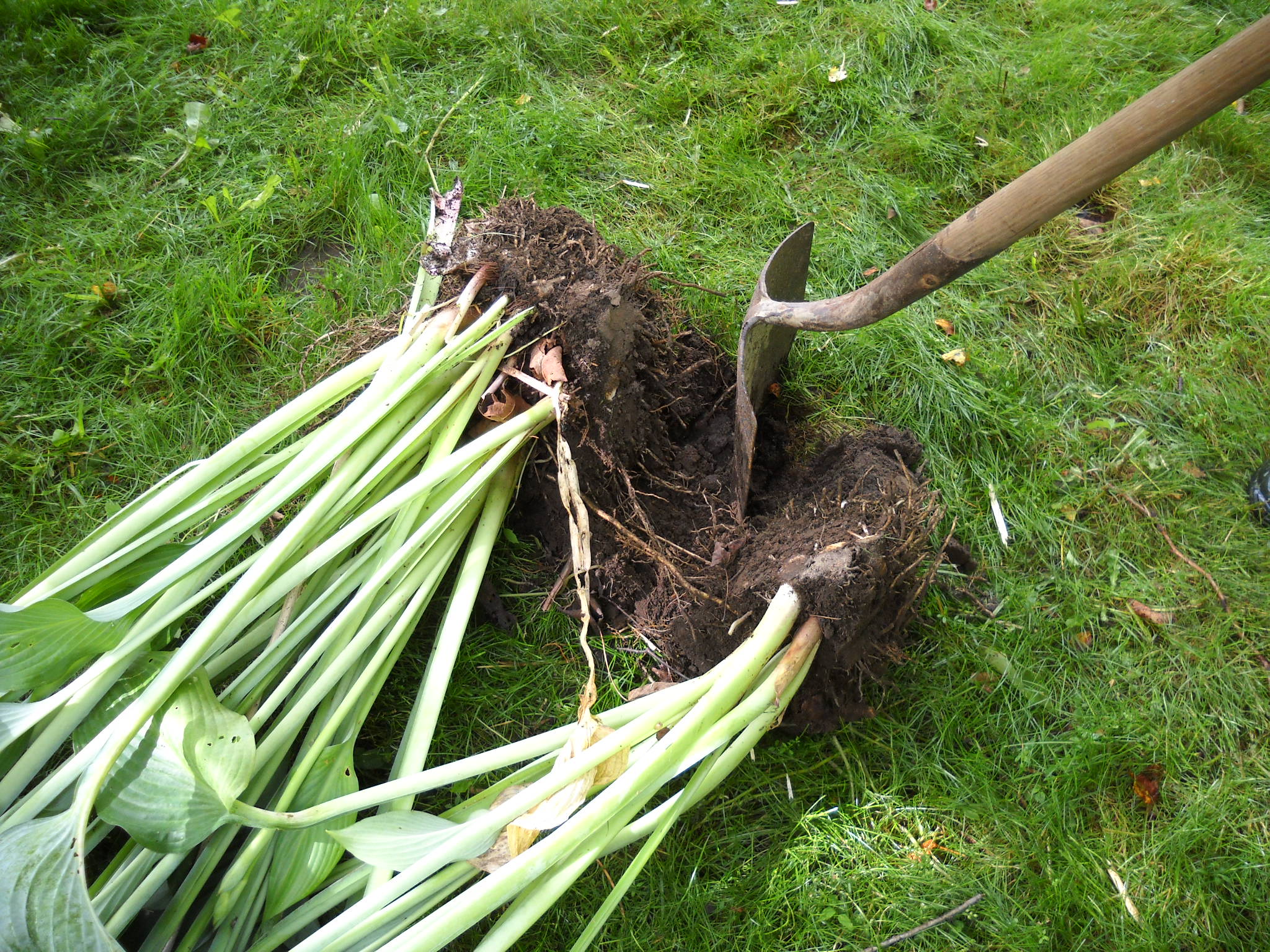
Dividing hostas
You can cut out a section of a large hosta or daylily by cutting out a wedge with a spade or even a long knife. I sometimes use a serrated root knife I got from Lee Valley Tools. Tracy DiSabato-Aust prefers a non-serrated knife, so I guess either will work just fine. Get down on your hands and knees and try to see natural division points before you cut.
Alternatively, you can dig up a plant, place it on the ground and then use 2 spading forks to separate it. Just insert them into the middle of the clump, back-to-back, and work the forks back and forth. It’s a lot of work for a big clump of daylilies. I prefer just to cut up a clump with a sharp spade. The spade lets me stand on it with all my weight to slice through the tough roots. I once divided a 4-foot wide clump of Joe Pye weed (Eupatorium maculatum) and ended up using a pick ax to whack it apart. Not a pretty sight, but I was determined to remove and divide it.
Groundcovers send out roots and can be divided anytime. Just dig up a plant, sever the root from the mother plant, and move it to a new location. Easy.
Some plants have fleshy taproots that are easily broken, and these are not good candidates for division. Peonies, Oriental poppies, bleeding heart and pink mallow fit in that category. They should be divided in the fall –though little seedlings move easily, spring or fall. Siberian iris should be divided in fall.
Some plants go downhill and become less vigorous if they are not divided on a regular basis. Have you lost a nice Shasta daisy? If so, please try again – but divide it every 3 years. That allows you to add compost and slow-release organic fertilizer to the soil, which rejuvenates the plants.
The easiest, least expensive method for getting more flowers is just to save seeds and plant them. I plant when the seeds are ripe, just scratching them in where I want more plants next year. I do this with Jack-in-the-pulpit, annual poppies, foxgloves and rose campion, and they generally reward me handsomely.
So don’t spend a fortune. Divide, trade with friends, start things by seed. In no time you’ll have all the plants you need – even if not all the plants you want.
Henry Homeyer is the author of 4 gardening books. His Web site is www.Gardening-Guy.com.