-

Now available for $24.95 including shipping. -
Now available for $21.00 including postage. Vendors I Like
 Click Here to buy from Cobrahead
Berries
By now my vegetable gardens is all planted, annual flowers are in, the weeds are pretty much under control. Time to relax and smell the roses? Well, maybe not. There are always tasks for the gardener. This is a good time to plant some berry bushes.
The first thing to do, if you want a good berry patch, is to test the soil to find out if you need to add specific nutrients. Go to your university extension Web site, or Google “soil testing”. You should be able to download a form and get instructions on how to collect a soil sample, and where to send it. All berry patches will also need some added organic matter such as compost, aged manure, or leaf mold.
Elderberries
Competition from weeds is an important issue for berries. You can’t just use a rototiller to chew up a patch of field or lawn to plant your berries. You really need to dig out the sod – or smother it this year to plant next year. A layer of 4-mil black plastic spread out over a lawn that has been cut short will kill the grass, roots and all, by the end of the summer. Landscape fabric will do the same, but is more expensive. Next spring the dead grass will add organic matter when you mix it in.
If you want to plant this year you have two choices: dig out the sod by hand, or rent a sod lifter – I reject the idea of using chemicals to nuke the grass. The sod lifter is powered by a gas engine; it sends a blade under the sod and along the edges to slice it loose. You still have to pick up the sod and lug it away. And you can’t roll it up like a rug – it’s too heavy. I slice the long strip of sod into 1- or 2-foot sections. Or, for small areas, you can just use a shovel to slice sod into one foot squares to pry out by hand, which is very labor intensive. Ugh.
All berries like sunshine. Six hours per day is the minimum for a good crop. More is always better. Berries do not like root competition, so keep your berry patch away from trees. I planted a rose recently that was more than 50 feet from a Norway maple, and found the soil full of tree roots coming from the maple. So pick a site far from trees if possible.
Raspberries are a great choice for the home gardener: they are expensive at the store and do not keep well. Better to grow your own and eat some every day in season. What are the best varieties? I asked Alicia Jenks, the owner of Green Dragon Farm, a pick-your-own blueberry and raspberry farm in Weathersfield, Vermont. She suggested getting ‘Prelude’ or ‘Killarney’ for an early crop. Then ‘Encore’ or ‘Latham’ for mid-season berries and ‘Heritage’ for late-season berries.
Alicia Jenks suggested planting raspberries 3 feet apart in a staggered double row in a 5 or 6-foot wide bed. Add plenty of compost to the soil and work it in well – a 4-inch layer is a good. She adds Pro-Gro, an organic, slow-release fertilizer to the soil at planting time in each hole. Although you can buy bare root plants early in the spring, most sellers of them are sold out by now. Potted bushes are still readily available at garden centers.
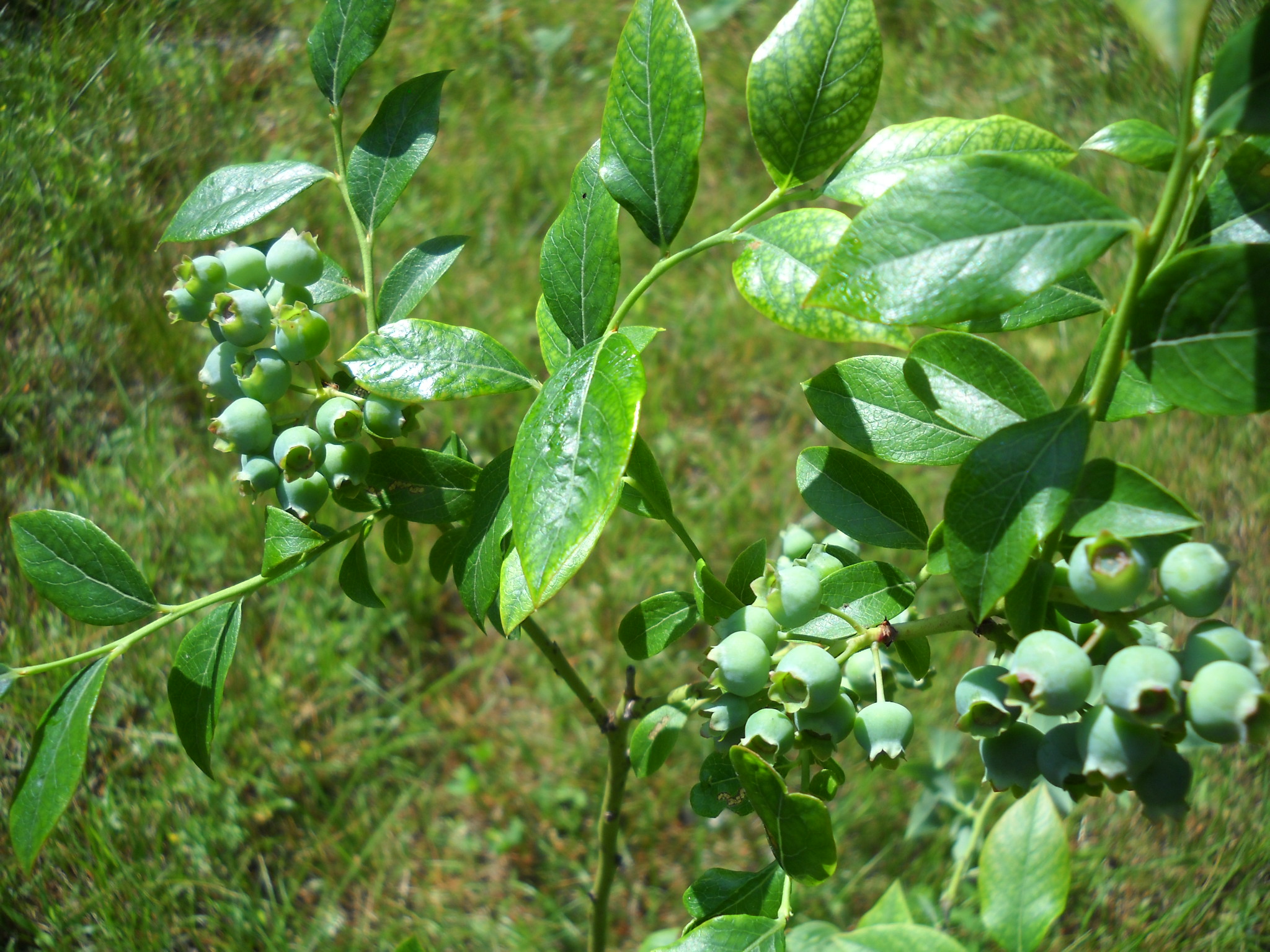
Blueberries are another good choice for every home gardener. The soil requirements for blueberries are very different than for raspberries, however. Paul Franklin of Riverview Farm, a pick-your-own apple, pumpkin
Blueberries
and berry farm in Plainfield, NH, told me that there are just three important things to get right in order to have a good crop: proper pH, proper pH and proper pH. He went on to explain that the soil must be very acidic in order to get a good crop – in the range of 4.0 to 5.5. So get your soil tested and add a soil acidifier such as elemental sulfur to get the soil pH right. Pro-Holly or Holly-Tone (organic acidic fertilizers) are good for blueberries, too, and can be added around existing bushes now.
Blueberries should be spaced about 5 feet apart in rows that are far enough apart to allow mowing. Most commercial growers mulch with woodchips to keep down weeds. The roots grow close to the surface, so you can’t dig out weeds willy-nilly – you may damage roots. So get grasses and weeds out in a 5-foot circle before you plant, and mulch well to keep them out. Weeds will steal the water and nutrients your blueberries need.
Elderberries
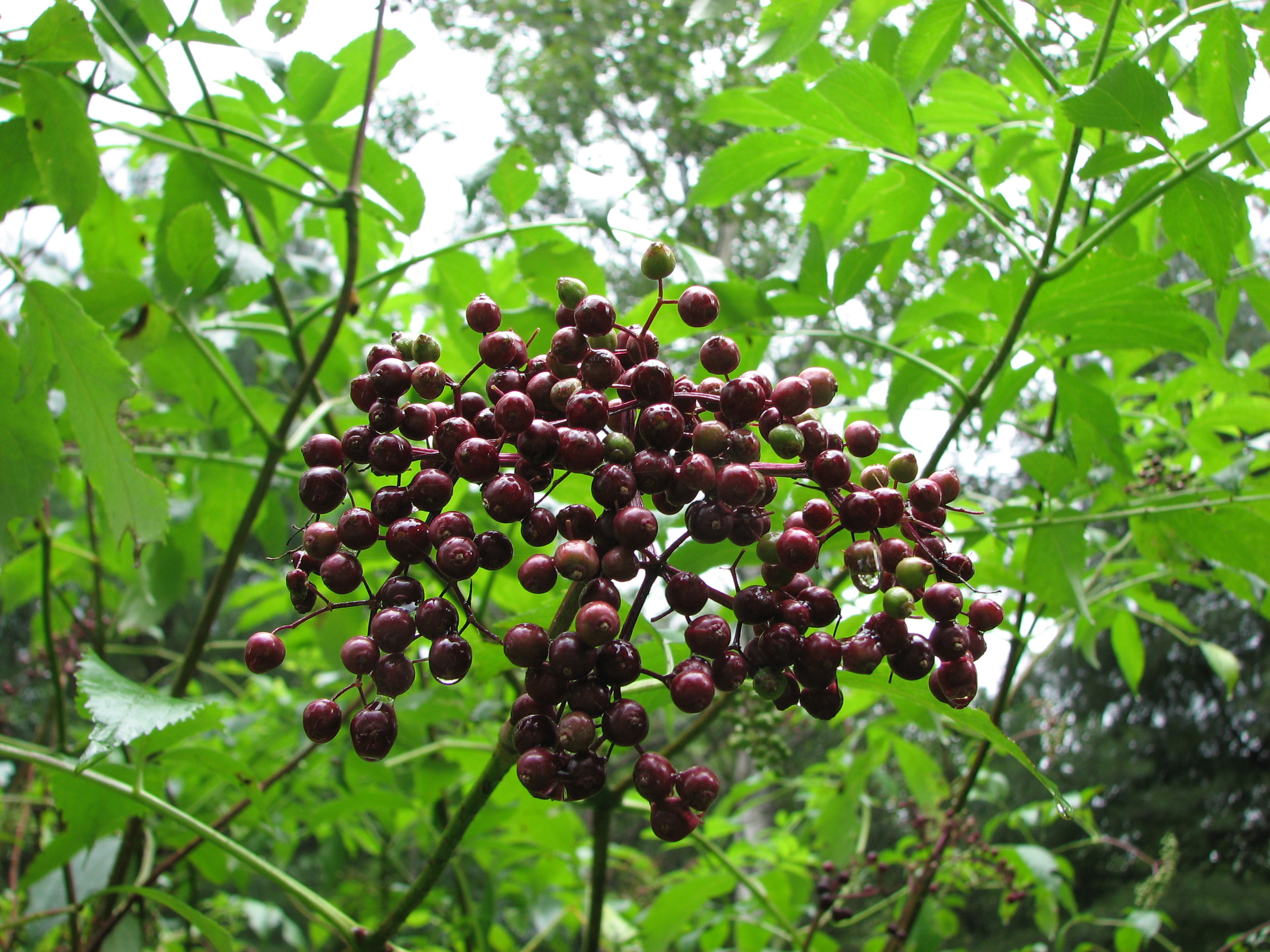
Elderberries are an easy crop if you have a moist location on your property. I grow 3 varieties on the bank of a little stream, and they do well. Pollination is better if you have 2 or more different varieties. The white, fragrant flowers form big clusters at the top of the bushes and are decorative right now. In the late summer I harvest elderberries by sniping off clusters of berries; later, in the house, I pull the berries off their stems and freeze them. I like to sprinkle them on hot oatmeal in winter and I also make an elderberry syrup to ward off colds.
So go plant some berries, or more berries, or different kinds of berries. You’ll be glad you did.
Henry Homeyer is a gardening consultant and Master Gardener living in Cornish Flat, NH. Contact him at henry.homeyer@comcast.net. His Web site is www.Gardening-Guy.com.
Gardening in the Rain
I’ve always preferred sunny days, both as a boy and now, as a quasi-geezer. I remember reciting this ditty as a small boy, “Rain, rain, go away, come back some other day!” And it did, eventually – but usually not as quickly as I wanted. Now as a gardener I appreciate the rain for what it does for my plants, but I still think to myself, after a few hours of rain, “Rain, rain, go away …”
Rain Gauge
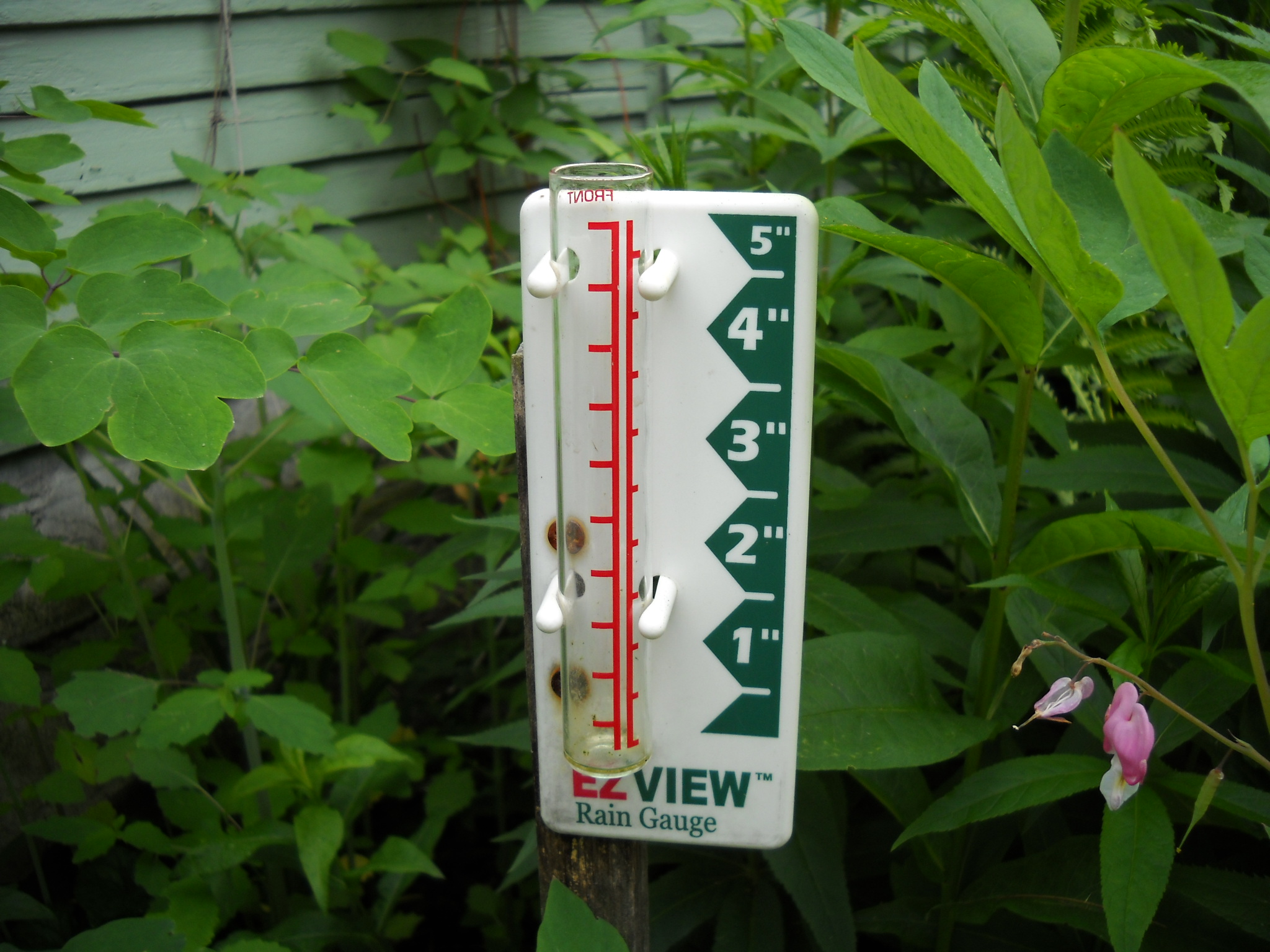
If you don’t have a rain gauge, you should. It doesn’t have to be one of those fancy electronic ones that sends signals to you from outdoors. A simple $5 device that consists of a cylinder with marks on the side to show each quarter inch of rain is just fine. And, if you really want to be frugal, an empty cat food or tuna can will work. Most of our plants need an inch of rain – or water from your hose – each week.
Plants are generally the most susceptible to death by dehydration right after planting. Their roots have been disturbed and frequently delicate root tips have been broken off. A hot, dry day can wreak havoc on a newly planted seedling. If your plants are growing in potting mix, it is best to submerse the plants in a bucket of water before nestling them into their growing holes. Hold the plants under the water until they stop bubbling. It can be hard to saturate a large root ball by top watering.
Rainy days are much better than sunny days for transplanting. You can minimize shock by preparing the new hole before you dig up the plant so that it can go right to its new home. My grandfather liked to say that you should move enough soil with a transplant that “it will remember where it came from.” Modern soil scientists would probably agree, saying that the soil microbes you move with a plant are important to its future health. After moving a plant, create a ring of soil around your transplant to hold water. Then, using a watering can, gently fill the ring and let water seep in. Repeat several times.
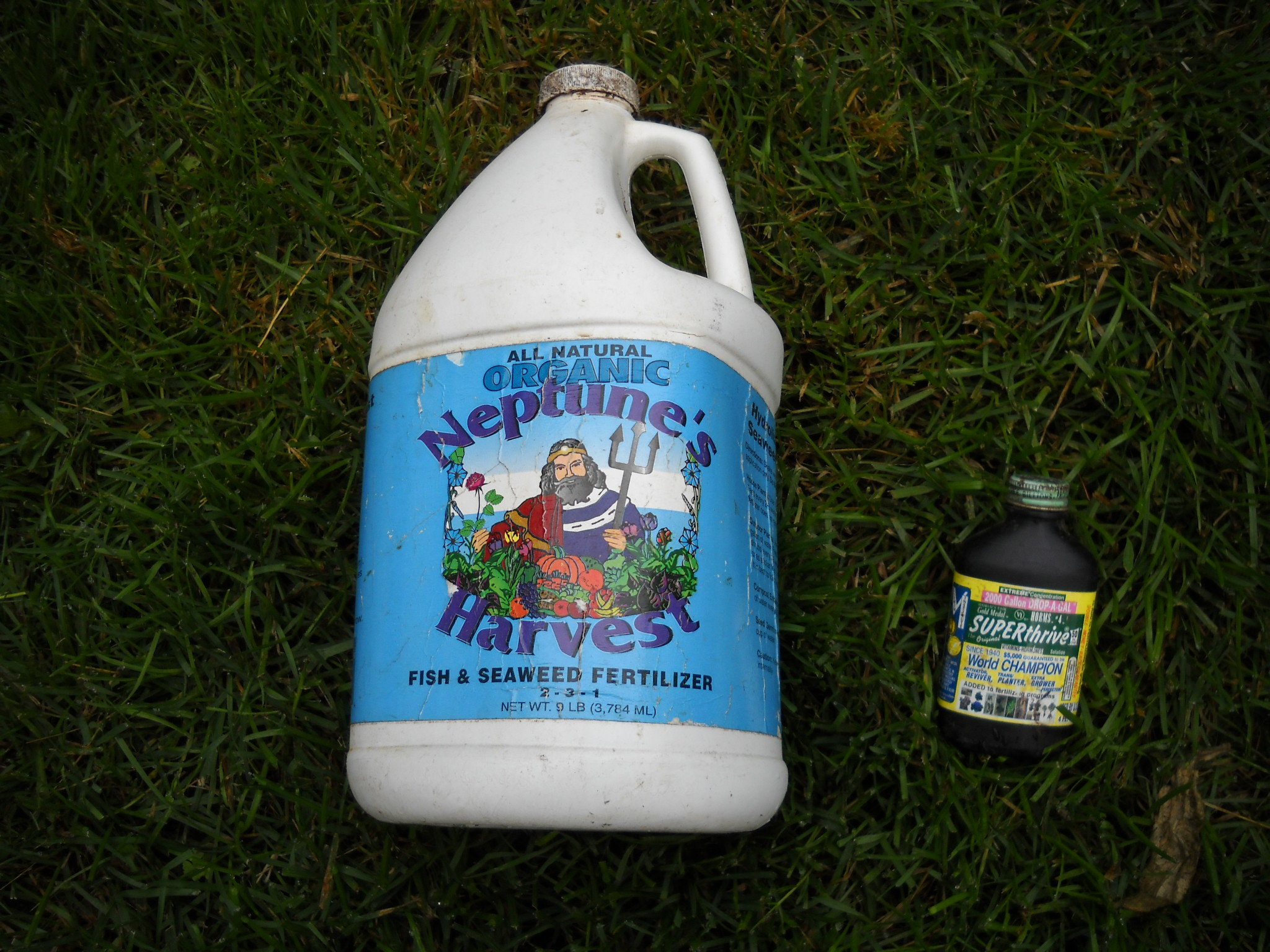
Soil Additive - Fish Fertilizer & SUPERthrive
I add two solutions to my watering can that help to minimize transplant shock. The first is called SUPERthrive. It comes in a little 4oz container but it only takes a quarter of a teaspoon of the solution for a gallon of water to treat plants against transplant shock. It contains vitamins and minerals; in my experience it reduces transplant shock and helps stressed plants (like those 6-packs of annuals I forgot to water on a hot day).
The other solution I use is a liquid fish and seaweed fertilizer. Neptune’s Harvest makes a very nice product, though there are plenty of others. The fish “juice” gives new plants nitrogen, phosphorous, potassium and trace minerals at a time when they need a quick burst of soluble fertilizer.
But back to those rainy days: if you don’t mind working a warm rain, go outside and weed. Weeds pull much more easily when the soil is wet. But avoid a lot of digging in wet soil. I like my CobraHead weeder (www.CobraHead.com), in part, because it is a low-impact tool. I can use its single tine to stir up the soil enough to plant a small lettuce plant or make a furrow for carrot seeds without making a big mess of the soil on a rainy day.
I never walk on beds when they are wet. Wet soil compacts easily, especially soils with a high clay content. Clay that is compacted and then allowed to dry out can be as hard as concrete. And don’t even think of rototilling wet soil. You can ruin the soil texture by doing so.
Most of us have plants in pots on the front stoop or on the deck. Be attentive to them when it rains. If they have drainage holes (as they should), they will collect water in their saucers below. Roots can rot if left sitting in water for days on end. So remove the plants from their saucers in a deluge, or shortly thereafter. If you notice that the runoff is brown, you are probably losing good nutrients. Pour that water in a bucket to use on a dry day to water your plants.
Want an indoor planting project on a rainy day? Get out your potting soil and a few leftover 6-packs from spring planting. Plant some lettuce seeds in those 6-packs for use in the garden once they get to be an inch or two tall. I find that starting lettuce in 6-packs and growing them on the deck is better than direct seeding in the garden – no weeds, and they are easier to monitor for water. I try to remember to plant lettuce every 2 weeks for a good supply all summer. And you can start fall broccoli by seed in mid-July- so mark your calendar today, and do so on a rainy day.
There are times in early summer when I get bone tired from doing so much gardening, day after day. I can’t seem to get it through my thick skull that I’m not a kid anymore. So a rainy day is a good thing. It usually forces me slow down a little. And my plants love them – in moderation.
Henry Homeyer is a life-long organic gardener, a UNH Extension Master Gardener, and a gardening coach. Contact him at henry.homeyer@comcast.net or P.O. Box 364, Cornish Flat, NH 03746.
Lilacs
Chris Wilson loves lilacs. He grows about 200 of them including more than 100 varieties at his home in West Newbury, Vermont. Like many gardeners, he was a little disappointed with the showing of his lilacs this year. There were fewer blossoms, and many were smaller than normal. I recently met with Chris, who works at E.C. Brown’s Nursery in Thetford Center, Vermont to discuss lilacs – and this year’s less than stellar performance.
First, Chris noted that many lilacs tend to follow two-year cycles of abundant bloom. Like apple trees that produce a heavy fruit load, producing a heavy crop of blossoms and seeds draws down on the energy of a lilac; the next year the lilacs tend to be less productive. I understand that phenomenon, but can’t imagine that all lilacs everywhere would be on the same cycle. But it does make me want to cut off the spent flower panicles on my favorite lilacs before they expend all the energy of making seeds.
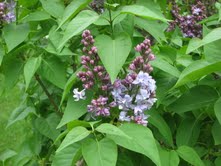
Lilac
The next possibility that Chris and I discussed was the extreme variations of temperature this spring. The early heat caused buds to swell and prepare for opening. That was followed by several hard frosts. Some of the buds may well have been damaged or made more susceptible to fungal diseases that have also attacked some lilacs this spring. He showed me some blackened stems and buds that were blighted and unproductive.
I have noticed that later-blooming lilacs are doing better than the earlier blooming lilacs did. That would make sense. Later blooming lilacs probably would not have buds that were ready to open during a week of high temperatures. Miss Kim, for example, is a very popular later-blooming lilac that is blooming quite well for me.
But my personal theory, unsubstantiated by any independent tests, is this: Last August was cool and rainy. I have read that lilacs set their spring buds in late summer, which I define as August- though the literature does not specify. I think that since lilacs got less sun than usual, they didn’t set as many buds. Then the hot/cold/hot weather this spring reduced even those numbers. And who knows what the lack of snow meant to lilacs. Gardening is full of unanswerable questions.
Conventional wisdom has it that lilacs need a top-dressing of ashes from the woodstove (or a dose of limestone from your local feed-n-grain store) each March. I disagree. Yes, lilacs do best in neutral or slightly sweet (alkaline) soil. For most of us, that means counteracting our acid rain by applying lime or wood ash once a year. But March? I think the timing has more to do with when farmers of past years were not too busy and had the time to spread some ashes. I believe that any time of year is just fine. It takes time for limestone to be incorporated into the soil. The key is to do it annually. I spread two quarts of wood ashes around a big lilac – whenever I get a chance. Do it now, before you forget. It really will make a difference next year.
Lilacs need annual pruning in order to look good. Most lilacs sucker, or send up new shoots from the roots. If you do not cut some of these back to the ground, the clump will get wider and wider. One way to keep your lilac vigorous is to remove a couple of the older stems each year, allowing the smaller and middle-sized stems to get larger. And unless you want to get on a ladder to cut blooms, you need to control height. Cut back tall stems to a fork, reducing height. The time to do it? Now, after the blossoms have finished.
It is often difficult to prune back stems to the ground as lilac stems grow very close to each other. But if you only cut back a stem to 2 or 3 feet above ground, you are left with stubs that are unsightly and that will sprout new shoots – often several new ones – that will clog up the center of the shrub more than the stem you cut off. My weapon of choice is a folding saw with a pointy end. I get on my knees and work the point into the clump as near the base as possible, and saw through a big stem. It takes time and energy, but is worth it.
After all the standard lilacs have finished blooming comes the show put on by Japanese tree lilacs. These are medium-sized trees, not shrubs. They have white flowers that are quite fragrant. But they may be invasive: the personnel at the Saint Gaudens National Historic Site in Cornish, NH, have found lots of young tree lilacs in the woods, and at the edge of the woods near their site. They have started pulling them as they decided that these visitors from the Far East have the potential to take over the understory. They are not, however, listed on any invasive species lists of prohibited plants.
The standard lilac is a wondrous plant. When I cross-country ski I sometimes see them by cellar holes of homes abandoned a century or more ago. Their flowers are beautiful and fragrant. What more could I we ask for?
Henry Homeyer is the author of 4 gardening books. His Web site is www.Gardening-guy.com.
Potatoes
Why is it that some people use nicknames for their children that are the names of vegetables or flowers? I’m sure you are familiar with “sweet pea” as a loving epithet (even for kids who are not sweet), or “pumpkin” for children who are neither round nor orange. The French, I am told, call their lovers “petit chou” which translates as “little cabbage”. But I have never heard anyone refer to a loved one as a potato. I wonder why, since potatoes are some of the easiest of vegetables to grow. I suggest you plant some now if you haven’t already.
I always wait until June to plant my potatoes, even though I could have done so in early May. I have found that later planting decreases problems with the Colorado potato beetle. That is an observation that I have previously reported here, and other gardeners have told me that when they planted later they, too, had fewer problems. I like to joke that by planting later all the beetles have gone next door.
If you have those nasty potato beetles, what should you do? The first line of defense is hand-picking. Look for the yellowish larvae or striped adults on leaves, and pop them in soapy water. Look for orange eggs on the underside of leaves, too. Check daily as soon as you have leaves on your plants. Don’t let a second generation get started, and you will have fewer problems.
You might also try an organic spray to control beetles. It is called Bt, which stands for Bacterium thuringiensis, a naturally–occurring soil bacterium that is available at garden centers as a powder. Dilute it with water and spray on leaves. When larvae eat leaves with the bacterium, a protein in the bacterium makes them sicken and die. It is not a contact poison, and will not harm us or our critters – nor will it kill adult beetles.
Potatoes are grown from sprouted pieces of last year’s crop. I generally save potatoes from one year to the next for planting. I went 25 years without buying potatoes until we got late blight in 2010. Blight can overwinter in potatoes, so it is not advisable to keep potatoes for planting if you’ve had late blight. If you want to plant potatoes, don’t buy them at the grocery store. Most conventional potatoes are treated to prevent them from sprouting. Buy ”seed potatoes” sold for planting – they are guaranteed disease-free.
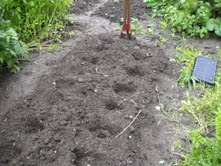
Planting Potatoes
I have tried three different planting techniques, and all work just fine. Let’s start with the easiest. Loosen the garden soil with a spading fork and stir in some bagged organic fertilizer and compost to the soil. Place on the soil surface some seed potatoes (or pieces of seed potatoes) with at least two “eyes” (buds). Then cover them with six inches of hay. Add more compost or soil on top of the hay so that no light gets to the chunks of potato. As the plants grow, add more hay and/or soil. The potatoes themselves grow above the seed potato; they need 6 inches of covering to have adequate space to develop.
I have also planted potatoes in a trench 6 inches deep. I loosen the soil in the trench and add some compost and bagged organic fertilizer. I place the seed potatoes 8 to 12 inches apart, push them into the loose soil, and cover them with 2 inches of soil. As they grow I add more soil until the trench is full. Some people hill up the soil over the trench to create even more growing space.
The third way to plant is to use a post hole digger. Dig holes 6 to 9 inches deep, add compost and fertilizer in the bottom of the hole and stir. Place your potato in the hole and cover with 2 inches of soil. As the potato vine grows, it is easy to push a little soil down the hole – in fact, rain often does it for me.
If you mulch your plants with straw or hay it will help keep down the weeds and keep the soil lightly moist. I wait to mulch until plants are a foot tall.
There are many varieties of potatoes available to choose from. One of the most productive is Kennebec, the classic white Maine potato. Also very good is Red Pontiac, which has red skins and a white interior. Both are excellent keepers, staying tasty all winter and into the spring. I also grow purple-skinned potatoes; they are called All Blue or Peruvian Blue, though they are smaller and less productive than some. And I usually grow Yukon Gold, a yellow-fleshed potato that is very tasty and quite productive. Fingerling potatoes are tasty, but much less productive than those listed above.
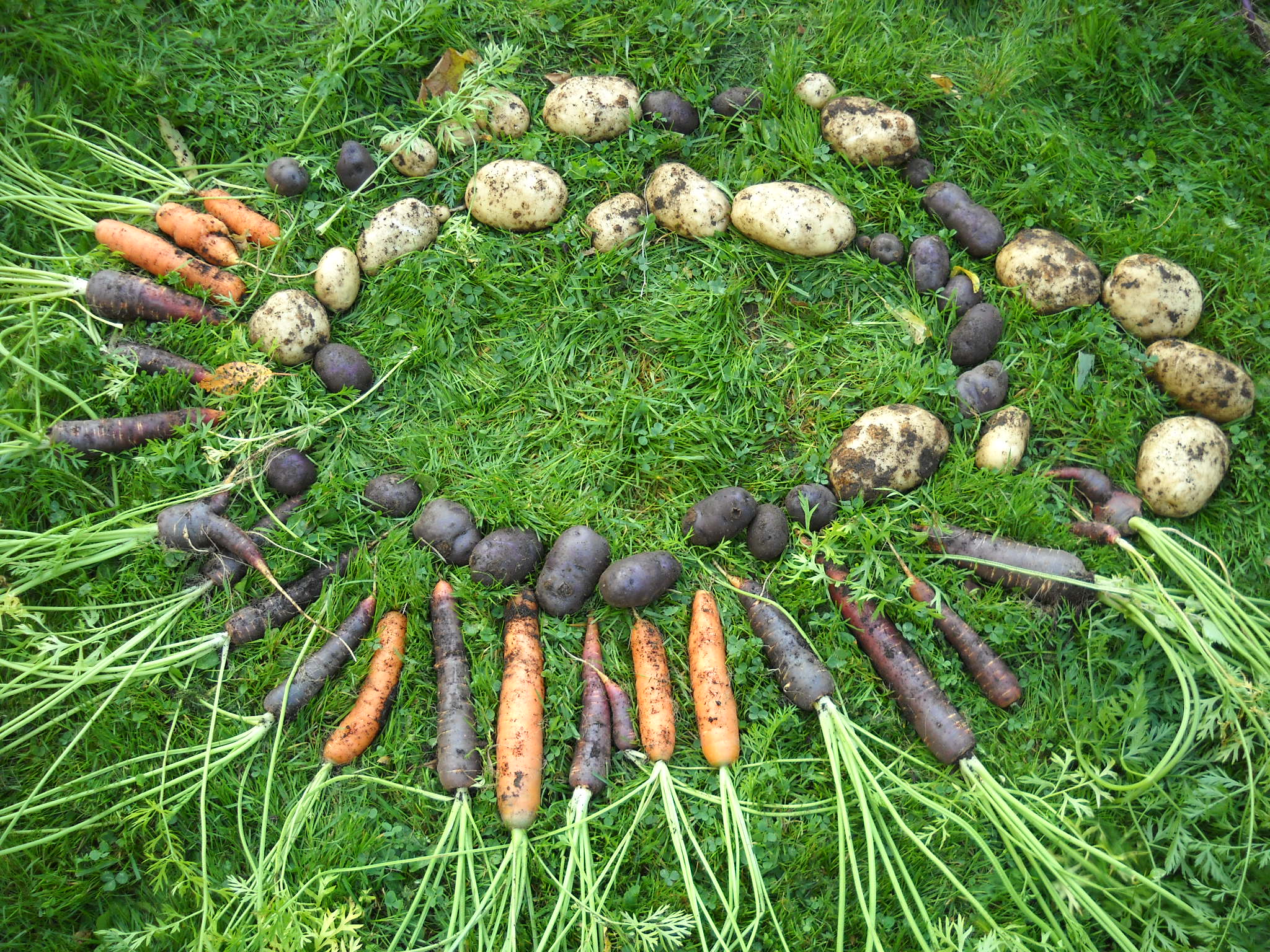
Harvesting With Grandkids
Harvesting potatoes is one of the high points of my garden year. I start in mid- to late summer, stealing a few by reaching down under a plant and pulling up a potato or two for dinner, but not disturbing the plant. Digging potatoes in the fall is like digging for treasure, and is great to do with kids.
So plant a few potatoes this summer – and start a new trend by calling your loved one your “little potato”. As far as I am concerned, that would be a compliment!
Henry Homeyer is a gardening consultant and the author or 4 gardening books. His Web address is www.Gardening-Guy.com.