-

Now available for $24.95 including shipping. -
Now available for $21.00 including postage. Vendors I Like
 Click Here to buy from Cobrahead
Flower Shows of New England
Before we launch into this week’s article…
Gardening Classes with Henry
Lebanon College: Gardening: A Practical Workshop. Garden writer Henry Homeyer will teach you the basics of organic vegetable and flower gardening. From garden design to seed-starting , planting, watering, weeding, mulching, and harvesting, this course will give each student practical knowledge of gardening. Tuesday nights from 6:30-8:30 for 5 weeks, April 3-May 2.Contact Lebanon College to reserve a spot for this5-part workshop www.lebanoncollege.edu or call 603-448-2445.
AVA Gallery, Lebanon. Henry will teach 3 classes at AVA Gallery this spring. You may sign up for one or all of these workshops:
Sculpting the Living Landscape: Starting Flowers from Seed
April 9; Monday, 6:30–8:30pm; One 2-hour class
Sculpting the Living Landscape: Perfect Perennials for the Upper Valley Garden
April 23; Monday, 6:30–8:30pm; One 2-hour class
Sculpting the Living Landscape: Organic Techniques for Enriching Soil and Managing Pests
May 7; Monday, 6:30–8:30pm; One 2-hour class
For more information go to www.avagallery.org or call 603-448-3117.
Each year I rejoice at the coming of the flower shows – they bring a taste of spring. By the time they arrive I‘m more than ready for blooming daffodils and tulips; I hunger for leafy trees and shrubs – even indoors. And I like their ambience: it’s like strolling down the midway at a country fair – but the products are different. Instead of trying to win a bear, I take a chance buying new and different bulbs or plants I can’t get in the ground for another 3 months. The hawkers, instead of selling temporary tattoos and Harley tee shirts, are selling garlic peeler/dicers and handy gadgets for cleaning floors.
The season starts February 11-12 with the New Hampshire Orchid Society’s annual show in Nashua, NH at the Radisson Hotel. Admission is $10, $6 for seniors. It’s a small specialty show, but nice. www.nhorchids.org.

Rhode Island Flower Show Sand Sculpture
The first big one, The Rhode Island Show, occurs February 23-26, and I can’t wait! I went last year for the first time and loved it. They have a wonderful line-up of speakers and educators showing slides and sharing wisdom. There is a real independent bookstore with hundreds of different titles of gardening books – I could stand there all afternoon, just thumbing through them. There are artists, craft producers and –get this – sand castles ten feet tall! (Someone brings in truckloads of sand and artists make a wonderland of castles with moats and gnomes and fairy princesses. It was fabulous last year, and will be there this year, too)
Last year the Rhode Island Show had competitions to see who could make the best sculpture using vegetables and fruit. There were garden hats decorated with flowers and –can you believe it? – women’s bathing suits made of leaves and flowers (displayed on mannequins, not gardeners!) There was beautiful stonework for inspiration, and lots and lots of plants – this year there will be 100,000 blossoms, I’m told. They are adding a food and wine section to the show in conjunction with Johnson and Wales College of Culinary Arts, among others. The show is at the Rhode Island Convention Center, Providence. Tickets $18-15. www.flowershow.com.
That weekend (February 24-26) is also the Connecticut Flower Show in Hartford. I went last year after leaving Providence and it was pretty crowded that Saturday – Saturdays anywhere are the busiest, and to be avoided if possible. It has over 300 booths and 80 workshops to attend over the course of the weekend. This year the theme is “Fabulous Fifties”. Tickets are $16. www.ctflowershow.com.
Next comes the Flower and Patio Show in Worcester, Massachusetts at the DCU Center March 2-4. I’ve never attended, but from what I’ve heard a major emphasis is on patios, outdoor furniture and the like. Tickets are $10. www.centralmaflowershow.com.
The Portland, Maine show is March 8-11 at the Portland Company Complex. Tickets are $15. www.portlandcompany.com.
If you don’t mind traveling, the Philadelphia Flower Show is March 4-11. Admission is $27, but the show is huge – and has gorgeous displays – it’s worth a visit if you can afford the trip. www.theflowershow.com.
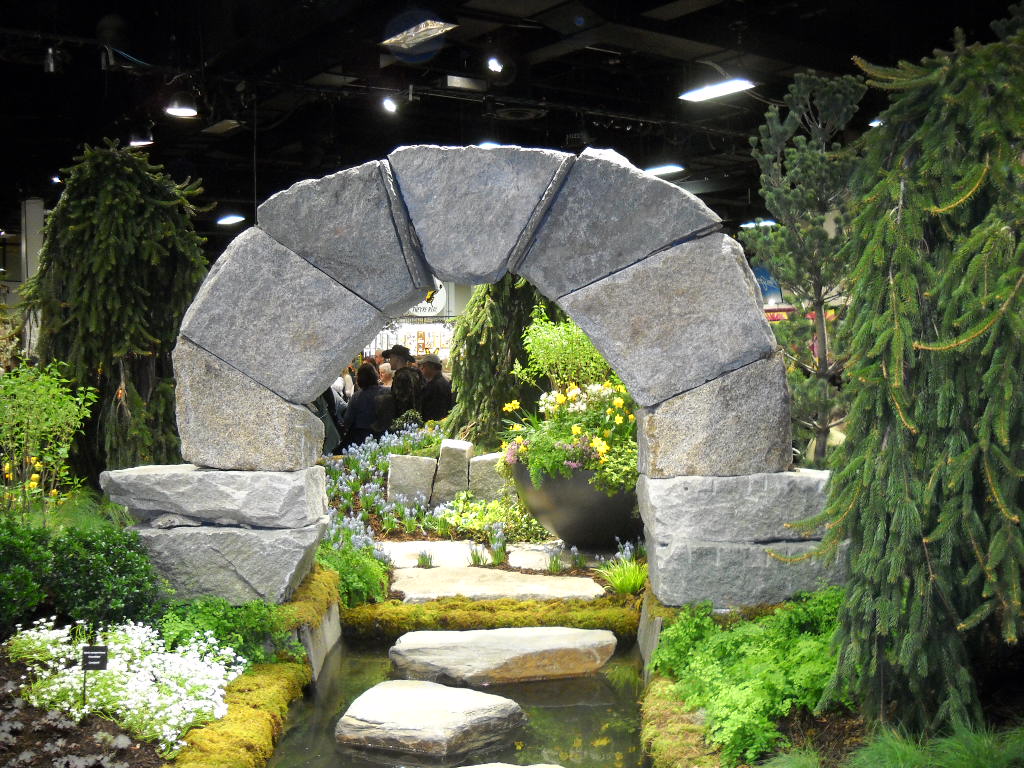
Boston Flower Show Stone Sculpture
The Boston Flower Show is always a big event. It’s at the Seaport World Trade Center, March 14-18. I went last year and liked it despite the crowds. Admission is $20. Lots of displays, lots of garden paraphernalia for sale- plan a full day. This year’s theme is “First Impressions” – stressing the “Wow! Factor”. www.masshort.org.
New Hampshire has the Seacoast Home and Garden Show each year at the Whittemore Arena in Durham. This year the dates are March 24-25 and tickets cost $8. www.homegardenflowershow.com.
Bangor, ME has a show April 6-8 at Bangor Auditorium. Tickets are only $5. www.bangorgardenshow.com.
The Vermont show, always one of my favorites, is now held only every other year and is not happening this year.
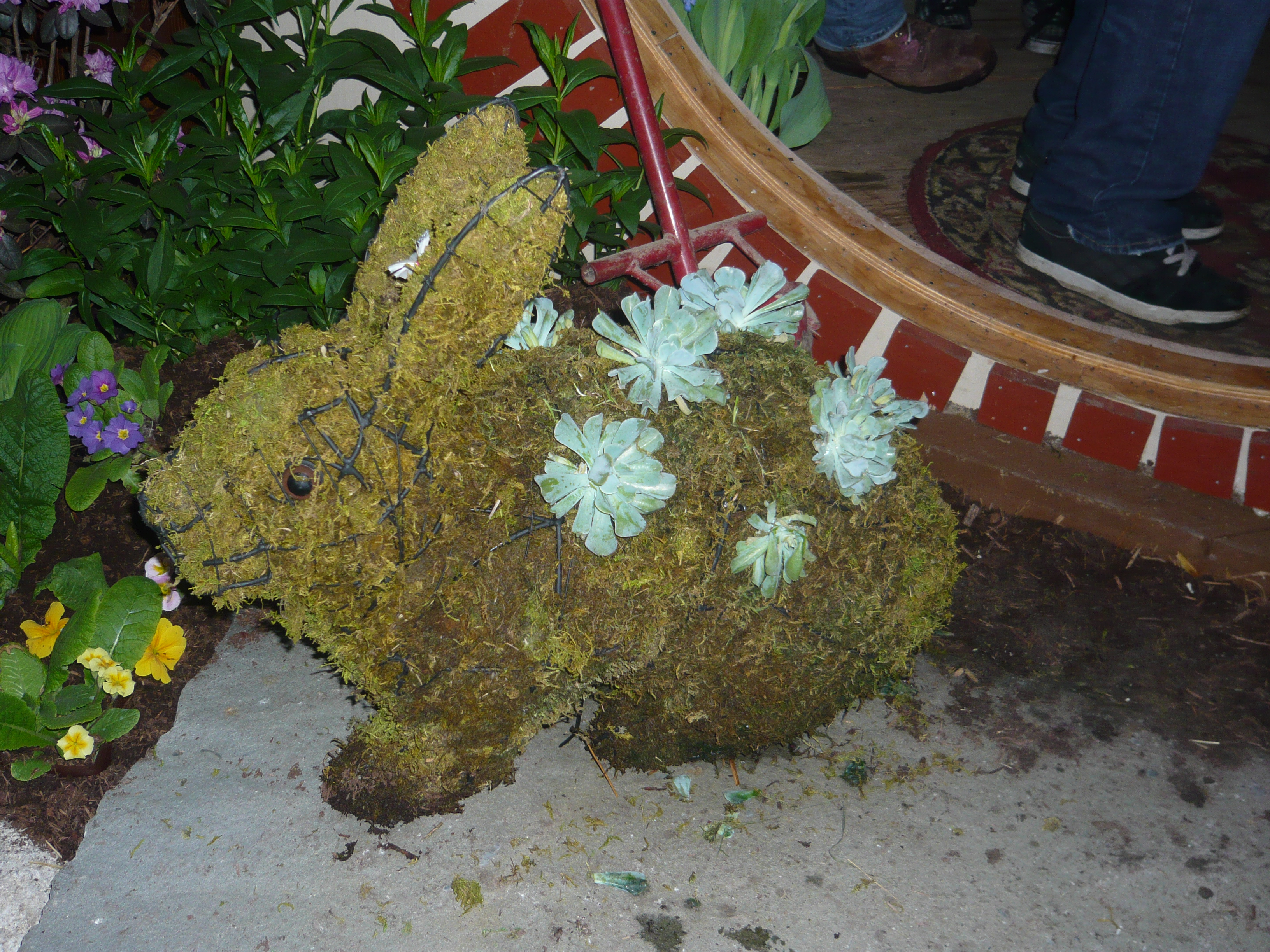
Whimsy at the Vermont Flower Show
And for those of you with deep pockets, there is the Chelsea Flower Show in London, England May 22-26. Definitely on my list of places to go before I kick the bucket, I’ve never been, alas. It sounds incredible. www.rhs.org.uk/shows.
I try to go to at least 3 flower shows each year. There is something about the scent of flowers in winter that draws me in, and there is always much to learn at the lectures and demonstrations. Maybe I’ll see you at one.
Henry Homeyer’s web site is www.Gardening-guy.com. Go there to see photos of last year’s shows. His e-mail is henry.homeyer@comcast.net
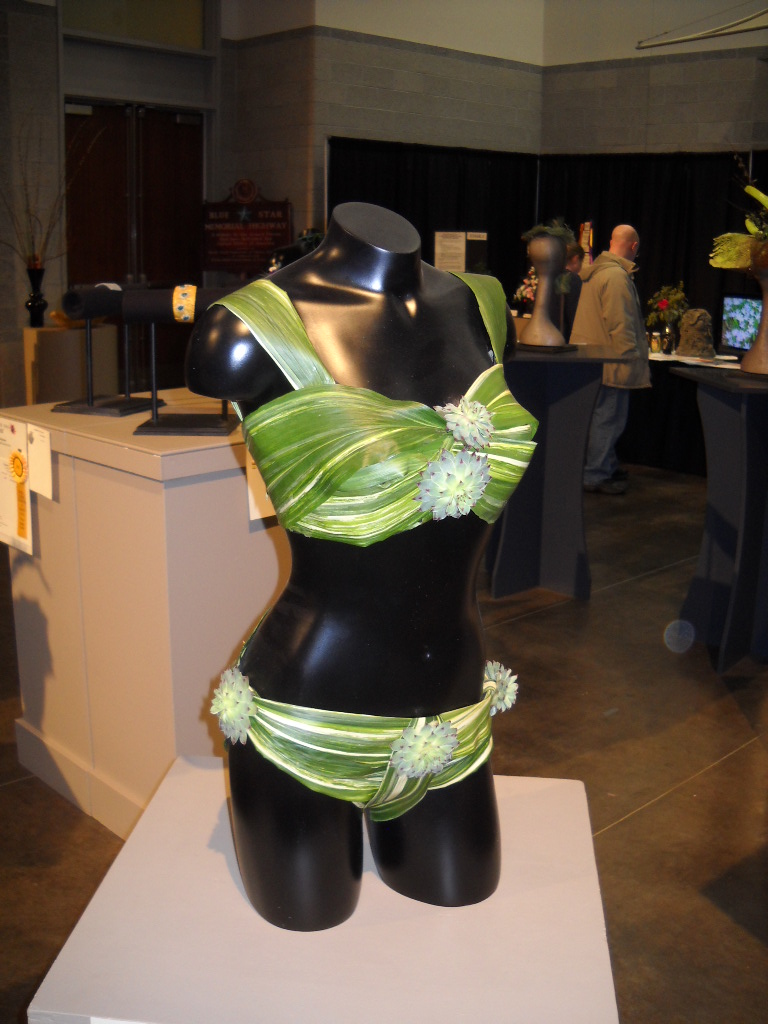
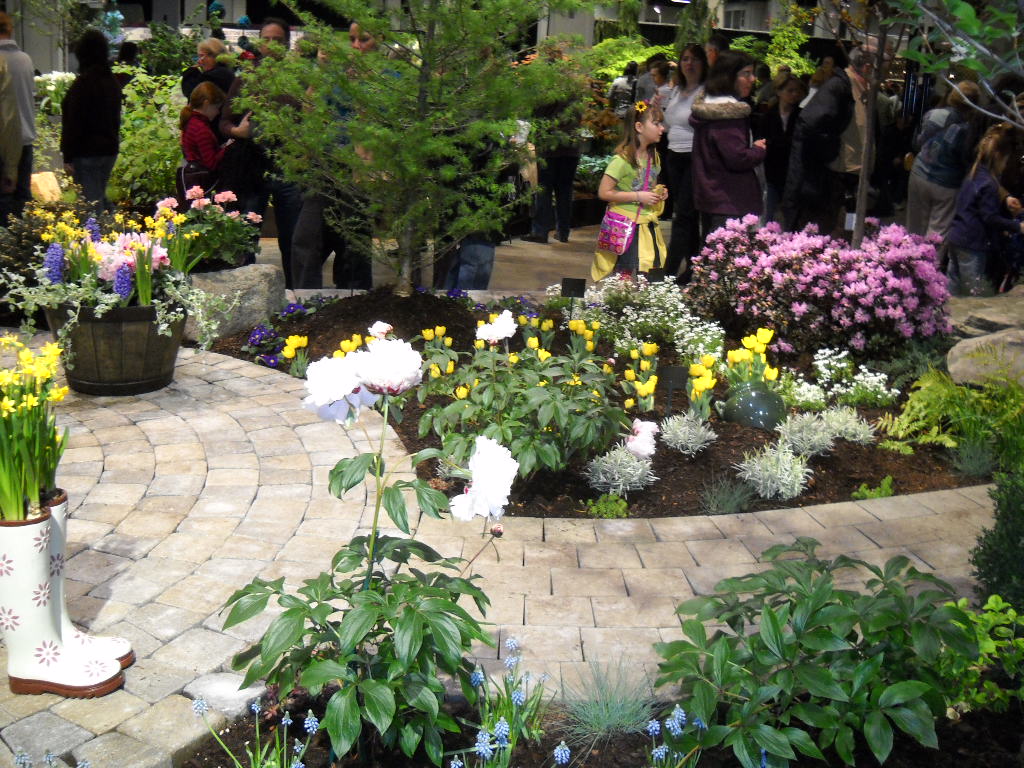
Boston Flower Show
- Rhode Island Flower Show Fashion
Eating from the Garden – Now!
Before we launch into this week’s article…
Gardening Classes with Henry
Lebanon College: Gardening: A Practical Workshop. Garden writer Henry Homeyer will teach you the basics of organic vegetable and flower gardening. From garden design to seed-starting , planting, watering, weeding, mulching, and harvesting, this course will give each student practical knowledge of gardening. Tuesday nights from 6:30-8:30 for 5 weeks, April 3-May 2.Contact Lebanon College to reserve a spot for this5-part workshop www.lebanoncollege.edu or call 603-448-2445.
AVA Gallery, Lebanon. Henry will teach 3 classes at AVA Gallery this spring. You may sign up for one or all of these workshops:
Sculpting the Living Landscape: Starting Flowers from Seed
April 9; Monday, 6:30–8:30pm; One 2-hour class
Sculpting the Living Landscape: Perfect Perennials for the Upper Valley Garden
April 23; Monday, 6:30–8:30pm; One 2-hour class
Sculpting the Living Landscape: Organic Techniques for Enriching Soil and Managing Pests
May 7; Monday, 6:30–8:30pm; One 2-hour class
For more information go to www.avagallery.org or call 603-448-3117.
___________________________________________________________________________
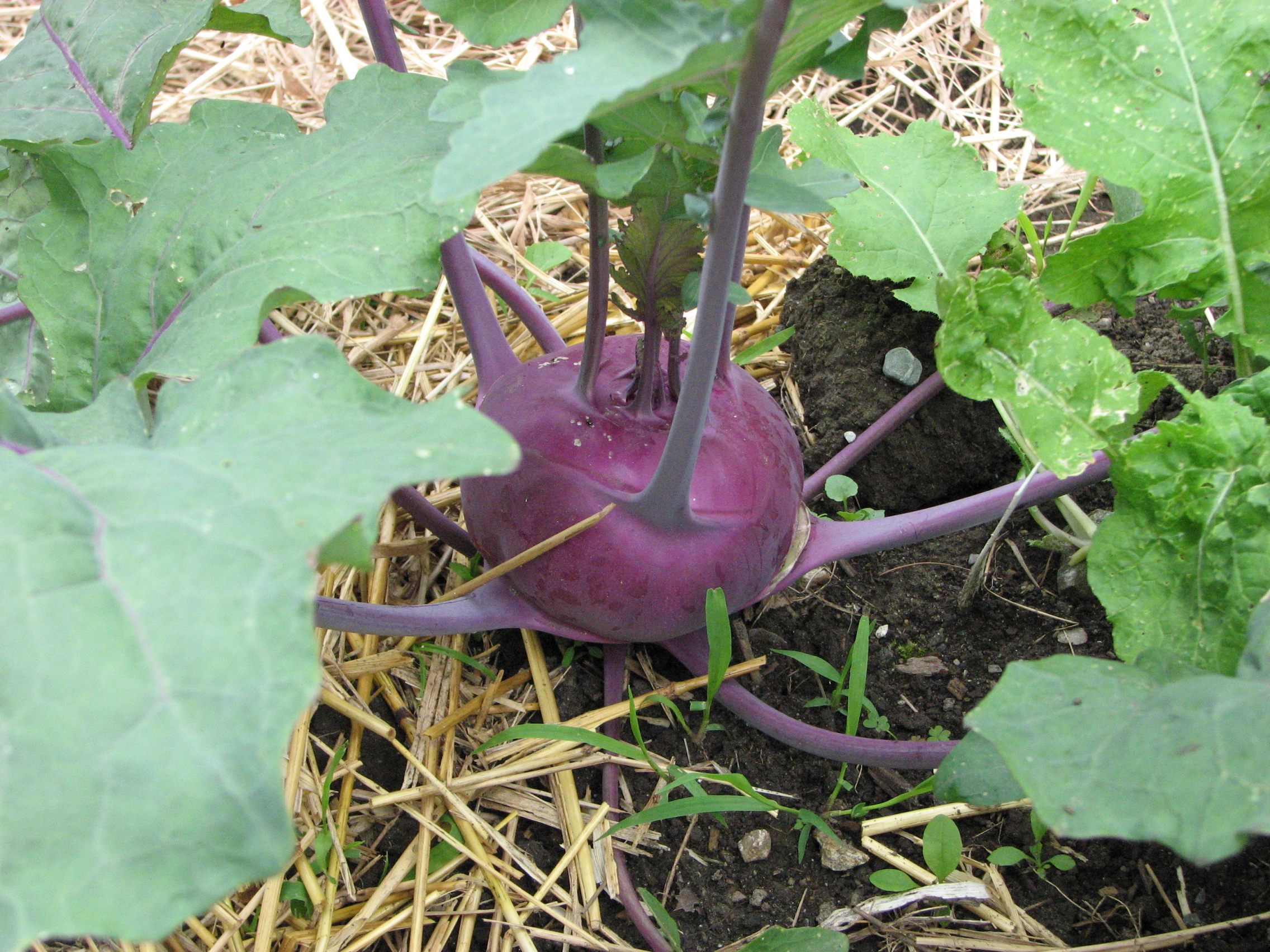
Kohlrabi
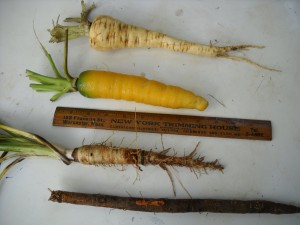
I made a nice omelet for breakfast Sunday morning that had (in addition to the regulars of eggs, cheese and onion) parsnips and kohlrabi saved from my garden. The kohlrabi gave crunch, but not much flavor. The parsnips, however, were fabulous. They added zing – real garden flavor in January. I could have used carrots, beets, potatoes, celeriac or rutabagas, all of which I still have from my garden. I really like growing much of my own food – and saving it for use all winter is something I’ve worked hard on. It’s easy, and if you are studying those seed catalogs now, you might think about the veggies you can store well for winter eating.
Root crops like those mentioned above store well at 35-50 degrees, with high humidity – and a low rodent population. That’s right, mice and squirrels like root crops, so storing those veggies requires that you have a system. In past years I’ve stored root crops in 5-gallon pails in a cement-block “cold cellar” with an insulated plywood lid. The cold cellar was installed in a cold part of my basement and it kept my huge potato crop nicely. But mice can slip through the tiniest sliver of space, and sometimes did. So this year I’m trying something new.
Through the town list serve I obtained a free refrigerator, which I installed in my basement. It’s not new, but serviceable. I’m storing my root crops in it, and it is doing a fine job. No rodents to worry about, and it keeps the crops at a steady 35 degrees. Its only imperfection is that fridges are designed to maintain a lower humidity than my vegetables prefer.
Only the 2 vegetable drawers allow me to maintain high humidity, so for the rest I use plastic bins of veggies covered with moist towels. I also have a jute-lined wire bin that I use for carrots and parsnips. I layered them
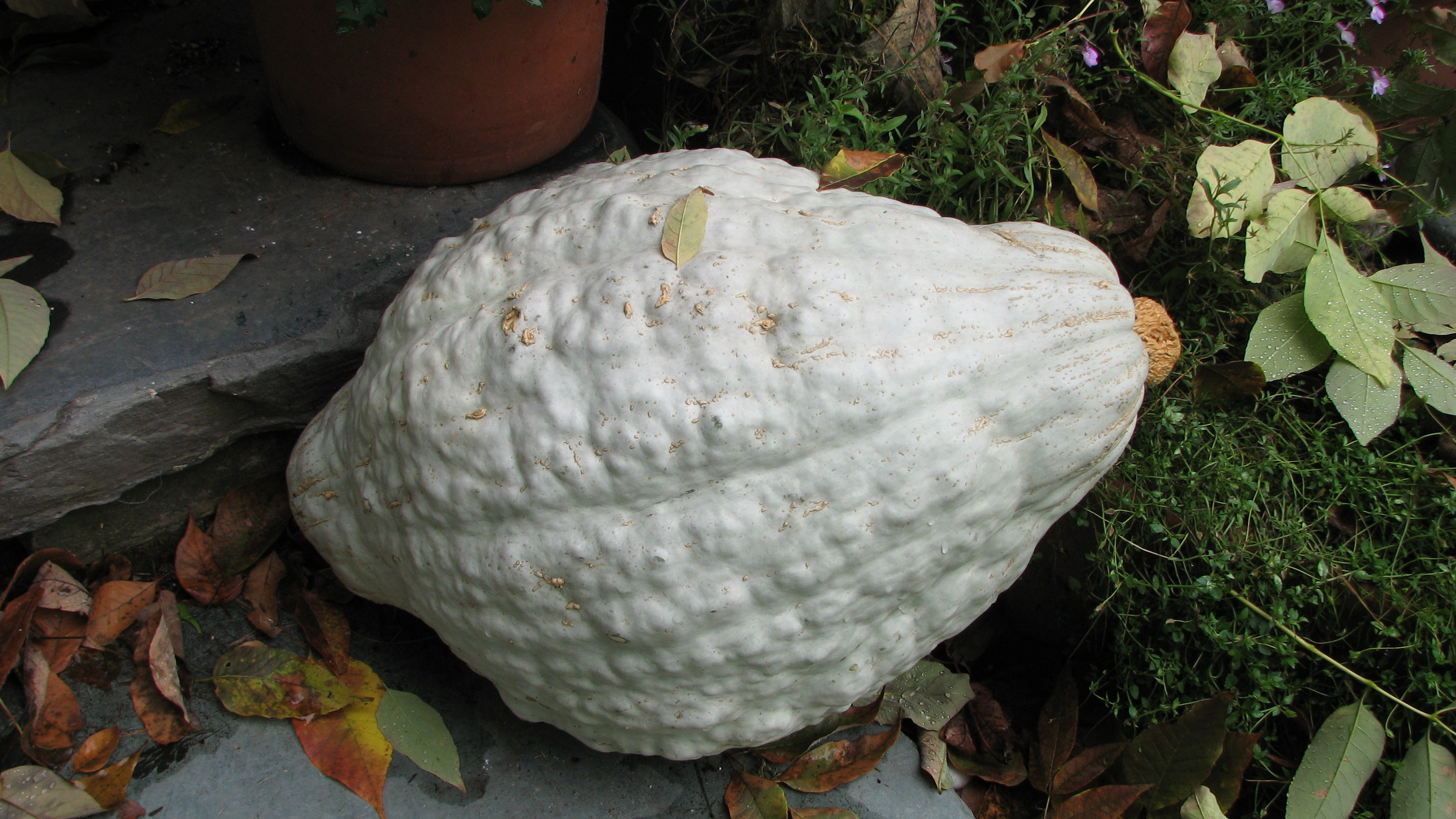
Blue Hubbard Squash
with moist sand last fall, which keeps the humidity right (available from Gardeners Supply www.gardeners.com). Of all my root crops, rutabagas seem to require the highest humidity, so I place those in the drawers of the fridge.
But not all veggies like cool, moist storage. Winter squash like low humidity and a temperature of about 50 degrees. I don’t have the perfect place for them, but if you have an unheated guest bedroom, that’s perfect. Onions and garlic like the same type of environment. Last year I stored a blue Hubbard squash for more than 12 months! It grows a leather-like skin which protects the interior nicely, and when I finally cracked it open around Thanksgiving the flesh was perfect!
Some years I find my Waltham butternut squashes store for 6 months or more without problems, and then some years they tend to rot. I imagine it has to do with the moisture level at harvest time. I’ve read that washing winter squash before storage and then dipping them in a 10% Clorox solution will minimize fungal rot, and I have done it, but cannot swear that it makes much of a difference.
The freezer is always great for storing veggies, so I am currently using 2 full-size freezers in the basement, and the big freezer section in my kitchen fridge. Each summer I fill gallon bags with whole tomatoes that I freeze for winter use in soups and stews. I suck out the air from the bag with a straw, which minimizes frost on the fruit – it’s almost as good as using one of those machines sold for the purpose, but much cheaper. I just zip the bag shut (up to the straw) and once the bag is clinging to the fruit, I slide out the straw and close the bag shut.
Here’s a list of what I am still eating from my garden, in addition to the veggies mentioned above: frozen broccoli, kale, Brussels sprouts, leeks, peppers, beans, zucchini, winter squash, parsley, pesto, corn and peaches bought for winter use, raspberries, black berries, blueberries, plums, elderberries and apples and cider. I have tomato sauce in jars and in the freezer, along with tomato paste in the freezer. Then I have dehydrated Sungold cherry tomatoes, apples, blueberries, hot peppers on the shelf of the pantry or in the fridge. And of course I have lots and lots of garlic (stored whole in a cool, dry location), and a variety of winter squashes including butternut, buttercup and delicata.
But back to that blue Hubbard squash: There is something inherently daunting about a 20 pound squash. First there is cracking it open (I use a meat cleaver, but a saw or a wood splitter would work, too, I suppose).
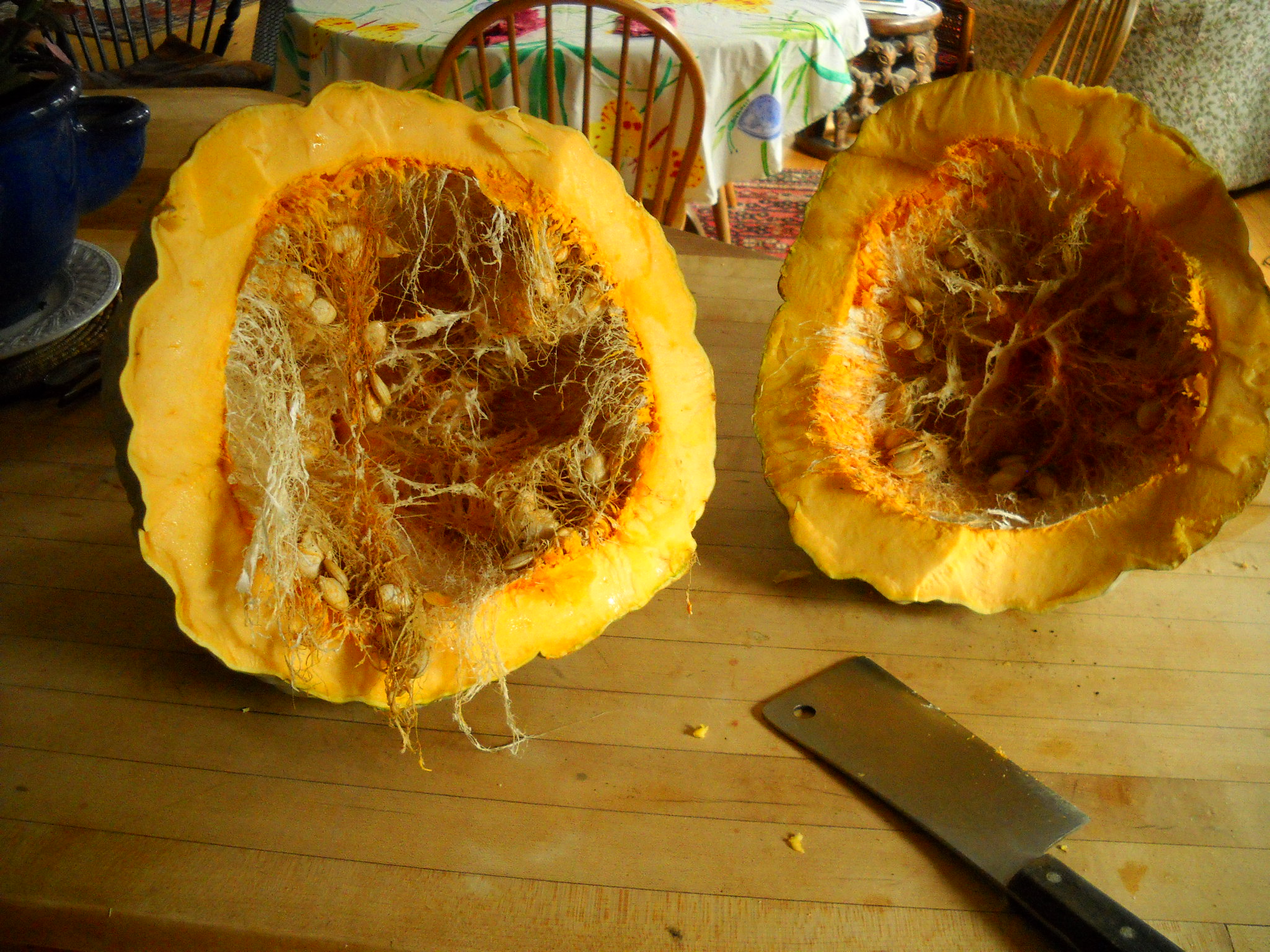
Processing Blue Hubbard Squash
Then there is the question of what to do with all that squash – when I finally did process it, it yielded 25 cups of pure food.
I placed big chunks of squash in my 16-quart stock pot with an inch of water and steamed it. When the flesh was soft I scooped it out and used some for a soup and froze the rest in zipper bags for later soups. My favorite soup using winter squash (based on one I ate while a Peace Corps volunteer in West Africa) also has peanut butter, hot peppers, fresh ginger, cumin and frozen tomatoes or tomato paste. I sometimes add black beans or kale for variety. It’s a good hearty winter soup that warms the body and soul. It’s great to be eating out of the garden in January. For the complete recipe, and one for roasted spicy squash seeds, go to my web site, www.Gardening-Guy.com. Bon appétit.
Henry Homeyer is the author of 4 gardening books. Contact him at P.O. Box 364, Cornish Flat, NH 03746 or by e-mail at henry.homeyer@comcast.net
Henry’s African Squash and Peanut Soup
This is my interpretation of a soup served throughout West Africa that I learned to love while living in Cameroon and Mali. You can vary the proportions according to your taste – a lot of hot pepper or a little; a lot of peanut butter or not so much. Improvising is good: I have been known to add kale or even fresh cranberries to it. Bon Appétit!
8 cups steamed winter squash, preferably Hubbard, but use what you have.
8 cups water
2 onions 2-4 cloves of garlic 4 fresh jalapeno peppers, chopped, or 1 tsp ground dry jalapeno
(add peppers in small portions until you decide how much you like)
2 stalks celery or half a large celeriac (which I use, because I grow it), chopped
6oz tomato paste
½ cup peanut butter
3 tablespoons grated fresh ginger
¼ teaspoon cinnamon
¼ teaspoon cardamom
½ teaspoon cumin
2-3 sprigs fresh rosemary, or 1 teaspoon Herbes de Provence or dry rosemary
2-3 bay leaves
2 Tablespoons honey (optional)
Salt and pepper to taste
Cooking Directions: Blend the cooked squash with water in food processor, add to a large heavy kettle in which you have sautéd the onions, garlic and celery. Add the other ingredients and let simmer for an hour or two. If you wish you can stretch the soup by adding more water.
Spicy Squash or Pumpkin Seeds
Remove and clean the seeds from a large winter squash or pumpkin and allow to dry for a day or more on a plate. Oil a large cast iron frying pad and add seeds. Keep heat at medium.
Stir in chili powder or hot pepper powder according to your taste. A pinch of cumin can add zing.
Add salt to taste.
Roast until the seeds are dark brown, stirring regularly to avoid burning.
Inspirations – deCordova Sculpture Park & Museum
January is generally an all-white month in my garden, though this year the snow has been off to a slow start. I love the curves of drifts, the smoothness of open spaces, the contrast between snow and the outlines of my trees, shrubs, arbors and stonework. Snow can create free sculpture in the garden – even without making snowmen.
In many gardens, however, winter is a boring time: without flowers, the garden is largely empty of interest. On a brilliant, blue-sky day I decided to visit an outdoor sculpture garden to enjoy a garden that is full of three-dimensional interest in winter. I wanted to see not only the sculpture, but the trees, shrubs and paths of the deCordova Sculpture Park and Museum in Lincoln, Massachusetts.
The deCordova was once the summer home of Julian de Cordova (1851-1945), a Jamaican by birth, who made his money as a tea broker and President of Union Glass Company. It is now offers a 35-acre sculpture park with 60 works of art, a museum (once his brick castle), a store, café and classroom space. When I visited, the museum was closed for the installation of a new show which opens January 22.
I spent about 3 hours looking at the outdoor sculpture and studying the landscape to see what I might be able to do on my own property – or that you might on yours. I am not an artist and have no budget for sculpture, but I had a great experience looking at contemporary sculpture of New England artists – the focus of the deCordova – and the landscape.
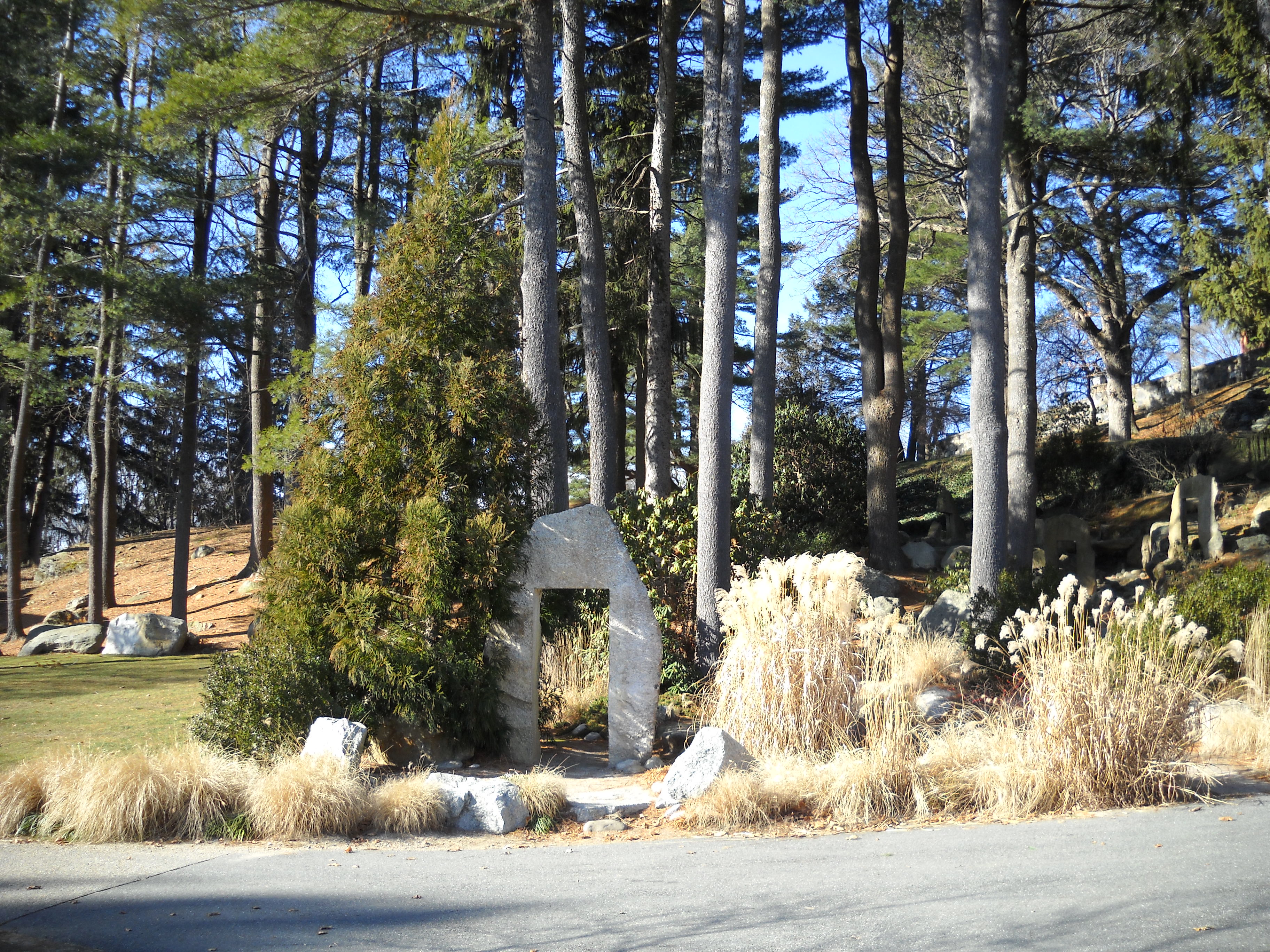
Stone Gateway At deCordova
Leaving the parking lot on foot, I was immediately drawn to a glade of trees and shrubs that had a lovely collection of decorative grasses and a stone entrance created by cutting a doorway into large piece of granite. Any arbor or entry catches my eye, and draws me to – and through – it. Passing through this doorway, I ascended a gentle hill which had natural ledge exposed and other cut stone pieces added. Evergreen rhododendrons and tall pines provided texture and color. It was lovely.
At the top of the incline was an open lawn surrounded by majestic oaks and populated with large sculptures. I continued on, climbing a rocky hillside, following a pathway. Paths are great for moving visitors along, particularly in a multi-level landscape – I always want to move forward to see what lies ahead.
In the course of my visit I walked on several types of paths – gravel, grass, stone and pavement. The most interesting to me, and one that can easily be copied without having a big budget, was quite simple: an arrangement of stepping stones. By that I mean that the stones were not flush to the ground, but a few inches above it; each stone was anywhere from 18-48 inches in width and/or length. Due to the irregularity in size and shape, and the fact that each stone was separated from the next by 6-12 inches, the visitor is required to slow down and step carefully.
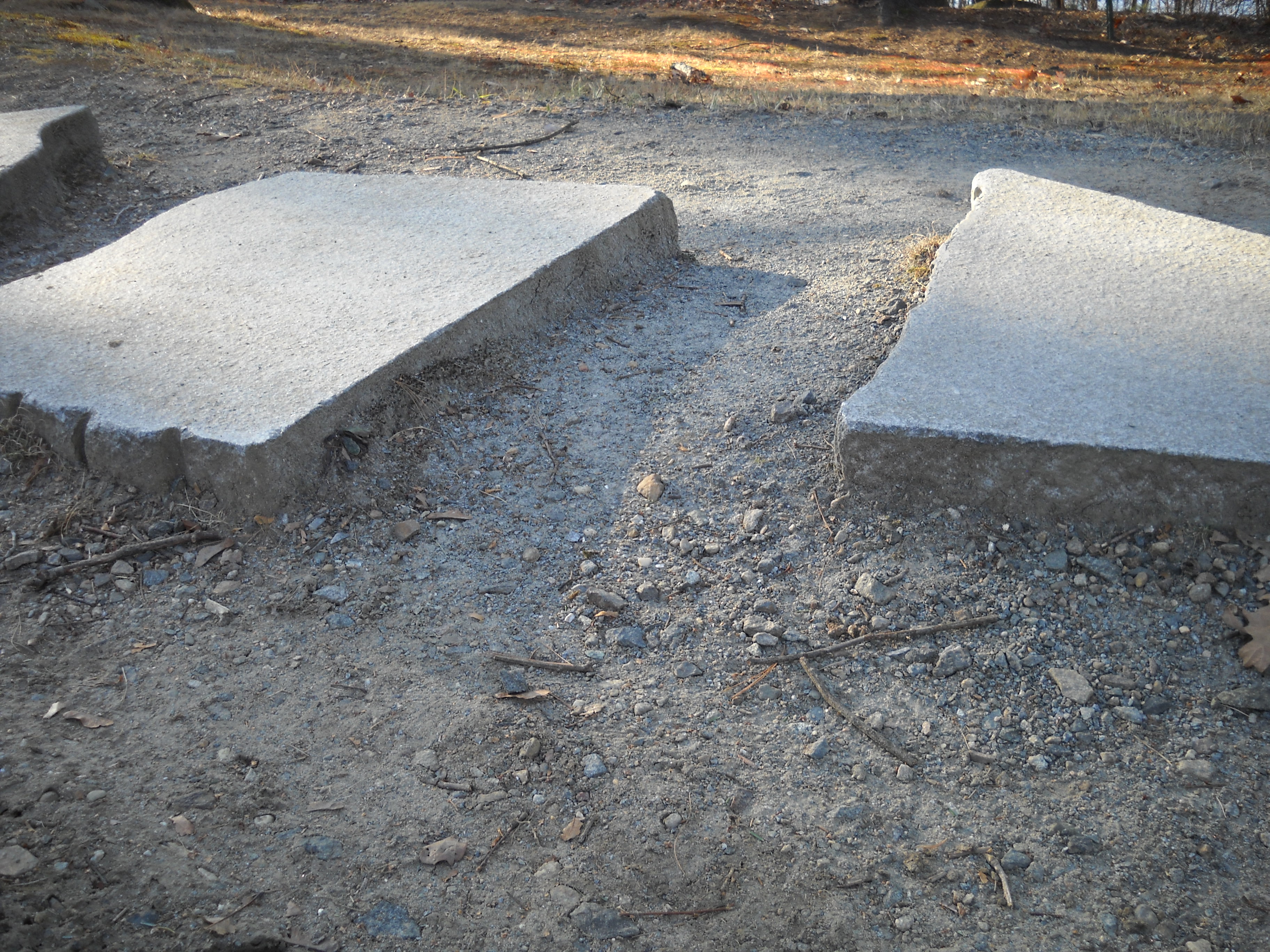
Steppingstone Walkway
I’d never seen a stepping stone walk like this in a public space. It is not wheelchair accessible (though wheelchairs could travel on the hard-packed smooth lawn near the pathway), and it would be easy to trip and fall if not paying attention. Still, I liked the fact that I could not rush along it. If you have a garden with interesting small flowers, a stepping stone path would be one way to keep visitors moving through the garden slowly to see them – or your sculpture.
At the far end of one path was a 3-foot tall retaining wall on which visitors had made their own sculpture, which delighted me. The wall was decorated with small cairns – 3-6 small stones placed in a pile. I made one myself. Again, this is something you can easily do on your own landscape – now, in winter. You can see a short video of the cairns here:
httpv://www.youtube.com/watch?v=_pPkbBy73iE
In order for your cairn to survive, given the movement of the ground as it freezes and thaws, you need to build it on a stable base such as a stone wall. But if you accept that your stone sculpture may tumble down by spring, you can build one anywhere. I’ve seen cairns that are 3 feet or more feet tall but a nice collection of stones can be just a few inches. Place them carefully so that when you lightly touch the stones they don’t fall.
Pine Cone Sculptures
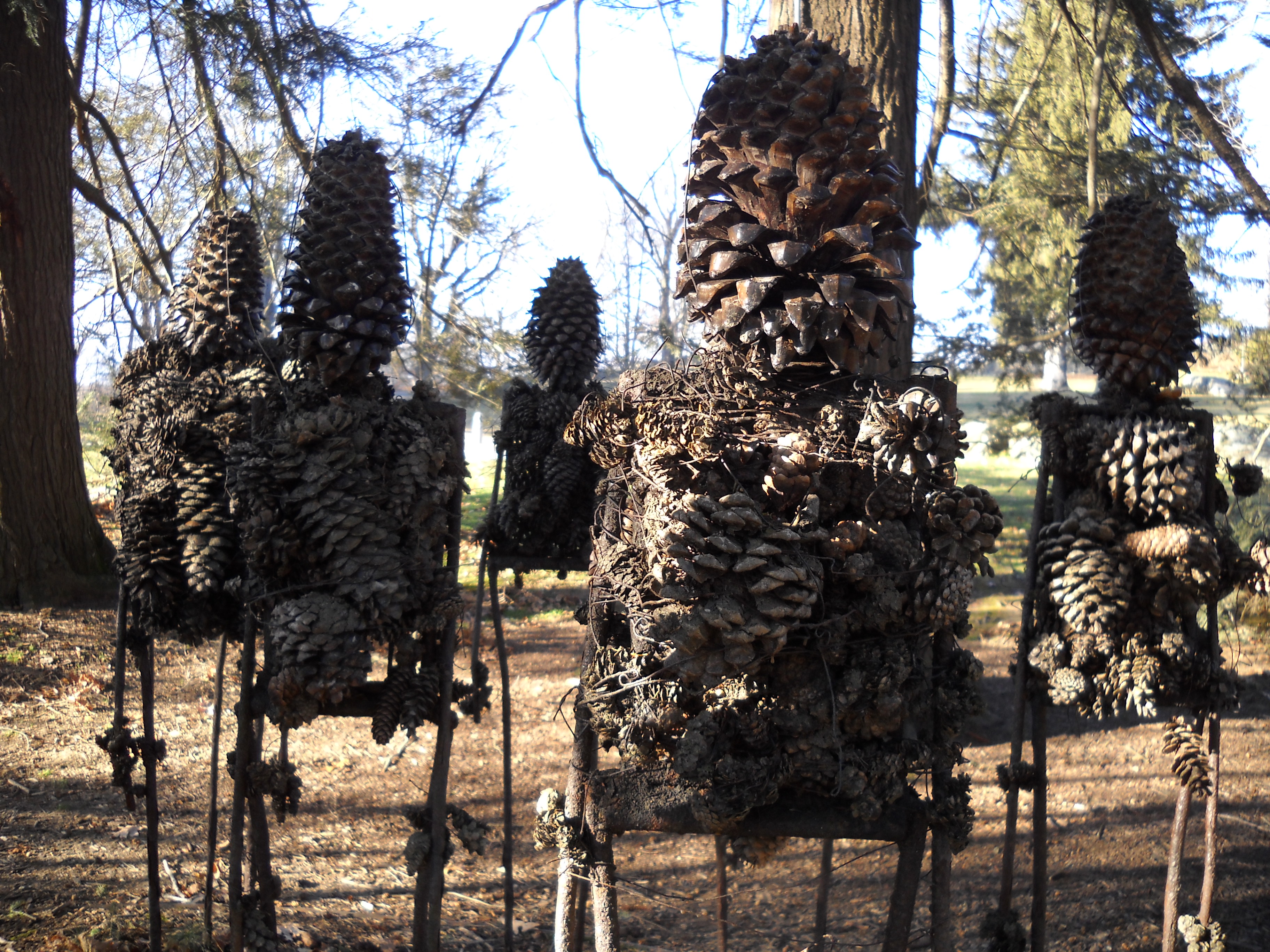
Sculptor Ronald Gonzalez created a site specific installation, a collection of human-like figures made of pine cones and steel. This is something that I could do, even though my artistic talents are (very) limited. He made simple stick figures of steel rebar, then attached (with wire) various sized cones to create heads and bodies. He created a tribe of them – a dozen or so – standing inside a circle of evergreen trees. I almost missed it when I walked by – but then let out a shout of glee when I saw it. Art? That’s for each viewer to say – but it was fun to see, and I might just create one – for winter interest.
So if your garden is flat and boring in winter, visit the deCordova to see what ideas you can bring home with you – and create something that will tickle your fancy and delight your eye next winter. See below some of the other sculptures at the deCordova:
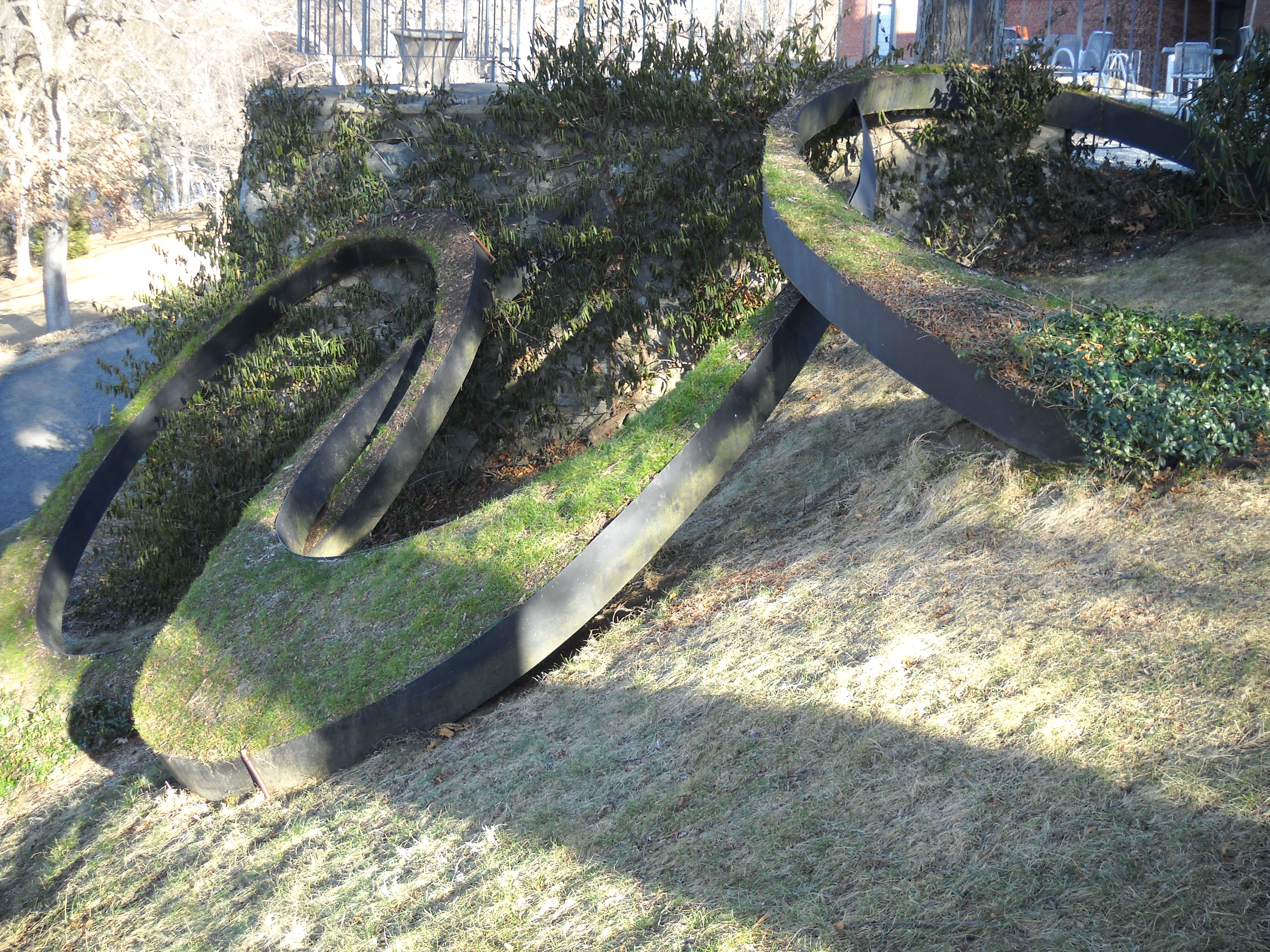
Sisters, Bob Boemig

Black Hearts, Jim Dine
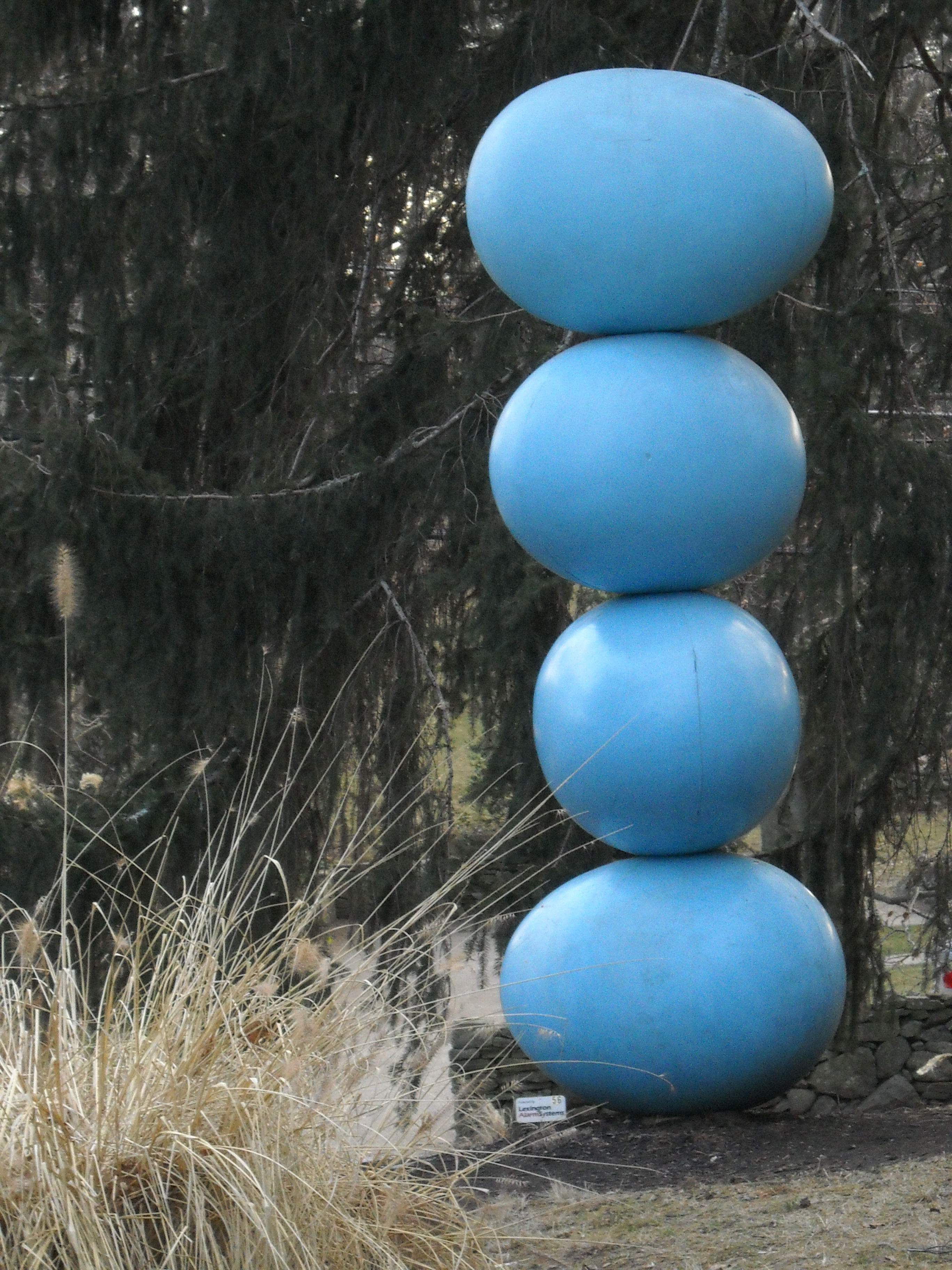
Laid, Martha Friedman
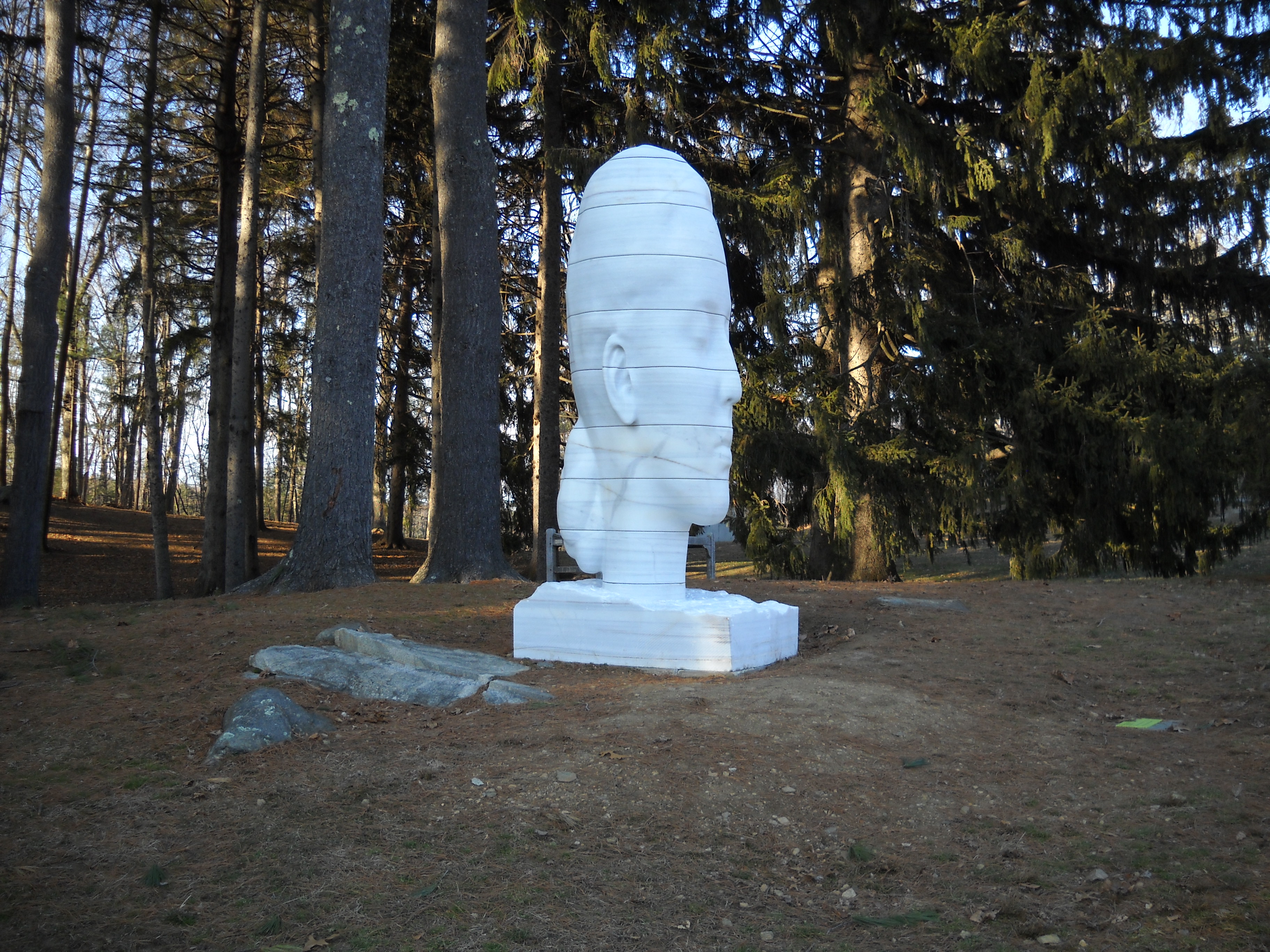
Humming, Jaume Plensa
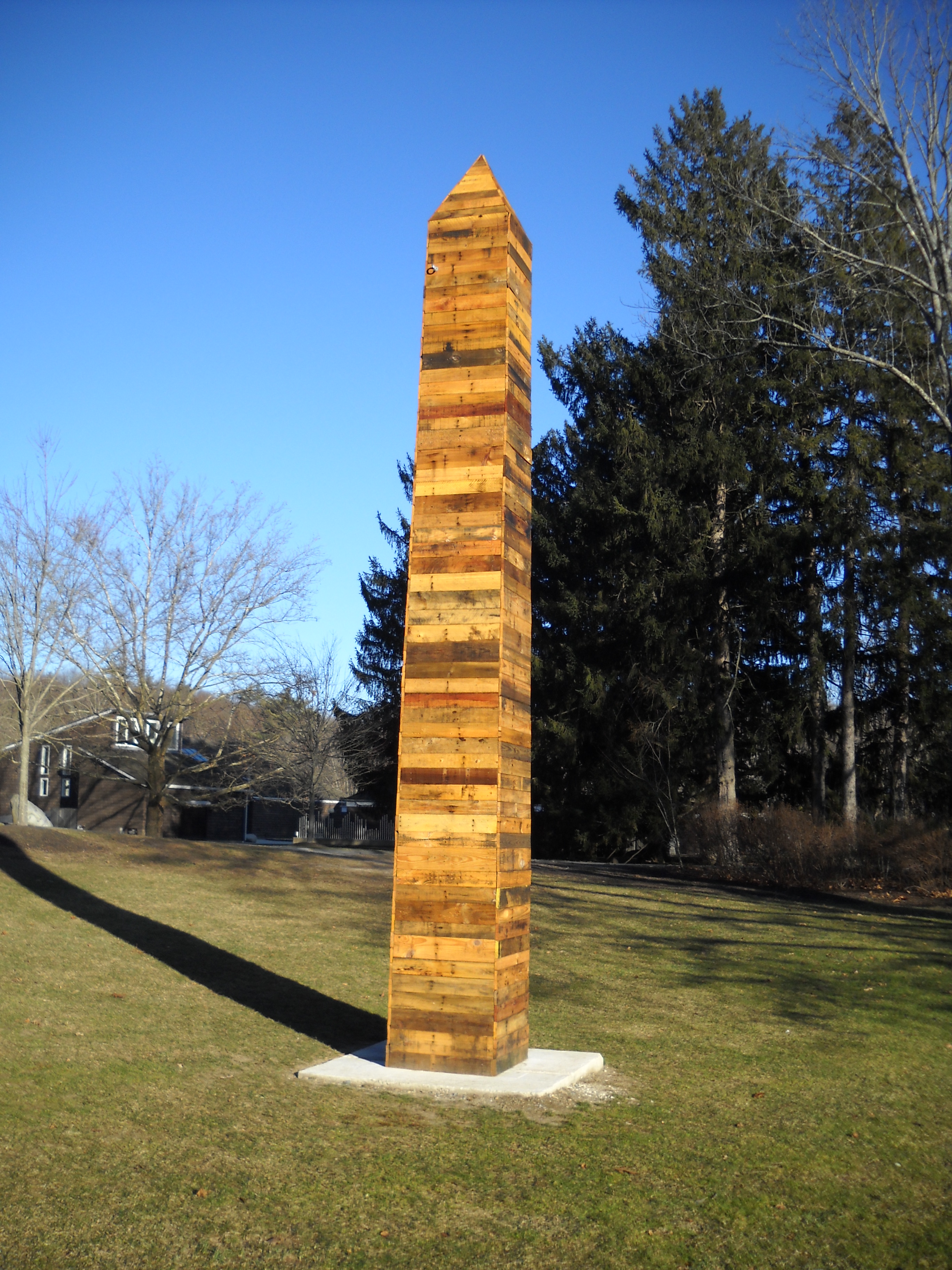
Cleopatra's Needles, Liz Glynn

Listening Stone, Joseph Wheelwright
Henry Homeyer is the author of four gardening books and writes a self-syndicated column on organic gardening that appears in 12 newspapers throughout New England. Henry’s Web site is www.Gardening-gGuy.com.
Gardening Resolutions for 2012
I am, at heart, an optimist. I believe that the rodents will leave my tulip bulbs alone, so last fall I planted plenty. I believe that the Zone 5 perennials I planted last summer in my zone 4 garden will survive the winter. I believe that late blight will not return next summer to ravage my tomatoes the way it did in 2010. But I also try to learn from my mistakes – and from the mistakes of others. Each winter about this time I like to reflect on the past year’s gardening efforts and make resolutions about what to do – or not – this coming summer.
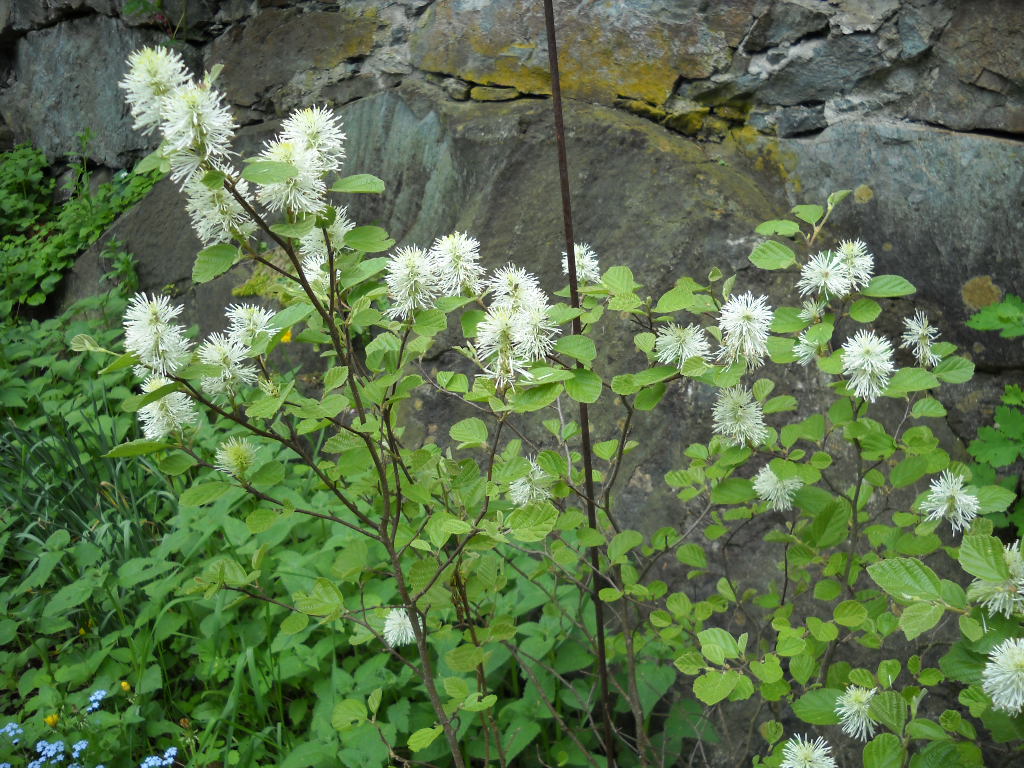
Easy Care Shrub, Fothergilla Major
This year I also asked some readers what resolutions they are making, and I’m going to share a few of their thoughts. I’ve had to edit and condense a few, so forgive me if I’ve edited yours – or left it out completely.
As the owner of a corgi, I liked this resolution, from Maria van Beuren: “I will plant the garden without assistance, however enthusiastic, from small dogs.” She provided this back story, which made me laugh:” I crawled down the row, carefully doling out tiny carrot seeds and tenderly covering them. Reached end of row and looked back to see that two puppies had concluded that I needed their expertise in digging and had come along behind me, efficiently trenching. Needless to say, most of the carrot plants I grew last year were oddly distributed in the garden.”
Nelson and Brenda Barter solved the carrot spacing problem (the seeds are small and hard to space properly), saying “We’ve learned that we really like premeasured seed strips for some applications. We always had trouble growing carrots and beets from seed packets, we’d thin them but they’d still bunch up and grow poorly or leave bare patches. We’ve had really good luck with both carrots and beets since we started using the strips; for us, they’re worth the small additional cost.” So try those, next year, Maria.
A number of readers said they were going to downsize next year. Tom Brennan had an interesting way of doing that – stay away from the catalogs:, “I’m going to make my garden smaller. At 79 it takes a lot longer to get things like weeding and cultivating done. BUT the drawback is I see something in a seed catalog and I’d like to try that, or something is said to be the very best tasting – and what’s one more row? So I think I won’t look at catalogs this year.”
Readers Donna and Bill Heroux wrote saying, “Instead of planting just one variety of radish, we’re going to plant an assortment-lots of colors, lots of flavors.” Now that is a resolution that I suspect will be kept – unlike some others which were much more ambitious.
Speaking of ambitious, Carol Mayer wrote, “Ditch the perennials and plant the trees and shrubs” is my motto for 2012. I plan to “garden smarter, not harder” as so many of us are saying now. I’ll keep the hostas and other easy care perennials but those that must be dug, divided, and replanted every 2-3 years must go.” Now that is a great resolution, but it sounds like a lot of work. More than will be done in 2012. And if Carol is like me, it’s very hard to shoot a plant – or throw it on the compost pile.
Might I suggest a modified resolution, Carol? How about this: Dig up 10 or 20 perennials and have a “yard” sale? Then use the money to buy those nice shrubs you want. A big perennial can often be divided into 6 smaller plants that still will sell like hotcakes at $2-3 each. Invite everyone from your garden club or even your entire e-mail address book! Twenty perennials can earn you a couple of hundred dollars. One last suggestion: pot them up nicely in the spring, and then sell them in mid-June when the plants have recovered from the move and look good. And remember that nothing sells better than a plant with blooming flowers!
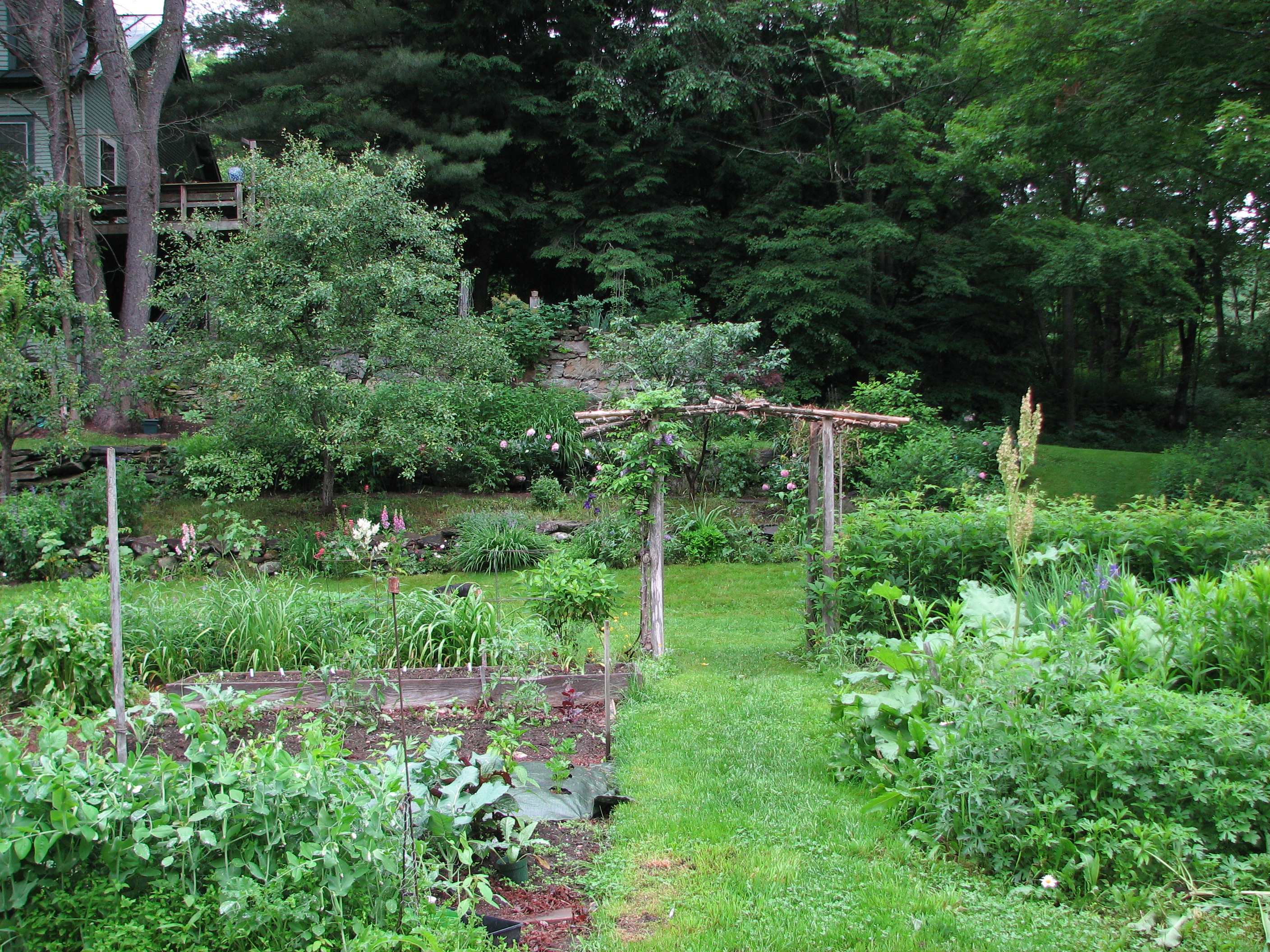
June in Henry's Garden
Meanwhile Marta Smith had a different approach – “My resolution is to not get carried away and end up planting too many plants for the space I have. My plants were too crowded and consequently did not produce as well as they should have. I will plant less and hopefully reap more, or maybe I will just turn the whole yard into garden space! Who needs a lawn anyway?”
Judy Hallam wrote, saying, “From now on I will only use slow release fertilizer in my garden boxes and containers for healthier, thicker plants. She added, “PS: This was your suggestion, Henry!” Thanks, Judy, Glad somebody pays attention to what I write!
And on a more philosophical note, I’d like to end with this from my friend David Zoffoli, who wrote, “I resolve to not worry about weeding, to go outside when it rains and enjoy life with the plants; to continue to order way too many annual seeds that I don’t plant; to plant more trees for birds, and to eat a pint of blueberries straight from the bush.” In other words, relax and enjoy the garden!
As for me? I resolve to try moderation in everything I do – even though it’s not my inclination! Thanks to all of you who wrote, and my best to all gardeners for 2012.
Henry Homeyer is available to speak at your gardening club or library. His Web site is www.Gardening-Guy.com. E-mail him at henry.homeyer@comcast.net