-

Now available for $24.95 including shipping. -
Now available for $21.00 including postage. Vendors I Like
 Click Here to buy from Cobrahead
Fall Lawn Care
I love a little bit of lawn. It sets off the flowers, walkways, stones, shrubs and trees of my garden. I think it looks good, even though it has weeds and dandelions mixed in and has a few thin spots. I should get busy now and do a little lawn care – and you might want to work on yours, too.
For starters, this is the time to plant seed. Fall is much better than spring, as the soil is warm and the seed will germinate more easily. Not only that, annual weeds and crabgrass are less interested in germinating now – they seem to know that winter is coming, along with the cold weather that will kill them. As an added bonus, the fall is generally rainy so you won’t have to water your new lawn very often.
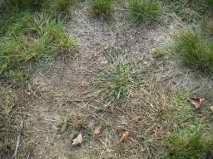
A lawn in need of attention
To develop a thicker, richer lawn, you can overseed the thin parts by spreading some seeds over existing lawn. Just loosen the soil surface a little with a short-tined rake and scatter seed over places that need it. Then spread a thin layer of compost over the seed. If you have some empty spots, do this: plant seed, add compost, and then cover the area with a thin layer of straw or hay to shade the soil and prevent it from drying out.
Don’t buy pure Kentucky bluegrass, thinking you will get a premium lawn. Get a good mixture of grasses. The color and texture of bluegrass is preferred by some people, but it requires full sun and more fertilizer than other grasses. Furthermore, any monoculture – such as a pure stand of bluegrass – is more susceptible to attacks by insects and diseases. And don’t get the cheapest seed you can find. Good quality grass seed costs more, but does better.
For a lawn that requires the least fertilizing and mowing, choose a mix that is about 80% tall fescue and only 20% Kentucky bluegrass. Fescue is not as fine as bluegrass, but it is deep rooted and will survive drought and high foot traffic. Few pests will bother it. Ten percent Dutch white clover in the mix will add nitrogen naturally – so long as you add no herbicides, which will kill clover. This lawn will do okay even without adding fertilizers.
Don’t expect to be able to plant just one type of grass seed everywhere on your property. If you have shade, buy a shade mix that has about 70% fine fescue, 20% perennial ryegrass, with perhaps 10% Kentucky bluegrass of a shade-tolerant variety.
I know that the “Weed-n-Feed” companies sell bags of stuff to promote good growth while keeping out weeds. You can have a better lawn, in my opinion, by spreading a little compost over your lawn each year. Just fling fine compost with a shovel and then spread it out with a rake – a quarter to a half an inch is plenty. Weeds? Keep the blades on the lawnmower at around 3 inches to help shade out weeds when they start up. But cut the lawn a little shorter the last 2 mowings before winter – that will reduce the chance of mold or mildew developing during wet times.
Acid rain is a reality here in New England, so unless you add limestone, the soil in your lawn will eventually get to the point where weeds thrive better than grass. You can get your soil pH tested through your state’s Extension Service or buy a kit at the garden center. The test will tell you how many pounds of limestone per thousand square feet of lawn – so brush up on your math skills.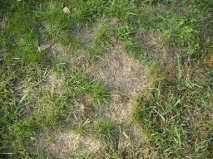
Limestone is very slow to move through the soil, and adding it in the fall gives it time to work. If you can scratch limestone into the lawn with a rake and get it below the surface a little, it will be closer to the crown, or growing point, for both roots and leaves. For new lawns, lightly rototill in limestone and compost in the top four inches of soil before seeding. Limestone provides calcium and keeps the soil from getting too acidic. If you buy “dolmitic” limestone it provides magnesium as well as calcium. “Calcitic” limestone does not have magnesium – a soil test will tell you whether you need magnesium or not.
I always use the mulcher attachment on my lawn mower in the fall to chop up the leaves. The attachment blocks the exit where the mower would normally spit out the clippings, so it chops everything more finely. I do rake up the bulk of the leaves, but the smallest bits stay on the lawn, adding organic matter and feeding the microorganisms in the soil – and making a healthier lawn.
Your lawnmower and other gas-powered equipment need a little tender loving care at the end of the season, too. It is a good idea to add stabilizer to the gas you use so that it won’t lose its zing over the winter, or foul the carburetor. The brand recommended to me by my local mechanic, Claude, is called Sta-Bil. Claude also recommends adding something to counteract the effects of ethanol in gas all season long – I recently bought a small bottle of “Quickshot” gasoline treatment said to “fight ethanol problems”.
Years ago I bought a couple of sheep to mow my lawn, and found that they were difficult to manage. I borrowed a portable electric fence to keep them out of the gardens, but they still managed to eat some flowers and inexplicably left parts of the lawn uneaten. Oh well, they did provide free fertilizer – and eventually lamb chops. Any way you look at it, a nice lawn takes some work.
Henry Homeyer can be reached at P.O. Box 364, Cornish Flat, NH 03746 or at henry.homeyer@comcast.net. His new book is called Organic Gardening (not just) in the Northeast, a Hands-On, Month-by-Month Guide.
A Time to Harvest
Sometimes it’s tough to know just when to pick things in the vegetable garden. We don’t want to pick produce before it’s ready, but neither do we want to pick them after our fruits have passed their prime. And to confuse matters even more, each variety of vegetable has its own moment of perfection.
I remember the first time I grew ‘Green Zebra’ tomatoes and waited for them to get ripe. They didn’t appear to. Then a few fell off the vine – they were overripe. The only way I could tell they were ripe was by the feel. When they started to get soft, they were ripe. But mostly I pick tomatoes by their color.
Green beans are best before they show the lumps that are the individual seeds. Young beans are delicious, but of course, you don’t want to pick them when they are too young, as you’ll get less production that way. Some beans, especially pole beans like ‘Kwintus’ (from Cook’s Garden Seeds) are still very tasty when you can see individual beans in the pods. Part of knowing when to pick is letting a few things get older than they should, and then remembering what they look like.
By now your onions have been harvested, I suppose. They are easy to identify as ready to harvest: the tops fall over and turn brown. If yours are still in the ground, go get them! Although you can pull the onions and let them dry/cure in the garden, I think it is better to dry them on a porch or deck out of the rain.
Beets taste the same, or almost, whether picked early or late. I eat the thinnings early in the season, I eat some mid-season, I harvest some after frost. Frost does not harm them – if anything, it even makes them a little sweeter. Carrots are much the same. I don’t find that my big, late carrots get woody – but if the variety that you grow does get woody, pick them earlier.
Potatoes keep on getting bigger until the leaves brown up and flop over. I generally pull potatoes before then, but last year my granddaughter, Casey, grew potatoes and did not get to harvest them until the tops had pretty much disappeared. The potatoes were still perfect – though as a general rule I wouldn’t let potatoes stay in the ground that late, fearing that they might rot in a rainy spell. Frost does not harm them.
Sweet peppers will turn red, but if you let them stay on the vine to get red, you lose production. If you pick them green, the plants keep on flowering and producing more peppers. Hot peppers get hotter if you let them stay on the vine until they are fully ripe.
Lettuce can be harvested either as a cut-and-come-again crop, or harvested as heads. If lettuce plants start getting tall, they’re getting ready to bolt and flower. So I try to pick them before they do so – a bolting lettuce gets bitter.

Broccoli
When broccoli heads start to show yellow, they are about to go by. The flowers are yellow, and you want to pick the heads or side shoots before the flowers appear as flowers. But if they do flower, they’re still edible. And cut anything off that has flowered, so it will stimulate the plant to make more side shoots.
Kale can be harvested any time; I like to keep it growing well into the fall. Frost is not a problem, nor is snow. I keep picking kale until the temperatures go down into the teens. The oldest leaves, down at the bottom of the plant, can get a little tough with time. Be sure to remove the central rib before you cook or freeze the leaves.
Summer squash can be picked very small – or quite large. Patty pan squash, one of my favorites, is perfect at the 4-inch diameter size, though I know someone who picks it at the 2-inch size – almost bite sized. Zucchini grows so fast that I often find some – the escapees- that are 18 inches long. Those I quarter lengthwise and scoop out the seeds. Then I run them through the shredder (top) blade of my food processor, making a nice mixture that I freeze as is. I use it as a base for making winter soups.

Blue hubbard
Speaking of winter, winter squash are a bit tricky to pick at just the right moment. What I have decided is that it really doesn’t matter when you pick them. When my blue hubbards or Waltham butternuts stop growing, or when I see that the stem is drying up, I pick them. Winter squash need to be cured for some weeks before eating for the best flavor.
Apples? If you have to yank on an apple to get it off the tree, it’s not ready to pick. If lots of apples are on the ground, the tree is probably ready to pick. Pears are usually picked green, and ripened on a window sill or in trays in the barn. Plums, like apples, come off in my hand at a gentle touch when they are fully ripe, but I can also tell by the color.
Like much in life, practice – and paying attention – makes perfect when it comes to harvesting. That, and having enough time to go out and get in the garden when you need to. Happy harvesting!
It Ain’t Over Yet: Fall Flowers Can Be a Joy
Big yellow buses are lumbering around everywhere I look, stopping and starting and making a morning car trip seem to take forever. A few trees are showing color, mainly those living in swamps or under stressful conditions. The leaves on my tomato plants have largely turned brown, meaning no new blossoms for late tomatoes. Fall is here. But I still have lots of flowers blooming, and more on the way.

Mums
Each fall I treat myself to some chrysanthemums. I don’t buy them at the grocery store in an effort to get the cheapest price. I go to my local farm stand and buy the biggest, most beautiful pots of mums I can. I like to support local farmers and garden centers – and I believe I get better quality flowers from them. Mums that have traveled on a truck from New Jersey aren’t necessarily of bad quality, but those that were grown near home are less likely to have been stressed or damaged by too little (or too much) water.
Sometimes I just plunk those mums down, pots and all, on the front steps. Doing so means I will have to water them every hot sunny afternoon, particularly if the mums are growing in peat pots instead of plastic ones. I like peat pots – they don’t use any petroleum products – but they do dry out more quickly than plastic. This is true even if you plant the pots in the ground. The lip of a peat pot will let moisture evaporate and dry out the roots unless the ground is pretty wet. So tear off the lip of the peat pot, or remove it entirely if popping them in the ground.
I know that some chrysanthemums sold now are said to be hardy in Zone 4, but I don’t care if they are or not. I use them as annuals, filling in spaces and brightening up places where I need color. They are great on the table, too, and will look good for 6 weeks or more.

Sneezeweed
Elsewhere in the garden I do have some nice blossoms. Sneezeweed (Helenium autumnale) is a tall fall bloomer that likes full sun. The petals are “recurved”, meaning that their daisy-like petals don’t lay flat or lean inward as the petals on a black-eyed Susan do. Instead, they lean back a little from the central button. Sneezeweed comes in a pure yellow, an orange and brown, a reddish color, and probably others. All are good cut flowers – and do not cause sneezing. I’ve read that the flowers were dried and used as snuff long ago.

Turtlehead
Turtlehead (Chelone lyonii) is one of my fall favorites. It likes moist soil, but will grow anywhere from full sun to full shade. It spreads slowly by root, creating dramatic clumps in just a few years – but it won’t take over the garden. The foliage is a deep green, stems are 4-feet tall, and the flowers are a pure pink – in the shape of a turtle’s head. There is also a smaller white variety, which is a native wildflower, but the blossoms are sort of a dirty white, and not very interesting.
Then there are many different fall asters. Several of mine stand over 4 feet tall and bloom in a variety of blues, purples, white and even pink. Butterflies seem to love them. They look nice in a vase, but I find they don’t last as well as turtlehead, mums, and some others. I let native asters – treated as weeds by some – fill in around the edge of wooded areas and in my shade gardens. They are much smaller than the cultivated ones, and their colors are not as bright. But keep an eye out for a clump along the roadside and bring some home if you like.
Then there are the fall crocus (Colchicum spp.) which are not crocus at all, but do resemble them. Mine are either white or lavender, and have either single or double blossoms. They pop up unexpectedly – they have no fall foliage. The foliage appears in the spring, then dies off. Each blossom is 2-4 inches from tip to bottom, and most appear on stems that don’t quite hold them up. So they flop unless you plant them in a place with a ground cover that will support them. Myrtle (Vinca major) seems to work well for that. My fall crocus have not yet appeared, but I know they will be along soon. They are bulb plants, and a bit pricey.

Gentiana makinoi 'Marsha'
Gentians are in bloom now, both in the wild and in my garden. The deep true blue of a gentian is unbeatable. This year mine are entwined with a perennial called Knautia macedonia, which has been blooming since mid-summer. It is a wine-red, pincushion-like flower that has long, thin stems. The two plants together are gorgeous, and the stiff stems of the gentian hold up the blossoms of knautia on rainy days. The particular gentian I grow is Gentiana makinoi, a variety named ‘Marsha’. Look for both, buy them if you find them; both are quite scarce in the nursery trade.
We never know when frost will first nip at our veggies and flowers. Most years recently it has been mid-October for me. But I’ve seen frost here in August once, and plenty in September. Until frost I’ll have plenty of annual flowers blooming. A particularly nice one for me this year has been Browallia “Amethyst’. The small blue and white flowers have been flowering like crazy for ages, and show no signs of slowing down. But I know their life span is limited, and I dread the day when the grim reaper – Jack Frost – takes them away.
Garden Designing with the Peek-a-Boo Effect in Mind
Little children – and grandparents – love to play games that make us giggle. One of the very first a child can play is called Peek-a-Boo: A child covers her eyes and you – and they – seemingly disappear. When they open their eyes (or pull back their hands) we are present. Good garden designers do the same with long views and sometimes even with special plants, or with a piece of garden sculpture. No, no tricks with hands over eyes are involved. It’s all about controlling what a visitor to the garden can see at any particular vantage point. Let me explain.

Framing Mt Bigelow and Flagstaff Lake
I was recently sitting on a porch overlooking Flagstaff Lake and Mt. Bigelow in Maine as the sun was setting. In front of me there were 3 or more clumps of spruce and white birch. Between each grouping of trees there was a 10-15 foot wide gap. The trees made it so that I could not see the entire view at once. I found myself moving my rocking chair so that I could see the section of the view that, at that moment, was most captivating. The view became all the more special when I had it in my sights. I was not bothered by the fact that I did not have an unencumbered view. I liked seeing just some of the view, helping me to focus on one particular aspect of it.
You can do the same thing in your garden. You can frame a view across the valley (if you are lucky enough to have one) by planting trees or pruning trees that are already there. You can hire a person with a chain saw to take out a 60-foot white pine if it’s blocking the view entirely. If you do so, you will get different glimpses of the view as you pass through the garden.
But back to the porch. Museums not only frame their art well, most choose a path for visitors so that the most spectacular views are in big rooms with high ceilings – after passing through a series of smaller, darker rooms. The Monet haystack paintings at the Museum of the Art Institute of Chicago are in a large, well-lit room that one enters through smaller, darker spaces. With time, you can do the same in your garden.
The creation of “rooms” in a garden is an old technique first used, I believe in England, France and Italy. Using walls or hedges, a large space can be broken down into smaller spaces, controlling what a viewer can see at any given moment. But creating rooms is not enough.
As you leave one space and come to another, there should be something special in each new space. Contrast keeps a visitor engaged. Each time I leave the brightness of my main garden to enter my primrose garden (a relatively dark space under some old apple trees) I am delighted. I slow down and look carefully at what is growing there. The change in light intensity causes me to pause, allowing my eyes to get used to the darkness. I see not only primroses (in season), but wildflowers, interesting foliage or colorful seeds, and I am delighted.
The natural contours of the land can help you to define garden rooms that are curved and asymmetrical. Letting wild trees grow up along an old, fallen-down stone wall can help to enclose a space. And a garden room does not need 4 walls. Even two walls will define a space nicely.
In small gardens, a Peek-a-Boo effect can be created by placing tall, wispy plants at the front of a garden bed, and smaller, intensely colored plants behind them. I have an artemesia that is 48 inches tall with big clusters of delicate white flowers. Its botanical name is Artemesia lactiflora. It is perfect for partially hiding something smaller behind it. This year I planted some short annuals around and behind it, an intensely red globe amaranth (Gomphrena globosa). You have to peek around the artemesia in order to get a better view of those red flowers.
I grow showy ladyslipper orchids (Cypripedium reginae) in a bright, sunny part of my garden. I keep them surrounded by other, taller plants. This is for two reasons: one, the taller things provide a bit of shade to my ladyslippers, and two, it creates that Peek-a-Boo effect that I like. I like the fact that in order to see and appreciate these lovely June-bloomers, a viewer must stop walking – which helps one focus on their unique character.
And as you work on your landscape, think about winter. You will probably spend little time in the garden. Can you create views and beauty that can be seen from your favorite chair or the window over the kitchen sink? Can you partially hide a stone, a bright blue ceramic birdbath or a statue or with your plantings? Can you provide just a glimpse of it from each window? Peek-a-Boo.
Creating special garden spaces is a long term effort. I’ve owned my house in Cornish Flat, NH for over 41 years – and I’m still working to improve my gardens.