-

Now available for $24.95 including shipping. -
Now available for $21.00 including postage. Vendors I Like
 Click Here to buy from Cobrahead
Flowering Trees and Shrubs
If you have traveled a mile from your house this past month, you have passed by plenty of blooming trees and shrubs. Some, like those bold, deep pink or magenta PJM rhododendrons, are brassy and loud in their announcement of spring. Others, like the maples and birches, are more subtle. All give me joy. All are worth observing.

Maple Flowers
It seems to me that maples are given scant attention when it comes to their flowers, but this year the maples in my part of the world are producing prodigious numbers of blossoms. Most trees have an occasional year when they produce a bumper crop of fruit, nuts or seeds. This appears to be a mast year for maples. Their flowers appear first each year, before the leaves, and are dainty greenish yellow. The flowers hang or dangle on thin green 1-3 inch long strings in a merry, decorative fashion. They don’t resemble flowers we pick or admire, for the most part. Still, given the numbers of them this year, they make a dramatic statement, creating a yellow/lime green cast to the entire tree, glorious from a distance.
The birches also have interesting blossoms, which are called catkins. Catkins are hanging appendages 2-4 inches long, a bit like tiny fuzzy sausages hanging in groups of 2-3 that produce (or receive) pollen. There are separate male and female catkins. Catkins also appear on some willows, and poplars. Like any wind-pollinated flower, catkins produce lots of pollen and may cause allergic reactions in some people. Male poplar trees produce pollen which is very irritating to many people, and is a main cause of hay fever at this time of year √ though the females are not allergy producers.
If you suffer from hay fever, a good resource is Tom Ogren’s book, Allergy-Free Gardening: The Revolutionary Guide to Healthy Landscaping. Ogren lists not only trees and shrubs, but many common flowers and rates them on a scale of 1 to 10 in term of how potent the pollen is.

shadbush, shadblow or serviceberry (Amelanchier spp)
The shadbush, shadblow or serviceberry (Amelanchier spp) have been blooming along the roadside in recent weeks. These are white-flowered understory trees or shrubs that bloom towards the end of the forsythia display, but before lilacs. The blossoms resemble apple blossoms, but the trees (or shrubs) have smooth gray bark and a lankier overall appearance than apples. They vary in size, but rarely get taller than 30 or 40 feet in the wild. As a domesticated shrub they can be kept in the 6-10 foots size.

Shadbush Flowers
If you want a good bush for feeding birds in summer, shadbush is a good choice. They produce blue berries that are much beloved by birds, and are generally stripped off the bushes before I get a chance to taste them. But they are tasty for us, too. And I love the smooth gray bark and the multi-stemmed growth of the bushes. The most floriferous of the varieties, for me, is Amelanchier arborea ‘Cole’s Select’. I found it at E.C. Brown’s Nursery in Thetford, VT. (www.ecbrownnursery.com) and I have gotten other varieties there, too.
This is a good time to prune your forsythia. As early spring bloomers, they set their blossoms for next spring this summer, so prune by early summer to get the best display next spring. That is a good plan for any spring-blooming tree or shrub. If you have forsythia that only bloom on the lower branches, you have an old fashioned variety, one that is easily susceptible to winter burn. The blooming branches are those that were protected by snow. The best solution? Cut them down, dig them up, and get a better variety. ‘New Hampshire Gold≠, ‘Vermont Sun≠ and ‘Northern Sun≠ are good, hardy varieties that should do well for you. Or ask at your family-run garden center for a good one for our climate.
Apples and crabapples set their buds for next year by early June. You should be done with pruning them by now, though a little pruning now is all right. Fruit buds are brittle at this time of year, and you can easily snap them off when pulling prunings from the tree, so be careful when removing branches. Pruning them when dormant is best, which is why March is the usual month. It≠s also fine to do some pruning in the heat of August.
Lilacs are some of the toughest and most wonderful of the blooming shrubs. Old farmers scattered wood ashes around the base of their lilacs in March to keep the soil sweet (not too acidic). You can do that now √ or anytime, really √ to help with next year≠s bloom. A quart yogurt container of limestone or wood ashes is fine for a small lilac or a couple of cans for bigger ones. It really does make a difference. And lilacs in full sun bloom much better than those planted in shade. Buy lilacs in bloom so you can see their color and sniff their fragrance before making a purchase.
This is a great time to plant trees in shrubs, but only if you are willing to water them all summer. If you≠ll likely forget, plant in the fall.
Hardening Off Plants and Planting the Vegetable Garden
Each gardener knows best when to plant the vegetable garden. For many, it’s Memorial Day weekend, though I tend to plant some things later, others much earlier. But long before I plant seedlings, I get them ready for planting. It’s called “hardening off.” Unlike a mother bird, you do not have to push your plants out of the nest all at once.
Whether you plant tomatoes that you bought at the greenhouse or started indoors yourself, your tomatoes have led a pampered life. Temperature, wind and moisture levels have all been controlled. Light levels have been less than the full sun plants will encounter in the garden. In the greenhouse some of the sun≠s power has been filtered through plastic and absorbed. My plants have been growing under lights much less powerful than the sun. It is important not to shock plants by moving them from shelter to garden in one fell swoop. They can get sunburned or windburned, which won’t kill your plants, but will slow down their growth for a couple of weeks.
I grow over 100 tomato seedlings most years (though I share many). These plants have been going for a walk every nice day to get ready for their big adventure. I start the process of hardening off my plants by carrying them outdoors onto my deck where they will get 3-4 hours of morning sunshine and just a little wind (the wind is blocked in 2 directions). If rain is forecast, I don’t put them outside – they can be beaten down by hard rains, or waterlogged.

Vegetables
After a few days spent in the morning sun, plants are ready for afternoon sun. But be careful: big, leafy plants (like lettuce) can dry out very quickly on a hot sunny day, particularly if growing in a 6-pack with only a small space for roots and moisture. You need to watch over them – or continue to leave them in a morning sun location. After a week of hardening off, plants are ready for the full sun of the vegetable garden.
The date of the last frost is unpredictable. I believe that it is better to wait and plant after all chance of frost has past. I have a garden in a low spot where cold air settles. And it is near a stream, so the soil is generally wet, which keeps the root zone chilly. Tomatoes, peppers, eggplants, cukes and squash do not do well in cold, wet soil. So I wait. And sometimes I wait until June 10 or so, but my plants catch up to those planted by my friends on Memorial Day. Even broccoli, a cold-hardy plant – does not do well in soil that is cold and wet and can get root rot.
In case you believe the tale that the last frost occurs with a full moon, 20 years of weather records kept by Sally Wellborn here in Cornish show that not to be true. Clear nights are more likely to have frost than cloudy ones, however.

Jet Star tomato
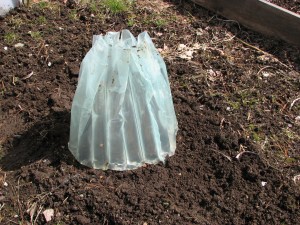
That said, I planted a Jet Star tomato in the garden on May 7. I teach Sustainable Gardening at Granite State College, and wanted to show my class how to plant a tomato sideways to develop a bigger root system (more on that later). After planting it I installed a “Wall-o-Water.” This is a flexible plastic cylinder that consists of baffles that I filled with water and then gathered together at the top to form a sort of teepee. The water heats up during the day, and gives off heat at night – and holds it in. I put one over a tomato plant last spring in early May and it went through several frosts without harm. They are available at garden centers and from Gardeners Supply (www.gardeners.com). They are reusable.

Tomatoes Sideways
Planting tomatoes sideways is good way to establish a bigger root system, and to deal with long, lanky plants that might otherwise flop over. I use my CobraHead weeder to loosen the soil in an 18-inch diameter circle and mix in some compost and bagged organic fertilizer.

Stripping tomato leaves
Then I strip off all the lower leaves from the tomato, leaving just a cluster of leaves at the top. Next I dig a hole for the rootball and a trench for the stem, and place the tomato in the soil (placed sideways) and cover it over with soil. I bend up the top few inches of the stem so that the leaves are above the soil line. It may seem to you that the stem will break, but it won’t.
If you have started broccoli, cabbages, kale or Brussels sprouts indoors and have floppy plants, you can plant the rootball and stems deeply, so that the thin stems are buried.
I believe that everyone should grow rutabagas, parsnips and kale, all under-appreciated plants that grow well, and are tasty. Plant rutabagas and parsnips by seed now, following directions on the packages. Kale is slow to start, so it is best planted now as seedlings. I find Winterbor kale the most productive, but Lacinato and Red Russian are also terrific. Good garden centers will have more than one type of kale.
Whatever you grow, remember to water when the plants are little. And don’t let the soil dry out where you have planted or you can lose your crop before it even starts. Gardening really is very easy: visit your garden every day, water if dry and pull a few weeds. You’re bound to succeed.
Spring has sprung
Spring really is here in Cornish Flat, NH. I know that we stand a chance of frost, so I am not planting frost sensitive plants. But I have onion plants in the ground, as well as some small lettuce plants and spinach I planted indoors back in March.
wall-o-water
I planted one tomato plant on May 7 and then enclosed and protected it with something called a “Wall -o-Water”. This is a water filled teepee made of plastic baffles. It heats up during the day, and holds in warmth at night. It supposed to protect plants from frost even if it gets down to 24 degrees!
primroses-on-may-6-2011
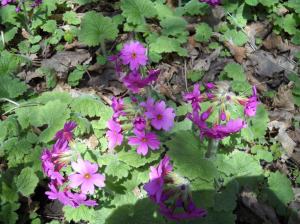
My primroses are blooming like crazy, especially one called Primula kisoana. It is a nice magenta, and spreads by root.
If you are looking for more spring activities, I suggest you read my new book, “Organic Gardening (not Just) in the Northeast: A Hands-On Month by Month Guide. It is organized by the month, so you can see what I do in April and May, for example.
Lawns, and the Machines Available to Work on Them
Most guys love machines, the bigger and louder the better. And before you take me to task for that comment, answer this: who in your family usually uses the chain saw, the lawn mower, the rototiller and the snow blower? In my experience it’s the guys. Not always, but most often. So spring is here, and the guys (and a few intrepid women) are itching to get out the chain saw to cut up the pine branches that broke off last winter and then get to work on the lawn.
Me? I’m not much of a machine guy, so to learn about the various motorized options, I visited Upper Valley Equipment Rental on Bridge Street in West Lebanon, N.H. and talked to Brian Henry, the manager. We looked over his arsenal of machines: a power broom, a lawn de-thatcher, a core-aerator and a 40 inch sweeper with a bristle brush, and I went home with a power broom to try out.

power broom
The power broom is actually an attachment that goes on a string trimmer (also known as a weed whacker). It consists of a rotating cylinder with rubber paddles that lift and push debris forward. The one I rented weighed 25 pounds, but because the motor and blades are at opposite ends of a 6-foot handle, the machine requires a certain level of strength and endurance (your 80-year old mother should not attempt to use it).
The power broom works: you can push a lot of debris with it. My lawn is quite soft and I found that if I didn’t keep moving the machine forward, it was possible to damage the grass and dig a depression. I see it as best used to clean up a paved driveway or the shoulder of the driveway with sand and gravel left from the winter. I still prefer a rake to a power rake, even though an old fashioned rake takes more time.

core-aerator
The core-aerator is a machine designed to make your lawn less compacted – and thus to grow better. It extracts plugs of turf from compacted lawns, allowing you to get compost and fertilizer into the soil. As I explain in my new book Organic Gardening (not Just) in the Northeast, you can test your lawn for compaction by trying to plunge an ordinary 6-inch screwdriver into the lawn up to the hilt. If you cannot easily do this, your lawn is compacted and you may wish to rent an aerator. It pokes holes 2-3 inches deep and half an inch across. The plugs extracted fall out on the lawn (and would eventually break down) but most people would want to rake them up. Spreading compost after aerating is a way to get organic matter into the lawn, increase biological activity to soften and loosen the soil.

Sweepster
I also looked at a walk-behind “Sweepster”. The one I saw had a 40-inch stiff-bristled brush on a rotating drum. It reminded me of a street sweeper, but it pushes the debris forward and does not pick it up. Since I have no pick-up truck I wasn’t able to bring one home, and (as a confirmed Luddite) I am not sure I need one anyway. Again, it would be great on driveways, and might also serve to clean thatch, or accumulated dead grass, out of the lawn.

dethatching
Speaking of which, I got a demonstration of a dethatching machine at the rental center. It≠s a walk-behind machine with lots of short metal blades designed to loosen and lift dead grass. If you have biologically active soil, the organisms in the soil (including earthworms) should breakdown your grass clippings, precluding the need for a dethatcher. But if you apply lots of chemicals to the lawn, you may wish to rent one, as chemicals tend to minimize biological activity. The machine would be good for scuffing up the soil in order to apply seed to an existing lawn, too.
Small engine repair shops are busy tuning up lawn mowers and sharpening the blades. If you are mechanically inclined, you can sharpen the blade yourself by removing it and using a bench grinder or coarse file to mimic the angle of the blade set by the manufacturer. If it has been warped or bent by hitting rocks, stumps or dog bones, you should replace the blade.
If you set your blade at 3 inches or more, you can minimize crab grass growth – effectively shading it out. If you want to minimize weeds in the lawn you can spread corn gluten. It is a corn product that should be spread now, during the period between the blooming of forsythia and lilacs. But it is not a miracle (some weeds will get established anyway), and for best results should be used 3 years in a row. Microbes in the soil break down the gluten, releasing peptides that inhibit root growth – of weeds, but also of any grass seed you might use, so don’t use it if overseeding the lawn now. Corn gluten contains nitrogen and acts as a fertilizer, slowly releasing nitrogen as your microbes break it down.
The best spring activities for improving your lawn, besides cleaning it up, are spreading some compost over it and adding some good grass seed. Half an inch of compost spread with a shovel and rake will energize your lawn, and adding grass seed will fill in the thin spots. So pick your weapon of choice – either motorized or manual – and get to work. Summer will be along soon.


