-

Now available for $24.95 including shipping. -
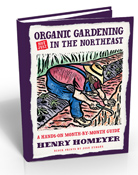
Now available for $21.00 including postage. Vendors I Like
 Click Here to buy from Cobrahead
A Cold Wet Spring
I’m tired of cold gray days, drizzle and downpours. My vegetable garden is so wet I should be fishing there, not gardening – though I am doing neither. Last spring we had hot weather early and our plants started off much too fast. Then a hard frost came that killed early fruit blossoms. Each year is different. Meanwhile, what can we do?
First, don’t worry about the fact that flowers are 2-3 weeks late in blooming. They will eventually bloom, and most early blooming plants are not damaged by a little frost, should we get some more, and we may. Last year I took pictures of my February Daphne (Daphne mezereum) in full bloom on April 4, and as of April 24 it still had not bloomed.
Don’t jump into your usual spring lawn and garden work yet √ or not unless your property is a lot drier than mine. If your shoes making dents in the lawn, or if you hear a “squish”, stay off the lawn. For flower beds, try using a 5-foot long plank to walk on if you must get in them to work. That will distribute your weight nicely. If you have two planks (each 6 inches wide), you can move from one to the next.
Rototilling now is definitely a no-no unless you have sandy soil on a hilltop. Grab a hand of garden soil, squeeze it with your fingers, and open your hand. Touch it lightly with a finger. If the soil does not crumble, it is too wet to rototill. Heavy clay soils hold water, and may never fall apart with a gentle touch √ unless you work in lots of compost. Rototilling too early can ruin soil structure.
You can, however, start seeds indoors now. I have about 300 seedlings started indoors, growing under lights. Lights are important. I know some gardeners grow a few tomatoes on the window sill, but growing plants without supplemental light generally results in spindly plants that are pale and reaching for the sun. A 4-foot, 2-tube fluorescent light will illuminate 2 flats (72 seedlings or more, depending on the size of the cells in the 6-packs). Lights are a good investment.
Keeping the light near the seedlings is important. I hang lights above the plants, keeping them 6-10 inches above the leaves and raising the lights as the plants get taller. It’s also important to let your babies sleep at night. Fourteen hours of light is plenty. It’s good to let temperatures in the room with the seedlings hover around 60-65 degrees, too and even cooler at night.

pruning
This is a good time of year to do some pruning. You can prune fruit trees and blueberry bushes now. Learn to recognize the flower buds of each, so you will know what you are pruning off. Apples and other fruit trees bloom on short (3-4 inch) fruit spurs that are more than one year old.

Fruit spurs
Fruit spurs are most commonly present on “scaffold” branches, those branches that extend outwards from the trunk at about a 45 degree angle. If you want to turn a small vertical branch into a scaffold branch that will eventually produce fruit, you can bend the branch by hanging a weight on it for a couple of months. Hang a plastic bottle on the branch, and add water to get the weight you want.
I recently attended a pruning workshop led by Bill Lord, a now retired UNH Extension fruit specialist. He said that older branches on blueberries that have no fruit buds this year probably won≠t have any in the future, and that you should prune off those limbs to stimulate new growth. The fat buds that will produce fruit are usually toward the tips of vigorous young branches – those 6-10 inches in length. Those branches generally produce the strongest buds. The smaller buds elsewhere are leaf buds. Bill said that each fruit bud can produce 5-10 berries!
This is also the time of year to get your soil tested. Call your Extension office, or ask Mr. Google where you can get it done. It only takes a few minutes to collect a sample, and a test can tell you much. Blueberries, for example, need very acidic soil (pH 4.0 to 5.5) to be productive. A soil test will tell you how much garden sulfur (approved for organic gardeners) to add around your plants. Blueberry roots grow in mats near the soil surface, so just sprinkle the sulfur on the soil to avoid damaging roots.
When getting soil tested, also have your soil tested for heavy metals like lead. It≠s an extra fee, but ingesting lead can harm you or your children. And get a test done to measure the amount of organic matter in the soil: you want 4-8% in for good vegetable production.
Spring will get here, eventually. Meanwhile, be patient. Take some time now to read a gardening book on a cold, raw day – perhaps even my new one. You might even recognize some of your favorite articles from this column.
Growing Grapes
Each fall I enjoy a special treat: munching the sweet-sour flavor of grapes I have grown. I generally eat them outdoors as they are full of seeds, and I enjoy spitting out the seeds, much as I did as a boy. I like to see how far I can spit them, and whether I can hit objects accurately. That≠s puerile, for sure. But it≠s good to be a kid again, especially as an adult old enough to qualify for Social Security.
According to my best reference text on growing grapes organically, The Grape Grower: A Guide to Organic Viticulture by Lon Rombough (Chelsea Green Publishing, 2002), there are some 10,000 varieties of grapes, and less than 1% of those are seedless. Grapes are supposed to have seeds, that≠s how they reproduce. We have been spoiled by 3 common grocery store varieties that are seedless, most notably Thompson≠s Seedless, which dominates the market.
Here are in the Northeast we can grow grapes for eating or for wine, despite the reputation of California as the place for wine grapes. According to the catalog of Elmore Roots, an organic nursery specializing in cold-region fruit plants, there are several good wine grapes to choose from. I called David Fried, owner of Elmore Roots, to talk about grapes recently. He told me that King of the North and Sabrevois, both red grapes, were the best for making wine. Six plants can produce enough grapes for making wine.
And for eating? Fried says Bluebell is the best. The fruit is pinkish-purple, and is great for eating fresh, or for making juice or jelly. It is disease resistant and survives frosts quite well.
So what do grape vines need to thrive? Full sun and good air circulation. Air circulation is important because low spots that have poor circulation tend to encourage fungal diseases. Growing on a hillside is best, preferably a slope facing south or east. Growing them on a stone wall works well, too, as the wall provides extra heat.
According to Rombough≠s book, ≥The ideal soil for best vine growth and production, especially of table grapes, is a deep, light silty or slightly sandy loam.≈ Rombough suggests digging some test holes 2-3 feet deep to see what the soil is like √ if you are on a rocky ledge, see where the deepest soil is for your grapes. He says you rent a power post hole digger to make test holes. David Fried noted that sandy soil in full sun is best.
Test the pH, or acidity of your soil, before planting and make adjustments as necessary. Soils with a pH of 6.5 to 7.2 are best. Remove grass, weeds and other competitors for nutrition from the area where you will plant your grapes. Rombough suggests planting grapes so that rows go along with the prevailing winds, which for me is east-west. That will help to dry out the vines in wet times, minimizing fungal problems. He says to plant roots 8 feet apart, and rows 8-12 feet apart if you are starting an orchard. And if you have bought grapes grafted onto a root stock, do not plant them deeply. The graft union (place where the roots and the tops were joined) should be above ground.

prune grapes
This is the time of year to prune grapes. They produce grapes on shoots that were new last year. Pruning now stimulates new growth that will produce grapes next year. And if you do not prune each year, your grape vines will develop into an unmanageable mess. An un-pruned vine may produce lots of blossoms, but the quality and size of the fruit will not be good.

Grapes grow well on trellises or wires.
Grapes grow well on trellises or wires. I have 2 rows of wire attached to my barn for grapes to grow on, but they are so vigorous that if I didn≠t prune off new growth each year, they would engulf my small barn and cover the windows. I wouldn≠t be able to reach the grapes for picking. The Grape Grower: A Guide to Organic Viticulture has excellent drawings of ways to set up wires for your grapes, and how to prune.
I hesitate to give advice on how to prune grapes, as I am still learning. Rombough≠s book shows a thick stalk coming up from the ground, with sturdy lateral arms attached to the wires, which I have. Each year I am supposed to cut off most of last year≠s vigorous new growth, leaving some short spurs on those lateral arms to produce this year≠s fruit.
I have just 3 grape plants, 2 growing on a trellis in front of my barn, and one growing on a cedar arbor I built years ago. I have a very high water table √ there is a nearby brook √ and I am surprised that my grapes have survived. But in my experience all vines, including grapes, are tough and adaptable. I don≠t get a huge crop and I share it most years with the birds, as they do love grapes √ and some years they are more attentive to my grapes than I. A flock of cedar waxwings can √ and will √ eat all my grapes in one sitting, those greedy gluttons. Maybe I should rent an owl – or buy a plastic one to live near my barn in grape-picking season.
Making A Spring Wreath
A friend recently pointed out to me that the evergreen spray I≠d put on the front door back in December looked pitiful. It did. Funny how I can not notice the obvious. I decided that the time had come to put something else on the front door, something that shouted, “Spring and summer are on the way.”
I like making wreaths. A spring wreath using pussywillows, red-twigged dogwood and alder branches seemed like a good idea, so I headed off to find twigs alongside the road. All three plants are native to New England, and plentiful in wet areas.
Pussywillows (Salix alba, S. caprea or S. discolor) are weedy little trees or big shrubs whose major virtue is that their male catkins are furry fellows that perk up an otherwise drab time of year. And pussywillows are tough. They will grow in water-logged soil that would be fatal to the root systems of most other trees or shrubs. On the other hand, they are weak wooded and often scraggly. But at this time of year they are in their glory.
Elsewhere along a roadside I’d noticed the brilliant red stems of redosier dogwood (Cornus sericea). The redosier dogwood is a native shrub that, like pussywillows, does well in wet locations. Tatarian dogwood (C. alba) is a landscape plant that is sold for its red twigs, too. New growth on either is brilliant red, particularly in winter. Second year growth turns gray, with just a hint of red.
Anyone who grows red twigged dogwoods needs to prune them severely each year to keep them from looking drab. The town road crew had done a good pruning job- early last summer their brush hogs had cut plenty of red-twigged dogwood right to the ground. The stems were bright red- and free for the cutting. A healthy dogwood can grow 2-3 feet in a single season.
I have generally considered black alder (Alnus glutinosa) a nuisance plant that fills in and takes over around my stream. In researching this article I learned that they do have a virtue: they are nitrogen-fixing plants, so they improve the soil. Alders have male and female flowers. The male flowers are typical catkins but the female flowers resemble cones. Last year’s seed producers are still visible and handsome.
Rather than using a wire form, I made a simple grapevine wreath that allowed me to squeeze twigs between the vines. This reduced the need to use wires to attach the twigs, though I did use some florists wire to help attach twigs in places. This very thin wire is green, and easily cut with scissors.
I went to the woods and cut a fifteen foot length of grapevine that was about as thick around as a pencil. It is important to use fresh, not dead, vines; the one I cut was a greenish white inside and flexible, so I knew it would work well. Grapevines are readily available and produce good food for our feathered friends, although they can choke out some trees if left to get huge.
To make the wreath I formed a vine circle about 16 inches in diameter by overlapping (or twisting) one half of the vine over the other half – the same way I start tying my shoelaces. Then grasping one of the loose ends I wove it around the vine circle in tight loops. When I ran out of vine I tucked the end into the circle and repeated the maneuver with the other end of the vine. When done the grapevine wreathe was about an inch and an a half thick and 18 inches in diameter.
Next I cut some pussywillow twigs 12 to 18 inches long and tucked them into the wreath one at a time, forcing them into the crevices between the vines. Sometimes it was tough to force a twig into the wreath as the bent vines make an almost impenetrable barrier in places. I used a screwdriver to pry the vines apart to make room for twigs if needed. The pussywillow twigs followed the contour of the wreath, but extended out beyond it.

Spring Wreath
Then I took redosier dogwood and alder twigs and tucked them into the wreath, again spreading the grapevines apart and letting the natural tension hold them in place. I cut them a bit longer so that they stuck out further from the grapevine portion of the wreath. I selected alder twigs that had the cones and catkins.
When completed the wreath was about 36 inches in diameter, and had a distinctly porcupine-like appearance. I ended up putting it on the wall near the front door, as it shows up better there than on the natural wood colored door.
Spring has been slow to arrive this year, and I’m more than ready for its arrival. Making a spring wreath has helped a little.
Selecting Seeds
Buying seeds is just like getting tickets for a Rolling Stones concert. Well, maybe not exactly, but in either case itâ≈ s good to get them early, before they are sold out. I’ve already missed the boat on one variety, but think I have everything else I need – and some are already planted indoors.
Last year I grew a broccoli-type green called Piricicaba, that I got from Fedco Seeds (www.fedcoseeds.com).When I called them in late March, it had already sold out. Dang. They are the only supplier I know of that sells them, though I suppose that Mr. Google would help me find them if I were really keen on it. Fortunately I got a similar green from Johnny’s Select Seeds (www.johnnyseeds.com or 877-564-6697) called Happy Rich, which is a name I like. Hasn’t made me rich yet, but it does make me happy.
Happy Rich (like Piricicaba) makes broccoli-like florets but not big heads. It is only 50 days to harvest, and is very tasty raw or cooked – unlike broccoli raab, which is bitter until cooked. The stems and leaves are good to eat, too. It produced food until Thanksgiving and it froze well for winter eating.
This year I bought a packet of purple mustard greens, a variety called Osaka Purple. Many mesclun mixes contain a few mustard seeds, and Iâ≈ ve developed a taste for those very spicy leaves, so this year I will sow them in a bed of their own. I got mine at the Boston Flower show from a company called Landreth Seed Co from New Freedom, PA. Landreth is the oldest seed house in America, founded in 1784. Osaka Purple is fast â√˚germination in as few as 4 days and 40 days to harvest.
Also new to me this year is the southern favorite, collard greens. Visiting the diverse seed racks at Gardnerâ≈ s Supply Companyâ≈ s store in Burlington, VT I found them from Botanical Interests, Inc. â√˚another seed company I’ve not tried before. The package says collards grow under more adverse conditions than lettuce or cabbage. They can be picked small for salads or cooked. They produce well in hot summers even though they are related to kale, a cool-weather crop.
Another green I am trying this year is spreen. Its Latin name is Chenopodium gigantium, which tells me 2 things: it is related to the common weed, lambs quarters (and also to quinoa). And it should be a big plant if left to grow tall. The description says this variety, Magenta Spreen, has young leaves “dusted with a beautiful iridescent magenta”. And it says to pick when 6-8 inches tall – I will try it in salads and lightly cooked. I will be careful not to let it blossom and distribute seeds since it is related to a weed. I got it from Johnnyâ≈ s Seeds.
I am planting flint corn this year, the corn that you dry and grind for cornmeal or polenta. Corn takes a fair amount of space, and you cannot crowd it – plant it too close together and you get small ears. Seeds can be planted 8 inches apart in a row, but only one row per 30 inch-wide bed. And instead of one long row, itâ≈ s better to plant 4 short rows for better pollination. I got my seeds from High Mowing Seeds at the Upper Valley Food Coop in White River Junction, VT.
I haven’t planted flint corn before, and itâ≈ s been 25 years since I grew sweet corn, but farmers tell me that warm soil temperatures are critical. The soil must be warm at planting time. I’m thinking of using a “plastic mulch” – laying down a layer of clear plastic before planting.
Clear plastic mulch lets the sun rays warm up the soil directly (as opposed to black plastic which warms up, and then radiates heat to the soil, a less efficient way). I once tested the temperature under clear plastic spread out with the edges sealed off to contain the heat. On a sunny May afternoon in the sixties, it was in the 90s under the plastic. I”ll pull of the plastic before I plant.
I’ve never had much luck growing melons or watermelons. Talking to a seed tester at Johnny’s Seeds in Maine in February, I was told that there is a hybrid cantaloupe/muskmelon that will do in my short New Hampshire summer: Sarah’s Choice F1 hybrid. He sent me a packet to try, so I will.

Photo by Johnny's Seeds
By the way, the information on Johnny’s Seeds packets is more complete than on any others I have ever found. It says to start (Photo by Johnny’s Seeds) cantaloupes indoors in 3-4 inch pots a month before last frost, and to pre-heat the soil with plastic mulch to get a good start. The soil should be 65 degrees at planting, the pack said. And though I know this for all vine crops, it warns to plant with as little disturbance to the roots as possible.
Sometimes I wish I had an acre of sunny garden so that I could grow everything I wanted, and in quantity. Fortunately, I do not – so I have a life, in addition to a garden!