• Wobar and the Quest for the Magic Calumet
    Now available for $24.95 including shipping.
  • Now available for $21.00 including postage.
  • Recent Articles

  • Vendors I Like

    click here to buy from Cobrahead Click Here to buy from Cobrahead
  • Cobrahead

    This is the best darn weeder made in the country, and I think I've tried them all. I use it to dig weeds, tease out grass roots, and mix soil at planting time. Neither right nor left handed, it is lightweight and strong.
  • West Lebanon Supply

    I buy all of my organic fertilizers and soil amendments at West Lebanon Supply. They carry several lines of seeds, watering devices, tomato cages, landscape fabric and much more. They also sell pet supplies - and allow dogs in the store!
  • E.C. Brown Nursery

    E.C. Brown Nursery has an amazing selection of high quality trees, shrubs and perennials. The staff is incredibly knowledgeable. Looking for something unusual? E.C. Brown Nursery probably has it.

Self Watering Planters


I recently got a copy of Ed Smith≠s revised and improved book on growing vegetables in self-watering planters, The Vegetable Gardener’s Container Bible (Storey Publishing, 2011), and decided that making one of his containers might be a good thing for a bored gardener to do before the gardening season begins.

Ed Smith has boiled down years of experience into simple language that anyone can understand. He recommends using self-watering containers instead of traditional pots because they do a better job of keeping the soil evenly moist- a key to success, particularly with veggies.

His book explains that plants are mostly water, so they need water to stay healthy. They need it for photosynthesis (to manufacture carbohydrates) and to carry soil nutrients throughout the plant. Ed explains that plants do best in biologically active soils, those that are “teeming with mostly microscopic creatures that supply plants with food, creatures that help them to assimilate food, creatures that help protect plants from predation and disease.” And those critters need moisture.

Self watering containers

Self watering containers

Water is also needed to cool plants in the heat of summer by the process of transpiration – which is the plant equivalent of sweating. In the process of losing water, “transpirational pull” is created – a force that sucks up water from the ground, bringing along soluble nutrients. Ed’s book explains that “Transpiration is the plant’s substitute for a heart; it is the way a plant moves fluids within itself.” A mature tomato plant in mid-summer can use a gallon of water a day.

Self watering containers have water reservoirs so that plants don≠t dry out quickly – sometimes holding 4 gallons or more. And the bottom line is this: when the soil is too dry, all biological activity stops – both in your plants, and in the microorganisms that nurture and nourish your plants.

The Vegetable Gardener’s Container Bible explains that a light, fluffy soil is essential for growing veggies well in pots. Plant roots and soil organisms need oxygen to thrive, so a fluffy soil does better than a compacted one. Ed’s recipe for success is to make a 50-50 mix of potting soil or peat moss with good quality compost.

The potting mix I bought was a bit heavy with sand, so I modified that recipe a bit: I mixed 12 quarts of potting mix and 12 quarts of compost with 2 quarts of perlite, a heat-expanded mineral that looks like bits of white Styrofoam. Perlite holds water on its surface and keeps the mix fluffy but adds no nutrients.

Ed’s book suggests that you can offer a well balanced diet of plant nutrients by adding blood meal, rock phosphate and green sand to the mix. Unlike chemical fertilizers, these nutrients are taken up slowly by plants, so your plants get a nice even supply. He suggests a third of a cup of each for each 40-quart batch of planting mix. Me? I add a cup of Pro-Gro, an organic fertilizer that has all those ingredients, and a quarter of a cup of limestone.

Big self-watering containers can be expensive. A good quality 40-quart container with a 4-gallon reservoir that will be adequate for a big tomato or 4 peppers will cost you about $40. But you can make your own container if you prefer, and I’ve done so for a fraction of that cost. Here is what I did, using Ed≠s good descriptions and photos.

I bought an 18-gallon plastic storage bin that came with a lid, and a 10-foot section of 4-inch vinyl downspout (enough for 4 bins). I made marks on the inside of the container at the top of the water reservoir, 5 inches from the bottom of the bin, and measured the width and length. I wanted to cut the lid to fit inside the bin at the top of the reservoir, so I transferred the measurements onto the lid and drew lines to guide me. I used tin snips to cut the lid, which, admittedly, is a bit of hard work (a jigsaw might work better).

At the lumber yard where I bought the downspout I asked a fellow to cut some 5-inch pieces for me with the “chop saw” used to cut lumber. He accommodated my strange request and I ended up with perfectly cut pieces (I could have used a hack saw to do the job at home).My planter needed 6 pieces of 5-inch downspout (spacers) to adequately support the lid – now the base of the soil compartment – sitting inside the bin.

To wick the water up into the soil compartment, I cut 2 holes in the lid (each hole a little smaller than the downspout I used as spacers). I attached two spacers right below the holes and later filled them with potting mix. To attach the spacers to the lid, I drilled small holes in the lid and the spacers, and wired them in place. That prevents them from moving. The wicking spacers are perforated – each has a dozen three-eighths-inch diameter holes drilled in it. Lastly I cut a fill-hole in the side of the bin at the top of the water reservoir.

The Vegetable Gardener’s Container Bible is full of good information on growing specific vegetables √ including unlikely candidates for containers like sweet corn and artichokes. I may grow an artichoke or some hot peppers in containers this summer, and then see if I can overwinter them indoors as both are perennial in warm climates. And in the meantime, I≠m making more containers. Give it a try!

Early Spring Chores


Spring in Cornish Flat

Spring in Cornish Flat

Spring in Cornish Flat comes in fits and starts. Warm sunny days are followed by cold rain – or even by snow. Spring is technically here, and I have started a few seedlings indoors (onions, artichokes, peppers, some early greens) but I will wait until April to plant most things indoors. No sense in babying tomatoes for 12 weeks – 8 is enough.

Each year the snowplows dump lots of sand and road dirt onto my lawn. I try to shovel the dirty snow back onto the road before it all melts. I do this because it is easier to shovel it now than rake it later, once it has all settled into the grass. And dormant grass in the early spring is susceptible to being damaged by my rake. It≠s important to wait until the grass is no longer dormant and the soil has dried before raking the lawn.

I haven≠t started pruning fruit trees yet, though the time is ripe. I wait until most of the snow is gone before pruning mainly because it’s hard to set up my ladder and carry off the branches in deep snow. Since I prune professionally, I can’t afford to wait too long – I need to finish all pruning before the buds open up in late April or early May. There is still knee-deep snow around my trees, so I haven’t gotten started anywhere.

I took my bucket of kitchen vegetable scraps down to the compost pile recently and found that the snow was deeper than I≠d thought – I fell through the compacted crust up to my knees. That happened despite some rain and warm days in the preceding days. Spring technically arrived on March 20, but winter in my neighborhood is being a bit feisty.

composting

composting

Many gardeners give up on composting during the winter months. Not me. I keep a 5-gallon pail under the kitchen sink and I don≠t find that it gets odiferous even though I only empty it once every week or two in the winter. Still, my compost pile is far away, and I’ve been wearing snow shoes to get down there. My compost pile is enclosed by 4 wood pallets, the kind that freight is delivered on, and the winter’s accumulation – mixed with layers of ice and snow – is nearing the top.

During the cold months all the microorganisms that would normally breakdown the vegetable matter are resting. No matter. When warm days arrive, the critters will get to work. But unless the compost pile has the proper mixture of ingredients, moisture and temperatures it is a very slow process – a couple of years until it’s ready.

The bacteria and fungi that break down compost need both carbon-and nitrogen-based materials. Good sources of carbon are leaves, hay and most brown matter. Things with lots of nitrogen are green leaves or grass clippings, manure, vegetable scraps and coffee grounds. A little nitrogen added to a compost pile will help to get quite a bit of carbon-based materials to break down.

There are many kinds of microorganisms in a working compost pile. Aerobic bacteria are the workhorses of the process; they require oxygen to live and reproduce. Anaerobic bacteria are the “bad boys”. If your compost smells like sulfur or rotten food, you have bacteria that thrive in an environment that has little or no oxygen. Some gardeners turn their compost piles to aerate them, or use a harpoon-like “compost hook” to create pathways for air. I rarely do either, though I did buy one of the harpoons to see if it made a difference. I didn’t see that it was a worthy investment.

Later this spring, I’ll take a garden fork and poke around in my compost pile. If it’s too wet, I’ll add dry hay or leaves to help dry it out and let in more air. Or I may even turn the pile, moving unprocessed matter to one side and adding some aged manure to speed up the process. At the bottom of the pile there should be some good old compost to use in the garden.

early bulbs

early bulbs

This is also a good time to see where you need to plant spring bulbs next fall. Take some pictures or place tags to show where the snow melts off first, and where you need some early bulbs. I like having early bulbs to herald spring: the earliest white snowdrops (Galanthus spp.), rich blue and purple scilla (Scilla siberica) and glory-of-the-snow (Chionodoxa luciliae).

Crocus

Crocus

Crocus are good, too, and some can be quite early – though nothing is as early as snowdrops. Actually, winter aconite (Eranthis hyemalis) flowers can be almost as early as snowdrops. They’re low yellow flowers, though they don’t do very well for me here in Cornish Flat. Instead of multiplying like my snowdrops, they seem to disappear one-by-one over the years. I need to replant some this fall.

In any case, don’t be discouraged by late spring snows or slushy weather. The sun has real strength now, and it won’t be long before we are in our gardens.

Planting Seeds Indoors


This week I started my artichokes and peppers on 3/15. I planted them in 6-packs using a 50-50 mix of standard organic potting mix from Moo-Doo, and compost. The compost provides some extra nutrition that peat-based starting mix does not have.

I also started arugula for early greens in my salads, and a new (to me) green or herb called Saltwart. I did one flat of seedlings, and placed them on an electric heat mat designed for the job of warming the soil. Today, 3/20, is the first day of spring and the two greens are up!

Today I am starting spinach seeds indoors in soil blocks. See either of my books, The Vermont Gardner’s Companion or The New Hampshire Gardener’s Companion to learn more about how to do this. Both are available at bookstores, or from my Web site, www.Gardening-Guy.com.
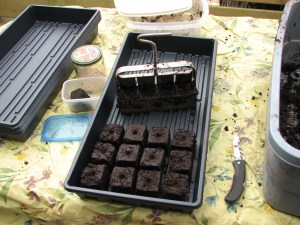
soil-blocks

soil-blocks

Meanwhile, my onions and leeks  planted indoors on March 1 are up and looking good. The shallots, a variety called Prisma, did not germinate well, or are very slow in germinating.

Planning and Designing a Serenity Garden

Posted on Wednesday, March 16, 2011 · Leave a Comment 


I know that spring is on its way, but in my garden spring plants are still buried deep in snow. So I spend time reading and thinking about what I might do later when the darn snow finally goes away. Even if you are starting to see bare earth, it is still too early to do much. I recently attended a nice talk at the Vermont Flower Show by garden designer Jeanne Daniele of Barre Town, VT. She spoke about how to design a “Serenity Garden” and I≠d like to share some of her ideas.

Jeanne Daniele defined a Serenity Garden as an “escape room” – a place where you can go to relax and get away from the outside world. She noted that small spaces are conducive to serenity, and that you will want design something that is quiet and secluded. Begin now, she said, by measuring the space you wish to develop and doing some basic drawings.

If you live on a busy street, Jeanne suggested screening your serenity garden so that you have privacy. Plants are the ideal screen, but they take time to fill in and really do the job. She suggested a fence as a temporary measure – a wooden stockade fence 8-foot tall will certainly do the job. My suggestion? Plan your garden behind the house and away from the road so you won’t need a fence.

But Jeanne said you can plant visually interesting shrubs like lilacs or forsythia in front of evergreen trees to create privacy over the long term. She suggested using 2 rows of plants spaced so that plants in the second row are staggered in such a way as to fill in the visual gaps of the front row.

A thick hedge will do much to minimize the obtrusive sounds of cars and trucks on the street. She also suggested that you can create pleasant sounds to mask the noise of the street. A burbling, re-circulating water feature will create gentle sounds. She also noted that you can install speakers and play a tape of pleasing sounds. I vote for natural sounds, and Jeanne did note that a nice serenity garden can attract birds that will add to the ambience.

Clutter is the enemy of serenity, according to Jeanne. A lovely flower bed filled with dozens of blooming flowers may not enhance your sense of calm if the pattern is too busy. Select just a few colors and types of flowers, and grow them in quantity. Instead of having lots of small clumps of brightly colored flowers, have fewer, larger clumps. Blues, grays and greens are relaxing and soothing. Hot pink or red? They might be lovely flowers, but they can be visually jarring. Plant them elsewhere if you need them.

Where do we go to relax? For many of us it is to the beach or a lake. That makes sense in her framework: there is a vast expanse of blue or green water, and very little clutter. There is sand or rocks, water and sky. Very relaxing. Think of that model as you design your serenity garden.

Repetition is relaxing, too. Forests can be very serene, in part because there is the repetition of tree after tree as far as the eye can see. If you want to develop a portion of your property to incorporate a wooded area, get rid of the clutter. By that I mean get rid of the shrubby, weedy undergrowth and prune off low branches. I find visiting cathedrals very relaxing – they are quiet and have high ceilings. So I like to prune off branches up to 20 feet if I can, creating that same feeling.

Jeanne Daniele explained that the texture and shape of leaves can affect your mood, too. She said that round, fuzzy leaves are very relaxing, but that pointed, shiny leaves are much less so. Most perennials only bloom for a couple of weeks, so selecting plants with attractive foliage is important – the leaves will be there all summer, long after the flowers have faded and gone.

Another suggestion she had was to enclose the space of your serenity garden and have a defined entry point. A gate or an arbor tells visitors that they are entering a special place. We tend to feel most at ease when we have our backs to a wall and can see everything that is entering our space. “It gives us a feeling of reassurance and protection from the outside world,” she said.

Relaxing Space

Relaxing Space

In order to have a truly relaxing space we need to have a good place to sit down. You will want something truly comfortable. Stone is cold and hard, so put wooden Adirondack chairs or nice recliners for yourself and your loved ones – or a hammock if you are so inclined.

I find that shade is important for me – after working in the vegetable garden I like to have a cool shady spot to have a cold drink and relax before tackling the next project.

Lastly Jeanne suggested that your serenity garden be low maintenance. If you have to prune and weed constantly, you have the wrong plants, she said. Shady areas are generally less weedy, but select your plants with care to find ones that take care of themselves. Plant densely and mulch to keep down the weeds.

So take some time now to think about creating a special spot, a place where you can relax in serene surroundings.

Filed under Article, Uncategorized · Tagged with

Hastening Spring

Posted on Wednesday, March 9, 2011 · Leave a Comment 


Most years I am picking snowdrops by early March. Not this year. I have more than two feet of snow on the south side of the house where I’ve planted my early spring bulbs. It’s a nice sunny spot on a gentle hillside, a place where no snow falls off the roof. I’ve read that a south facing slope with a 5% pitch will cause spring bulbs to bloom as early as if they were growing 300 miles to our south, say Philadelphia. I will probably shovel some snow off that bed to speed up the process, but right now there are still snow banks 6 feet tall to climb over to get there. Sigh. I’m so ready for spring.

daffodils

daffodils

But I’ve done a few things to hasten spring – at least inside my house. Last fall I potted up daffodils and tulips and let them rest in a cold part of the basement. In mid-February I brought up the first containers of bulbs, and the daffodils are alreadyblooming. In addition to some nice rectangular Italian terra cotta containers (14 x 6 inches, and 6 inches deep that contain a dozen bulbs), I planted up my big cedar window box that I made years ago (and described in a column). It holds 30-40 bulbs and will be a great display.

I’ve gone to three flower shows already (Providence, Hartford and Vermont), and can’t leave any show without purchasing a few things in bloom. I bought blooming pots of crocus and Tete-a-Tete daffodils, those small ones that bloom early outdoors. At the Vermont Flower show I got a new variety of a perennial that I grow, a foamflower (Tiarella cordifolia) called “Lace Carpet” that should bloom well in the shade and spread by root. I’ll have to keep it indoors on a windowsill until the ground thaws.

forced bulbs

forced bulbs

If you buy a small pot of forced bulbs, think about displaying them somewhere unusual, not just on the dining room table. My favorite way to get a giggle is to place them poking out from a pair of boots. It will cause you – and your friends and loved ones- to do a double take, and then pause to look more carefully. Other places might include in a crock pot or blender on a kitchen counter, or on the toothbrush holder in the bathroom. E-mail me pictures if you come up with something that pleases you. (henry.homeyer@comcast.net) Blooming flowers help me get through the mud season.

Ten days ago I cut some forsythia stems, brought them inside, and placed them in a vase in a sunny window. They are now starting to bloom, even though sometimes it takes three weeks or more for forsythia to wake up and start blooming. The trick for a good forsythia arrangement is to cut stems that have plenty of fat buds and good long stems that will display nicely.

pussywillow stems

pussywillow stems

If the snow were not so deep, I would go get some pussywillow stems to force, too. Right now I would still need snowshoes to get to the wild pussywillows near the stream, and since I have other things blooming, I have not bothered to do so. You can wait until the pussywillows are already fuzzy, but doing so now is nicer – you can watch them wake up indoors. Once they look good, pour out the water in the vase and the pussywillows will not change – they will remain just as they are for months. If you leave them in water they will produce pollen and spill it on your tablecloth.

Apple and crabapple trees force nicely, too. March is traditionally the month for pruning apple trees, though it will be late March or April before the snows melt enough for me to get at my apple trees, I think. When you do your pruning, be aware that blossoms form on fruit spurs that are 2 years old (or older). These are short stubby branches – 3 inches long or so – that generally are found on branches that are parallel to the ground, or up to a 45 degree angle to the vertical. Those straight up, vertical branches generally do not produce flowers and fruit.

Over a year ago I asked you, my readers, if I should start a blog, or go on Facebook and Twitter. Most of you suggested a blog, but not to bother with the others. Slowly I have investigated the social media and have started a blog at your urging. To see it, go tohttp://henryhomeyer.wordpress.com. The publisher of my upcoming book, Bunker Hill Publishing, has urged me to twitter, and though I think it silly, you can now follow me on Twitter. Facebook? Not yet.

I like blogging. My weekly columns can only be 900 words, and I often have more to say. Blogging is good for that. And now that I have started seeds indoors and soon will be gardening outdoors, I hope to be able to pass on useful information on a daily or weekly basis that is not related to the weekly newspaper columns. I was a school teacher in the late sixties and early seventies, and I still enjoy teaching. Blogging is just one more way to do so. And sharing info about plants helps get me through the mud season.

Filed under Article, Uncategorized · Tagged with

Gardening Guy Kills Plant!

Posted on Wednesday, March 9, 2011 · Leave a Comment 


ivy-killed-by-under-watering

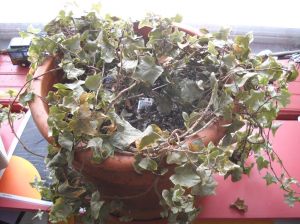
Ivy Killed by under watering

Okay, this is a warning to all you folks who have houseplants: spring is here. That means that your plants are speeding up Gardening Guy Kills Plant!their growth, particularly of roots. The sun is stronger, too, which means that your plants are losing water faster than earlier in the winter. And there are more hours of sunshine. This all adds up to a need for more water.

Rosemary is one plant that is very susceptible to drying out at this time of year. If you have been watering once a week, you’d better water twice a week. Sarah Milek of Cider Hill Gardens in Windsor, VT (www.ciderhillvt.com) tells gardeners in her wonderful herb workshops that ”A totally dry rosemary is a dead rosemary.” I tend to grow rosemary indoors in plastic pots even though they are not as nice looking to my eye as the old fashioned unglazed terra cotta pots. I do that as the clay pots dry out, wicking water away from your roots.

All of this is just to admit that it appears that I recently killed a nice ivy plant that I’ve had for several years. It is in a clay pot in a west-facing window that gets hot sun. I’ve been busy, and forgot to water it enough. It appears to be dried up and dead. And although I continue to water it, thinking perhaps the roots are still alive, no amount of water will resuscitate a dead plant! Still, I will cut back the foliage and keep an eye on it, hoping for signs of life. Don’t make my mistake!

Filed under Henry's Blog · Tagged with

Surviving Mud Season

Posted on Sunday, March 6, 2011 · Leave a Comment 


Mud season is made tolerable for me, in part, because I can go to the Flower Shows. So far I’ve been to shows in Providence, Rhode Island, in Hartford, Connecticut and the Vermont Flower Show in Essex Junction. Each offered something different, but each had lots of blooming spring flowers, trees and shrubs.

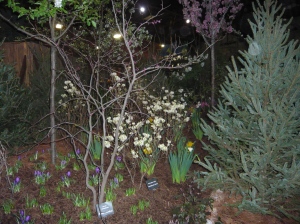
One of my favorite spring shrubs is Fothergilla (Fothergilla major). This beauty has white bottlebrush-like blossoms that appear in April in my garden. But at the Vermont show there were some that had been brought into a greenhouse and made to bloom now. It is a slow-growing shrub that for me has been unbothered by pests or diseases, and has spectacular fall colors.

Fothergilla in center, background, white

Fothergilla in center, background, white

Also at the Vermont Show was a Redbud (Cercis canadensis) in bloom. I’ve had a small redbud for at least 5 years, and have not one blossom. If it does not blossom this year I shall give it a good scare by girdling it with a sharp knife. This technique, called “spanking” a tree, is scary for me because you can kill a tree it you do it wrong, I think. The key is to cut down through the outer layers of bark, just hitting the hard interior, but not removing any bark. Bill Lord of the UNH Cooperative Extension says it works on apples, but I figure I have nothing to lose trying it on my non-blooming redbud.

On the horizon? I plan to go to the Boston Show on March 17, and Floribunda, the Norwich Home and Garden show that same weekend. I hope you get to a show, too. You can go to my website and read my article about the flower shows of New England. It’swww.Gardening-Guy.com. I’m having the site re-built and you should soon be able to order my new book there before it comes out in the bookstores.


Filed under Henry's Blog · Tagged with

Beautiful Birches

Posted on Wednesday, March 2, 2011 · Leave a Comment 


Driving down a wooded lane recently, I remarked on the striking contrast between the deep green pines and the snow-white bark of our native white birches (Betula papyrifera). There are several kinds of birches that do well in New England, and I like them all.

White birch (also called paper birch or canoe birch) is probably the most common of our birches. They can grow up to 50-70 feet tall in the wild, but most are not that large; the national champion is growing in Cheboygan County, MI is 107 feet tall and 76 feet across at the top, truly an exceptional tree. In the wild I see them everywhere from the rich soil at the edge of fields to the rocky, sandy soils on cliffs above the interstate highways √ and occasionally growing right out of rock ledges. From what I have read, it is not a city tree and does not thrive in areas with polluted air and water. It does best in full sun.

Before I knew better, I often wondered why I never saw any little white birches in the woods, only trees that were 15 feet tall or more. The answer is this: young white birches do not have white bark. They have reddish brown bark, which eventually turns white and develops the peeling habit that attracts boy scouts looking for fire starting material (it is very oily, and will ignite with a match even when soaking wet and freshly harvested).

Birches are often sold in clusters of threes, and look good growing together in bunches. Unfortunately, they often lean away from the center when growing close together, and sometimes get permanently bent down by wet snows or ice. I’ve seen them cabled together to prevent that. If you want a trio of birches, try planting 3 small birches about 30 inches apart- giving them enough room to grow.

Gray birch (B. populifolia)

Gray birch (B. populifolia)

Gray birch (B. populifolia) is sometimes mistaken for white birch, as it has a very similar bark. But as it gets older, the bark tends to become dirty looking, an off-white. But it is tough, and will grow in acid, sterile soils that verge on sand or rock. It is a small to medium sized tree (20-40 feet tall) that is hardy to minus 30 degrees. I see it often in mixed hardwood forests.

Sweet birch, also called black or cherry birch (B. lenta) is another native birch, one that is rarely seen used by landscapers despite the fact that it is a handsome tree, particularly when young and the bark is a shiny reddish brown. Older trees have a somewhat flaky dark color.

All birches are susceptible to a number of pests and diseases including leaf miners, leaf spots, and a variety of other pests. Most of those problems are not lethal, but can be unsightly.

Of all the birches, probably the least subject to pathogens and insects is the river birch (B. nigra). It is a fast-growing tree that can reach 30-40 feet tall in 20 years. The bark of young trees is light-colored and peels freely. Older trees have brownish bark that is≈ deeply furrowed and broken into irregular plate-like scales,- according to Michael Dirr’s Manual of Woody Landscape Plants, my tree bible. River birch is commonly sold as a landscape plant.

yellow birch (B. alleganiensis)

yellow birch (B. alleganiensis)

I love the yellow birch (B. alleganiensis) which has a shiny bark, first yellowish, then darkening as the trees get older, ending up with a “grayish to blackish brown plates” according to Dirr. I have observed them at the 6-inch diameter size still showing their yellow-gold color with the curly bits of thin peeling bark. It is, according to Dirr’s book, less susceptible to leaf miners than most other birches.

I’ve read about dwarf birch (B. nana), but I have never seen one. I will look for it, as according to Manual of Woody Landscape Plants, it is neatly rounded and only grows 2-4 feet high. It has very small leaves and sounds like a nice, dainty addition to any mixed perennial bed. It does well in moist soil, which I have, and it is hardy to Zone 2 (minus 50 degrees)! Anything that will survive those temperatures has got to be tough. Like most birches, it has leaves that turn a nice yellow in the fall.

So as you study your winter landscape, think about planting a few birches, come spring. They are wonderful in the wild, and can have a place in the garden as well. I grew up with a trio of white birches on the lawn, and have always liked them.

Filed under Article, Uncategorized · Tagged with

More on carrots

Posted on Wednesday, March 2, 2011 · Leave a Comment 


I have finally settled on a blog address after a couple of false starts. Here is some more info about carrots:

Storing carrots outdoors: I have left carrots in the ground, and covered the ground with a 3 inch layer of leaves and then 6 (or more) inches of hay or stray. This keeps the ground from freezing solid most years, particularly if there is snow cover. I put a stake in the ground at the carrot bed so I can find them if there is a foot or more of snow. When I want carrots I just dig off the snow, move aside the mulch, and dig. The carrots are even sweeter for having gotten cold – some starches are converted to sugars.

Carrot Band

Carrot Band

Carrots as musical instruments: I found a Web site for the “Carrot Museum” that has pictures and links to folks playing instruments made of carrots – pan  pipes and a clarinet that used a carrot as the main part of the horn. Go tohttp://www.carrotmuseum.co.uk/musical.html. The site has lots of other info about carrots and their special properties.


Filed under Henry's Blog · Tagged with

Planting onion seeds indoors

Posted on Wednesday, March 2, 2011 · Leave a Comment 


On the first of March I planted seeds of Patterson and Copra Onions, King Richard leeks and Prisma Red Shallots. This is the earliest I’ve started seeds, but onion family plants take a long time to get to planting size if started from seeds, and after all the snow this winter I am ready for spring!

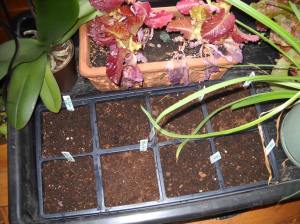
Onion seeds planted in flat, ready to grow

Onion seeds planted in flat, ready to grow

I planted some onions in straight planting medium, others in a 50-50 mix of planting mix and compost. I want to see if the plants respond differently. One thing I noticed is that the 50-50 mix is much easier to get moist prior to planting. Planting medium is peat-based and very dry when it comes out of the bag. When you water it, the water tends to run right through, but when mixed with compost it holds water nicely. The compost will provide nutrition for my seedlings that a straight peat medium will not. One way to moisten the peat planting mix is to set your containers in water and let them suck up water from below. It takes a while, but will do the job well. Once the medium is moist there is no problem watering in the future.

I planted my onions in 5-inch square containers. In each I planted about 25 seeds, which is quite a dense planting compared to other veggies. But they grow well together and will separate easily when I plant them outdoors in April. I am growing them under lights, as just putting them on the window sill doesn’t really provide enough light. I acquired some new LED lights from Sunshine Systems (www.sunshine-systems.com). These lights (Glow Panel 45) use just a fraction of the electricity of my old fluorescent lights.

Filed under Henry's Blog · Tagged with